
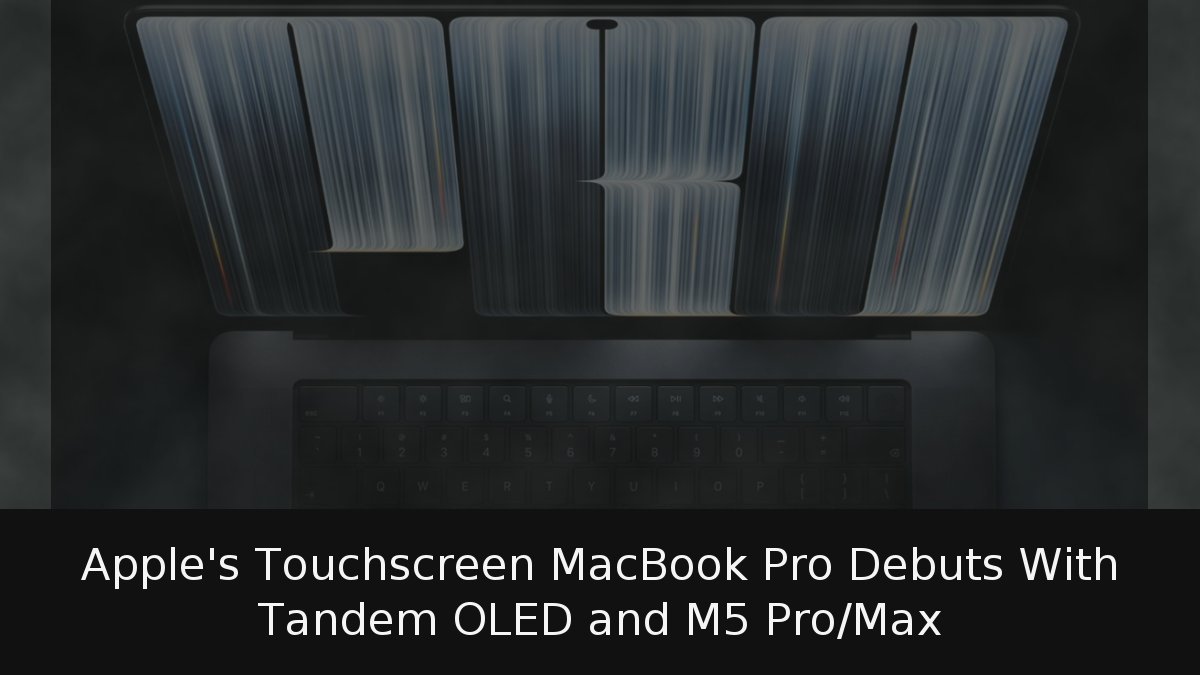
Apple has officially introduced the MacBook Pro with PROLED XDR Display, marking the first Mac to support direct touch input. The new 14- and 16-inch models pair a tandem OLED panel with M5 Pro and M5 Max chips, up to 128GB of unified memory, and a starting price of $2,899. Pre-orders opened on October 28, with retail availability set for November 6, including in Spain.
- Touch comes to Mac: The touch sensor is integrated directly into the OLED panel, reducing latency and enabling gestures like swipe, pinch-to-zoom, and drag-and-drop.
- Display leap: PROLED XDR offers 1,000 nits sustained full-screen brightness, 2,000 nits peak, a 10,000,000:1 contrast ratio, and ProMotion from 10Hz to 120Hz.
- Pricing pressure: At $2,899, this is the highest starting price for a MacBook Pro, sitting $900 above the newly announced 14-inch M6 model.
Touch, Dynamic Island, and a Redesigned Hinge
Apple’s approach to touch on the Mac is additive rather than transformative. The touchscreen does not replace the keyboard or trackpad; instead, macOS translates many taps into clicks so existing applications work without modification. For apps that adopt new gesture APIs, developers can build touch-specific controls. Apple says Pixelmator Pro, Logic Pro, and Final Cut Pro are already optimized, while third-party tools like Notion, Canva, Adobe Lightroom, DaVinci Resolve, Blender, and Algoriddim djay Pro will also take advantage of touch.
The notch is gone, replaced by the Dynamic Island, which now hosts Spotlight, Live Activities, and Siri AI. Users can accept AirDrop requests, control music, or check real-time updates directly from the expandable interface. Apple also redesigned the hinge to keep the display stable when pressed, and added a revised cooling system to direct hot air away from the panel.
“The new MacBook Pro with PROLED XDR Display is a monumental step forward for the Mac,” said Johny Srouji, Apple’s chief hardware officer. “PROLED XDR is the world’s best laptop display.”
OLED Performance and Real-World Brightness
The PROLED XDR panel is a tandem OLED design with two emissive layers, available in 14.2-inch and 16.3-inch sizes with resolutions of 3024×1986 and 3472×2266 pixels, respectively, both at 254 pixels per inch. Apple claims more than 80% coverage of the Rec.2020 color space and supports Adobe RGB on a Mac for the first time. The display is factory-calibrated and offers 16 reference modes, including two for medical imaging without diagnostic use.
One nuance worth clarifying: the 2,000-nit peak brightness for standard dynamic range content is only achievable outdoors, according to Apple’s fine print. Sustained full-screen brightness is 1,000 nits, and the panel can dim to 1 nit in dark environments. The previous miniLED LCD model advertised 1,600 nits peak, but OLED’s pixel-level dimming delivers true blacks and eliminates blooming around bright objects.
Apple has not specified any burn-in mitigation measures for the OLED panel, a topic that remains relevant for long-term professional use.
Chips, Battery, and Ports
The touchscreen MacBook Pro uses M5 Pro and M5 Max chips, not the new M6. Apple introduced a separate 14-inch MacBook Pro with M6 starting at $1,999 a day earlier, which retains the Liquid Retina XDR display and lacks touch. The touch model supports up to 128GB of unified memory, but only with the 40-core GPU version of M5 Max, and up to 16TB of storage, also exclusive to M5 Max.
Battery life is rated at up to 24 hours, but that figure applies only to the 16-inch M5 Pro model during video playback. The 14-inch model ranges from 20 to 22 hours, while web browsing drops to 13–17 hours depending on configuration. Fast charging recovers 50% in about 30 minutes.
Apple has reduced weight significantly: the 14-inch model starts at 1.38 kg and the 16-inch at 1.82 kg, up to 318 grams lighter than before. Connectivity includes three Thunderbolt 5 ports, HDMI, an SDXC card slot, MagSafe 3, a headphone jack, Wi-Fi 7, and Bluetooth 6. The six-speaker system now delivers 50% deeper bass, and a 12MP Center Stage camera handles video calls.
Pricing and Market Position
U.S. pricing is as follows: $2,899 for the 14-inch M5 Pro, $3,399 for the 16-inch M5 Pro, $4,499 for the 14-inch M5 Max, and $4,799 for the 16-inch M5 Max. These conversions do not include taxes and are not Spanish retail prices; Apple’s Spain store listed only the November 6 arrival date at the time of publication, though local pricing starts at €3,349 for the 14-inch M5 Pro.
Apple has positioned touch as another input method rather than a replacement for the keyboard or trackpad. The $900 premium over the M6 model raises a legitimate question: for photographers and video editors, the OLED display alone may justify the cost. For everyone else, touch on a laptop remains a convenience that is used less often than advertised. Until more applications genuinely exploit the new gesture APIs, the M6 model appears to be the more rational purchase.