
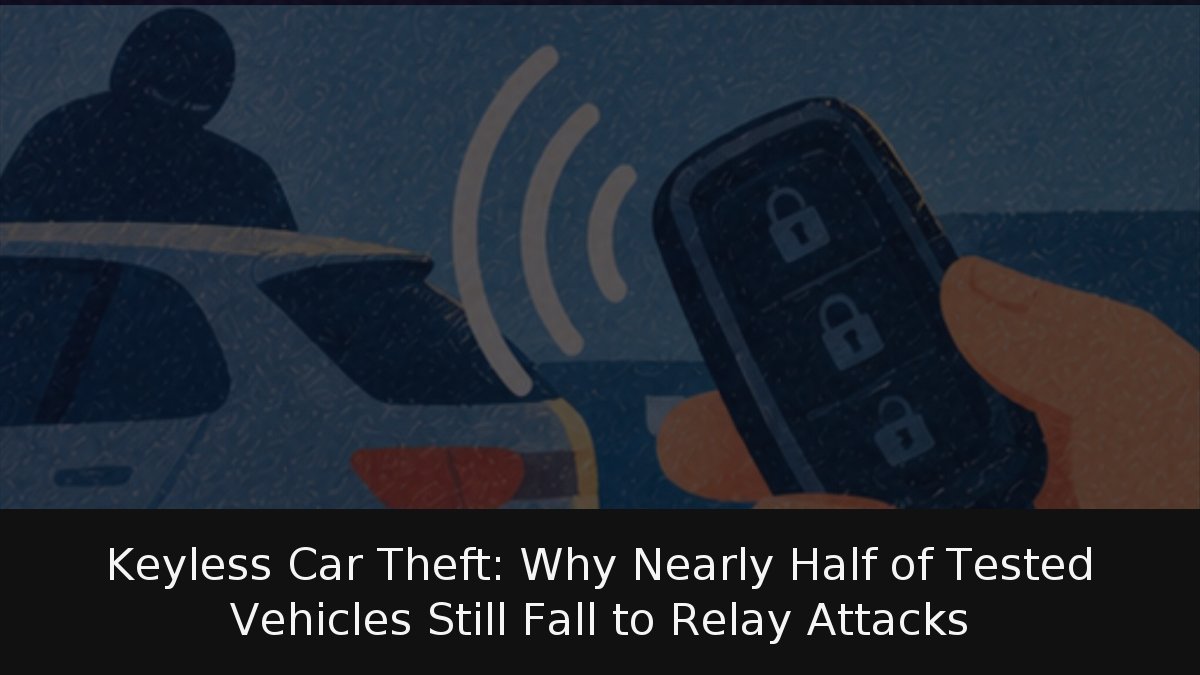
Keyless entry and push-button start have become standard on modern cars, but the convenience comes with a well-documented security trade-off. Germany’s ADAC motoring club has spent ten years stress-testing these systems and, in an August 2026 update, reports it has now examined more than 850 vehicles. The headline finding is sobering: nearly half can still be unlocked using an amplified signal, and in roughly one in three cases the engine will start as well.
- Scale of the problem: ADAC has tested over 850 keyless vehicles in a decade, and almost 50% remain vulnerable to relay amplification.
- No forced entry: The attack leaves no signs of tampering, which can complicate insurance claims.
- Proven fix: Ultra-wideband (UWB) ranging defeats the attack by measuring signal travel time rather than trusting signal strength.
- Slow adoption: The vulnerability was published in 2011, yet UWB only reached production cars in 2018.
How the relay attack actually works
The technique does not involve cracking encryption. Two people and two devices are enough: one unit sits near the key fob — by the front door at home, or in a café — while the other is positioned next to the car. Together they relay the radio conversation between fob and vehicle, so the car behaves as though its owner is standing right beside it.
ADAC notes that the signal can be stretched hundreds of metres and can pass through walls and doors. The thief decrypts nothing; the devices simply act as a courier. Once the engine is running, the car keeps going without the key until it runs out of fuel or battery charge. And because there are no forced-entry marks, proving the theft to an insurer can become an uphill battle.
This is not a new discovery. According to ADAC, the vulnerability was first described and published in 2011 by ETH Zurich, the Swiss federal technology institute.
It would be wrong to attribute every no-force theft to keyless relay gear. In October 2025, Spain’s Guardia Civil announced the arrest of nine people accused of stealing and falsifying 90 luxury vehicles worth more than €18 million. According to the statement, the group located cars using geolocation devices, started them “without needing a key or using physical force,” and then coded a new key. The release does not specify the exact technique, but the pattern of tracking vehicles with hidden devices is a separate reminder to check for unwanted trackers.
Why UWB shuts the attack down
Ultra-wideband technology measures the actual distance between fob and car instead of relying on signal intensity. It calculates how long the signal takes to travel back and forth; a repeater introduces a delay that betrays the fact that the key is not where it claims to be. ADAC confirms that, under the amplification setup it uses in testing, UWB-protected cars stop responding entirely.
The Car Connectivity Consortium (CCC), which brings together carmakers and phone manufacturers, builds its digital key standard on the same principle. In its use-case documentation, the consortium explains that UWB time-of-flight measurement blocks relay attacks based on signal amplification — a protection it calls “secure ranging.”
According to ADAC, Jaguar Land Rover was the first manufacturer to fit the technology, in 2018 models, followed by the Volkswagen group in 2019. As of October 2026, the club lists protected models from around a dozen brands, but there is no brand-wide rule: the useful question is whether your specific model and model year uses UWB.
Motion-sleeping keys help, but only partly
Some manufacturers build a motion sensor into the fob that switches off its radio after a period of stillness. ADAC does not regard this as ideal, because theft remains possible during that idle window. If motion-sleep is the only protection, the club argues the key should deactivate within five minutes of being left stationary.
Practical steps if your car is already keyless
- Check whether your model is protected. ADAC publishes its list of tested models from 2016 onward (registration required). If yours is missing, ask the dealer whether the keyless system uses UWB; the club recommends asking before you buy and, if in doubt, skipping the feature.
- See whether the manual allows you to disable keyless entry. Many cars permit it, which neutralises the attack. You lose convenience but regain the security of a conventional key.
- Keep the fob away from doors, windows and exterior walls while at home, and use a closed garage overnight if you have one.
- Use a signal-blocking pouch or box — and test it. A metal tin, a shielded sleeve or even aluminium foil can work if it blocks the signal completely. ADAC advises verifying it: put the key inside, walk to the car and pull the handle. If it opens, the pouch is useless.
- Be wary of aftermarket gadgets. ADAC warns that some electronic immobilisers are controlled by another equally vulnerable keyless system, and that cheap kits requiring the immobiliser to be disconnected may void insurance cover.
- A visible physical barrier still deters. A steering-wheel lock forces a thief to spend time and make noise — precisely what the relay attack is designed to avoid.
When your phone is the key
Digital keys on smartphones shift the risk from radio to handset. Apple’s support documentation for adding a car key to Wallet states that Express Mode is enabled automatically, allowing the car to be unlocked without unlocking the iPhone or using Face ID, Touch ID or a passcode. ADAC recommends protecting the phone-based key with a passcode despite the inconvenience, since a stolen handset could otherwise mean a stolen car, and acknowledges that independent security testing of these keys is still lacking.
If an iPhone is lost, Apple explains that marking it as lost disables the car key and Wallet cards, but not keys you have shared with other people — those must be revoked separately. Keeping anti-theft settings on your phone now protects your car too.
The striking part is not the ingenuity of thieves but the patience of the industry. A vulnerability published in 2011, a countermeasure available since 2018 that ADAC considers cheap to integrate, and still almost half of tested cars open with a repeater. Until keyless entry is audited as a security system rather than sold as a convenience, buyers must ask the question the brochure never answers: does it use UWB? If the answer is no, a tested signal-blocking pouch and a careful read of the manual remain your best defence. If it is yes, the risk simply migrates to your phone and the key left by the front door.