
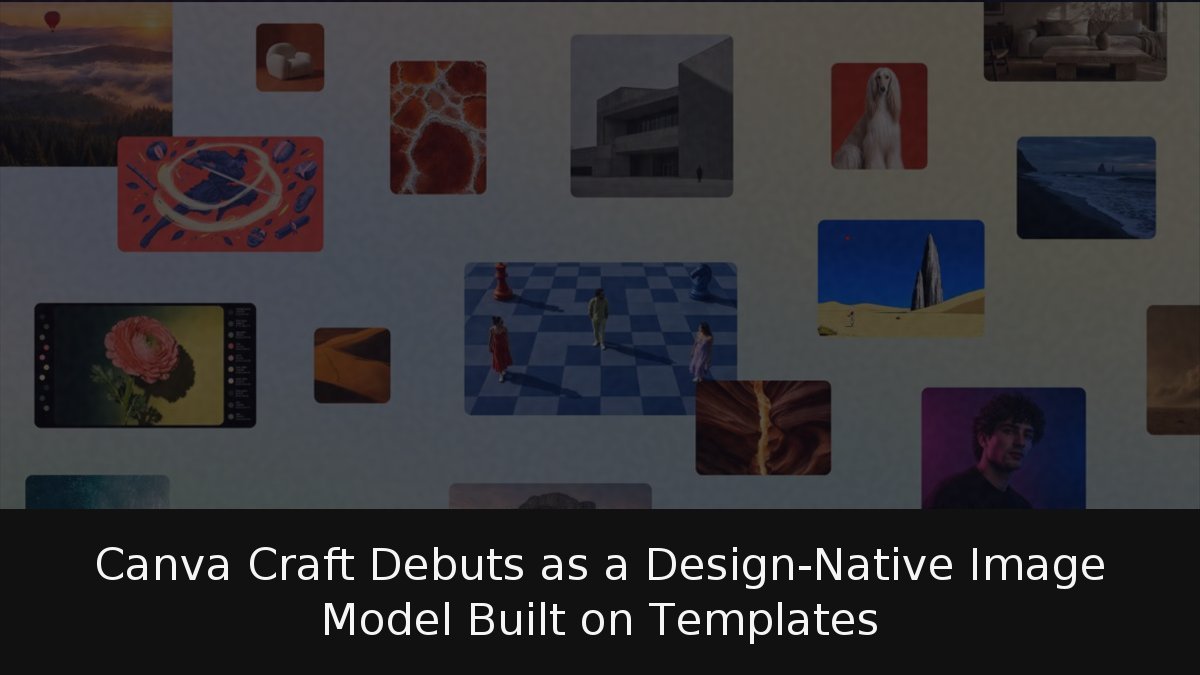
Canva has unveiled Canva Craft, the first image generation model trained entirely from scratch by its internal research lab, Canva Research. The model is now available to every Canva user worldwide through the Dream Lab panel and to developers via the public Canva API. It produces images at up to 2K resolution across more than 30 aspect ratios, including a custom option. What sets Craft apart is its training data: instead of learning primarily from photographs, it was built on millions of human-made design templates from Canva’s content library, covering posters, social posts, presentations, infographics, menus and typography-heavy layouts.
- Design-first training: Craft learned from templates rather than photos, giving it a stronger grasp of layout, hierarchy and typography.
- Two-stage generation: A planning model maps the composition before a second model renders the final image, improving text legibility and object placement.
- Broad availability: The model is live for all Canva users via Dream Lab and for developers through the API, with cheaper fast variants and MCP integration on the roadmap.
How Craft differs from conventional image models
Most image generators move directly from a text prompt to pixels. Craft takes a different route. According to Canva, a planning model first interprets the request and drafts a composition plan: which elements appear, where they sit, at what scale, what visual hierarchy applies and what text the image must carry. A second model then turns that plan into the finished image. Canva promises greater precision as a result, including readable text, objects placed where requested and the ability to change one element without disturbing the rest.
That structure aligns closely with Magic Layers, Canva’s tool for converting an image into editable design layers. It is a natural fit for everyday design work such as presentations, social graphics and marketing collateral, where layout discipline matters more than photorealism.
Training, evaluation and the numbers behind the launch
Canva says the model was pre-trained on millions of templates, then fine-tuned with supervised examples and reinforcement learning informed by its professional designers. Those designers evaluated more than 25,000 image pairs against leading models, and when automated scoring disagreed with human judgment, the designers’ verdict prevailed. Researchers from Leonardo.ai, the generation platform Canva acquired in 2024, contributed to development, and Canva Research now counts more than 160 researchers and engineers, formed in 2025 from the Kaleido and Leonardo.ai teams.
On DesignArena, a public leaderboard where users vote between AI-generated images, Craft debuted in fourth place overall with an Elo score of 1,340, slipping to 1,330 a day later. Canva highlights first-place finishes in People & Portraits (87 models) and Landscapes & Nature (85), second in Abstract & Patterns and fourth in Products. The company frames this as making Canva Research the world’s second most advanced lab for image generation, though the three models ahead are all from OpenAI. That ranking reflects collective voting rather than absolute scores, and the “second lab” conclusion is Canva’s own interpretation.
When automated evaluations and human judgments differed, we sided with the designer.
Access, performance and what comes next
Craft can be reached from Dream Lab in the lower-left panel of Canva or through the public API, where it is invoked as craft_v1_2k and draws on the account’s AI credits. Prompts can be written in any language, and the model renders on-image text in 55 languages, though Canva has not published the list. Each API request takes roughly 50 to 60 seconds end to end, which is slow by current standards. Canva has not clarified how much of each plan’s AI usage allowance the model consumes.
Two cheaper and faster variants, Craft-fast and Craft-ultrafast, are in development, alongside integration with AI assistants through Canva’s MCP server, described as coming soon. The intent is to let users generate images with Craft from assistants such as ChatGPT or Gemini. The timing is strategic: Canva has lowered its growth forecast for 2026, and external analysts suggest its valuation may have fallen from $42 billion to $35 billion. With more than 250 million users producing over 400 designs per second, Canva notes that even a few cents saved per generation makes an enormous difference, which explains both the distillation work that made Craft about ten times faster than its first internal build and the decision to own its model rather than rent one indefinitely.
Craft represents a coherent bet: Canva is not chasing the most spectacular image but the most useful one for layout work, with readable text and editable layers, backed by an asset almost no rival possesses, millions of its own designs. The crowded market still includes Firefly, Google’s and OpenAI’s models and specialist tools, so the real test will be whether the cheaper variants preserve quality and whether Canva clarifies the cost of using Craft on each plan.
Sources & References