
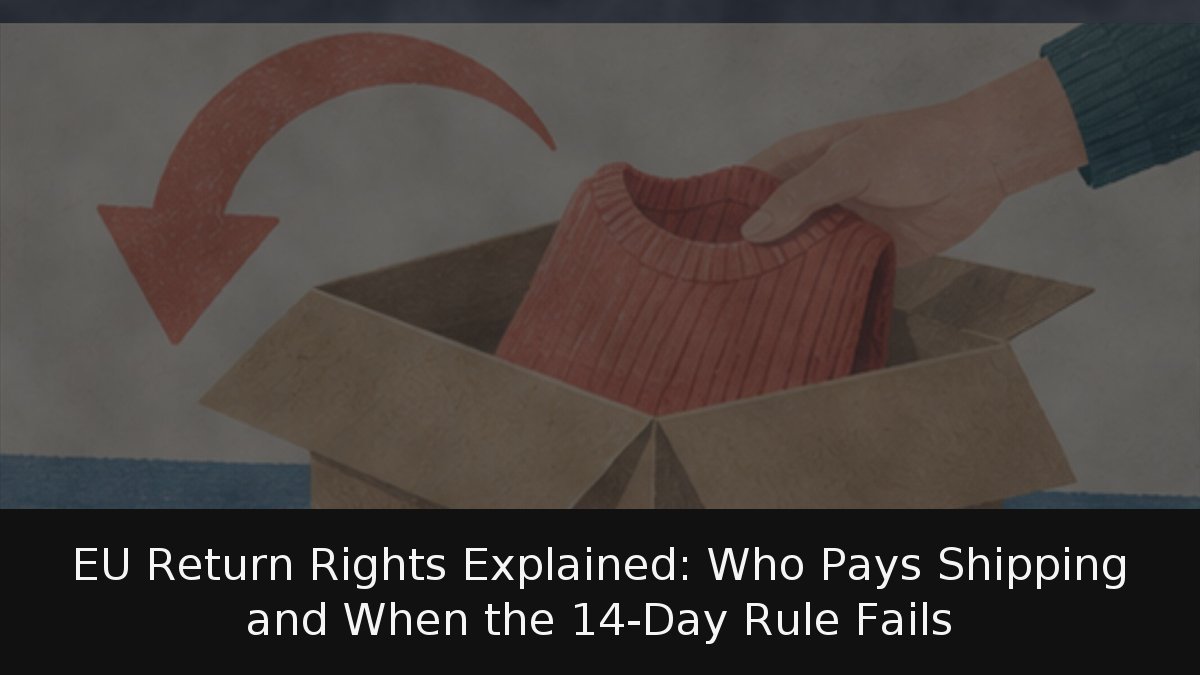
Buying online from a business inside the European Union comes with a safety net that plenty of shoppers still underestimate: a 14-calendar-day window to walk away from the purchase without giving a reason. The seller then has a further 14 days to return the money, including the cost of the cheapest original delivery option. Return shipping, meanwhile, falls on the buyer — but only when the retailer flagged that cost clearly before the sale closed. The Spanish framework lives in articles 102 to 108 of the consolidated consumer protection statute (Royal Legislative Decree 1/2007), which transposes Directive 2011/83/EU into national law.
- Countdown starts at delivery: The clock begins the day the parcel reaches the buyer or a nominated third party, and resets from the final shipment when an order arrives in several boxes.
- Notice beats arrival: What counts is the moment the withdrawal is communicated, not when the package reaches the warehouse — a dated email or the model form is enough.
- Refunds are broad but conditional: Sellers return everything paid, standard shipping included, yet may hold the cash until the item or a proof of dispatch shows up.
When the clock starts, and how it can stretch
For physical goods the window opens on the day of receipt (article 104). For services and digital content without a physical medium, it opens on the date the contract is signed. Splitting hairs over delivery timestamps is pointless: under article 106 any unequivocal statement sent before the deadline does the job, and the burden of proving that the notice went out rests with the consumer. Keeping the confirmation email the retailer is expected to send matters more than most buyers realise.
Two extensions are worth memorising. If the trader never disclosed the right of withdrawal, the deadline slides 12 months beyond the initial two weeks — and once the information finally arrives, a fresh 14-day period begins (article 105). Separately, unsolicited doorstep visits and excursions organised by the seller get a longer 30-day window under article 102. European Commission guidance also notes that a deadline landing on a non-working day rolls over to the next working day.
Return costs, refund mechanics and the free-returns myth
Under article 108.1 the consumer covers the direct cost of sending goods back, provided the trader warned about it beforehand. Silence, or a promise to absorb the cost, shifts the bill to the seller. For bulky purchases such as a sofa, the retailer must estimate that return cost before the contract is concluded. Refunds follow article 107: the full amount paid, standard delivery included, within 14 calendar days of the withdrawal notice. Extra charges for premium or scheduled delivery are not reimbursed, and the money normally travels back through the same payment method unless the buyer agrees to something else at no cost.
The merchant can legitimately sit on the refund until the product is recovered or the buyer produces proof of shipment. The buyer, for their part, has 14 days to dispatch the goods and carries liability for any loss of value caused by handling that goes beyond what is needed to inspect the item (article 108.2). The widely advertised “free returns” policy is a commercial hook rather than a legal duty — the only binding obligation is transparency about who foots the bill.
What cannot be sent back, and what gets confused with withdrawal
Article 103 lists the carve-outs. The ones that hit online shoppers hardest are bespoke or clearly personalised items, perishable products, sealed goods unsealed for hygiene or health reasons, opened sealed discs and software, and digital content whose download began with the buyer’s consent and awareness that the right was being surrendered. Dated accommodation, car rental, catering and leisure bookings are excluded, and passenger transport tickets sit outside the regime entirely under article 93. Single newspapers and magazines are out too, though subscriptions remain returnable, as do public auction purchases.
Note what is missing from that list: smartphones, laptops and headphones are not excluded, and breaking the seal on a box does not erase the right — it merely exposes the buyer to a diminished-value charge if wear is excessive. Two further distinctions trip people up. Withdrawal never applies to purchases from a private individual, which is precisely the trap in second-hand hardware deals. And regret is not the same as a fault claim: defects are covered by the legal guarantee of three years for goods and two years for digital content and services under article 120, with free repair or replacement as the remedy.
Cross-border sellers, marketplaces and a button Spain still owes
Inside the EU the rules travel with the buyer. When a dispute involves a company in another member state, Iceland, Norway or the United Kingdom, the European Consumer Centre in Spain can step in as a mediator — but only after a written complaint to the trader, and its settlements are amicable rather than binding. On marketplaces the decisive question is who the counterparty is. Platforms generally act as intermediaries, so returns are claimed from the seller unless the failure was technical or the platform handled the payment; the vendor’s identity and trader status must be disclosed before checkout. Sellers based outside the EU may still be bound by local consumer law, yet enforcement is where the theory collapses, and the European centre network does not reach beyond the countries listed above.
The bigger structural gap is administrative. Directive (EU) 2023/2673 requires online shops to provide a visible withdrawal function, available throughout the whole period, with a confirmation step and a dated acknowledgement of receipt. Member states had to transpose it by 19 December 2025 and apply it from 19 June 2026. As of 17 October 2026, the consolidated Spanish statute in the official gazette — last updated on 28 February 2026 — still does not contain it, a delay that consumer advocates publicly criticised on the application date. Until the button appears, the right survives intact but is harder to exercise: withdraw in writing, through a channel that leaves a timestamped trail. The measure is arguably the most practical upgrade since the 2014 overhaul, because it targets the real friction point of returns — not the deadline itself, but how deliberately obscure some retailers make the exit door.