
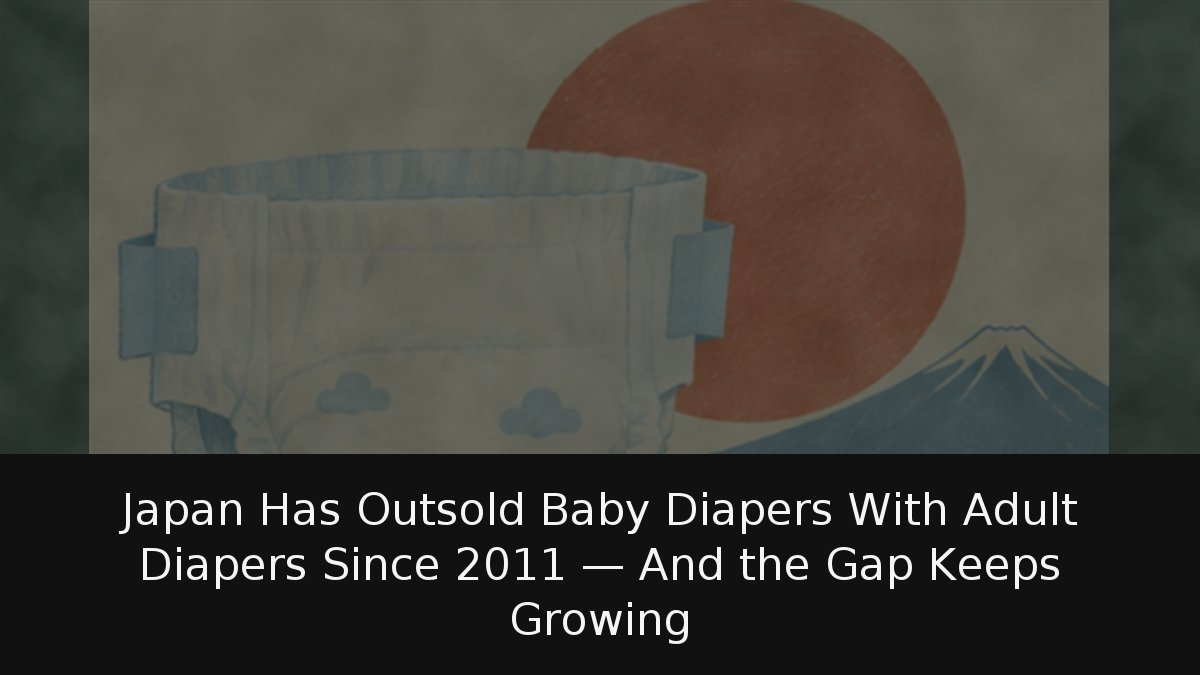
Japan has sold more adult diapers than baby diapers every single year since 2011, and the gap has only widened. What looked like a demographic curiosity fifteen years ago is now the clearest preview of a structural shift in global consumer markets: shrinking birth rates on one side, rapidly expanding elderly populations on the other. With 29.6% of its population over 65 and a fertility rate of roughly 1.2 children per woman — far below the 2.1 replacement level — Japan is running the experiment that most developed economies will confront over the next two decades.
- Japan’s crossover: Adult diaper sales have outpaced baby diaper sales since 2011, and the trend has held for fifteen consecutive years.
- Market scale: The global adult incontinence market is valued at $80.9 billion in 2025 and is projected to hit $108.17 billion by 2034.
- Circular materials: Unicharm recovers cellulose pulp and superabsorbent polymer from used diapers at plants in Shibushi and Osaki, using ozonation for sterilisation and extrusion to reclaim SAP.
- Next frontier: Cellulose-based biopolymer replacements for petroleum-derived SAP are targeted for commercialisation in the second half of this decade.
How Japan Became the World’s Aging Laboratory
The 2011 crossover surprised no demographer. Japan began its demographic transition earlier than any other industrialised nation: birth rates slipped below replacement during the 1990s, and the share of elderly citizens climbed above OECD averages. Exceptional longevity — Japanese life expectancy exceeds 84 years — combined with low fertility produces an inverted population pyramid that presses on every dimension of consumer demand: fewer babies, more dependent older adults, and an entirely different product mix.
The adult incontinence market has answered with genuine technical innovation. Products from Unicharm and Daio Paper now deliver absorption, ventilation and fit properties that were exclusive to premium baby diapers two decades ago. A large, mature market justifies R&D spending that smaller markets cannot support, turning competitive pressure into an innovation engine.
Turning Used Diapers Into Raw Material
The waste volume generated by adult incontinence products is a first-order logistical and environmental problem. Unicharm has built recycling processes at its Shibushi (Kagoshima) and Osaki (Miyagi) facilities that recover cellulose pulp and sodium polyacrylate superabsorbent polymer (SAP) for reuse in new products.
The engineering is anything but trivial. Used diapers must be sterilised, separated by material and stripped of the SAP that locks in urine. Unicharm has patented ozonation techniques for sterilisation and extrusion methods for SAP recovery, converting hazardous sanitary waste into reclaimed feedstock.
The implications reach well beyond Japan. Europe and the United States face the same waste-volume pressures as their 65-plus populations grow, and several European governments are already discussing regulatory frameworks for sanitary-product recycling. The company is also investigating cellulose-based biopolymers engineered to degrade faster in landfill, with commercialisation targeted for the second half of the decade.
A $108 Billion Market by 2034
Growth from $80.9 billion in 2025 to $108.17 billion in 2034 rests on two engines: aging in already developed economies such as Japan, South Korea, Germany and Italy, and expanding access in emerging markets where penetration has historically been low. It is worth noting that industry trackers scope the numbers differently — some place the combined baby-and-adult diaper category at $80.9 billion, with the adult incontinence segment alone at $2.32 billion and a 5.5% CAGR — yet the direction of travel is identical.
China is the second-largest and fastest-growing market, with more than 220 million people over 65 and a one-child policy legacy that accelerated its aging. Its adult incontinence category expanded from RMB 7.03 billion in 2018 to RMB 13.71 billion in 2024, an 11.7% annual pace. India and Southeast Asia follow, with smaller bases and steep demographic curves. In Europe, 20.9% of the EU population was over 65 in 2024, a share expected to pass 25% by 2030; the regional adult incontinence market already exceeds €10 billion a year and grows between 4% and 6% annually, with Spain among the countries above the 20% threshold.
Affordability remains a parallel pressure. A 2026 survey by the National Diaper Bank Network found that nearly one in two families struggled to pay for diapers, at roughly $100 per child per month, while safety-net programmes such as WIC and SNAP do not cover them. Diaper banks now distribute adult incontinence underwear alongside baby diapers and menstrual products.
What began as a curious Japanese statistic in 2011 has hardened into a structural transformation of the global consumer market. The companies that recognised it a decade ago — Unicharm, Kimberly-Clark, Essity and Procter & Gamble — hold a real advantage in scale, patents and retail relationships. Those that still treat aging as a niche segment rather than a central product variable will find the next decade expensive. Japan’s fifteen-year head start is no longer merely a warning; it is a working blueprint.