
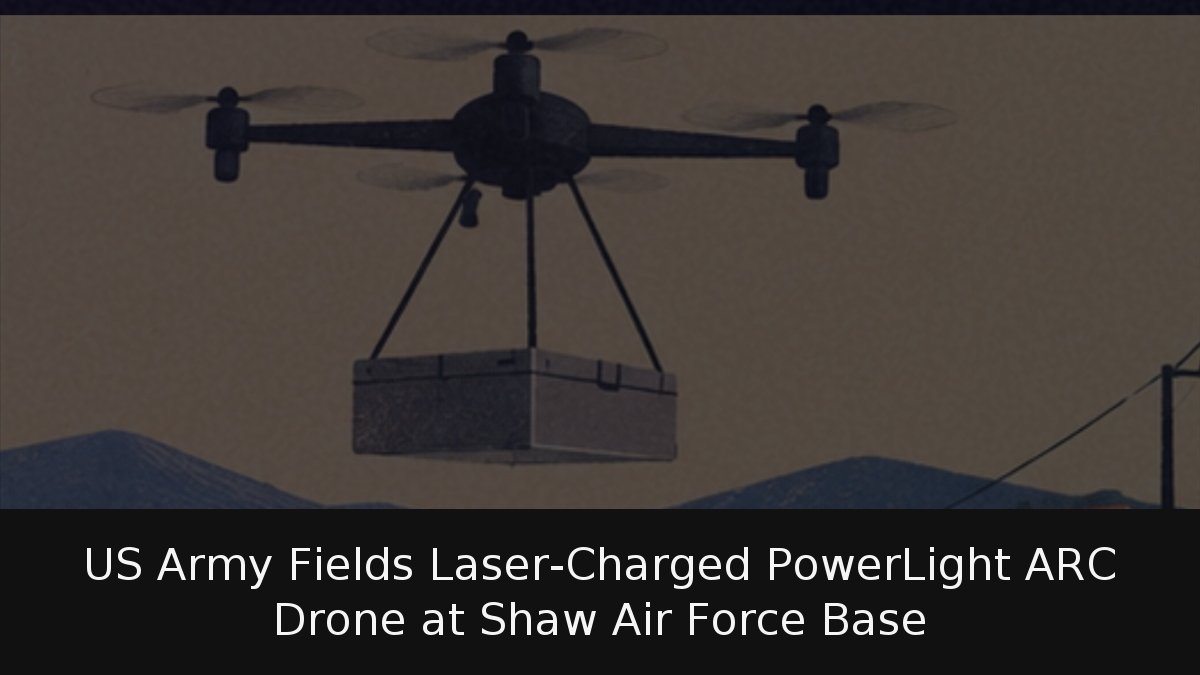
In April 2026, the US Army began operating at Shaw Air Force Base in South Carolina a drone system that carries no batteries, emits no radio-frequency signal and can stay aloft for as long as ground power is available. The platform is called PowerLight ARC, and it keeps unmanned aircraft flying by transmitting energy to them in mid-air. The deployment fell under Operation Enduring Independence (OE-I), and until now there had been no public confirmation of it.
The drones used in the demonstration came from Kraus Hamdani Aerospace — specifically the K1000ULE, a high-efficiency fixed-wing platform designed for long-endurance missions. Pairing that airframe with PowerLight’s power-beaming ground system produces something that until recently existed only on paper: an unmanned aerial vehicle with effectively unlimited endurance and none of the detectable signature generated by conventional batteries or RF communications.
- No batteries, no RF: The aircraft draws power from a ground-based directed-energy beam rather than an onboard battery pack.
- Proven in the field: The Shaw AFB deployment marks a move from laboratory testing to real operational use.
- Long-endurance airframe: The K1000ULE can fly for up to 24 hours in fixed-wing mode and up to 12 hours in eVTOL operation.
- Persistent surveillance: The system suits perimeter monitoring and force protection, but remains limited by line of sight and ground-station range.
How a laser beam replaces the battery
The radio-frequency signature of a drone is its Achilles’ heel in modern conflict zones. Counter-unmanned aircraft systems (C-UAS) work mainly by detecting the RF emissions of remote controls, live batteries and communication modules. Removing those emissions makes an aircraft invisible to an entire category of defence systems.
PowerLight ARC solves the energy problem differently: instead of carrying power onboard as a battery, the drone receives it from the ground through a high-power infrared beam. Photoreceptors on the aircraft convert that light directly into electricity — no conventional battery, no active RF receiver, and no remote-control transmitter in the spectrum that detectors watch.
The Department of Defense’s Operational Energy – Innovation (OE-I) division, which awarded PowerLight a follow-on contract to develop and integrate its AerialReCharge (ARC) system, describes the same principle: a drone operates until its battery reaches a predefined threshold, then automatically connects to the ground station and recharges while still airborne. That detail matters tactically. In contested areas, soldiers no longer have to leave cover to swap batteries in the field.
The K1000ULE is well suited to the role. It sits in the Group 2 category, meaning a flight weight of 9 to 25 kilograms, an operating altitude of up to 1,066 metres above ground and speeds below 463 km/h. It is fully electric and can carry sensor payloads, making it useful for reconnaissance, surveillance and extending communication pathways. PowerLight’s engineering and test teams are running integration work and trials at Shaw Air Force Base, supported by operators and mission planners from US Air Force Central.
The limits PowerLight ARC has not solved yet
Line of sight is the central constraint. The directed-energy beam requires the ground system to “see” the vehicle at all times. In urban, mountainous or otherwise cluttered airspace that continuity is not always achievable. The current workaround is to chain multiple supply stations together to cover routes with blind spots, which complicates operational logistics.
Effective distance is the second limitation. PowerLight’s current systems have a restricted operational range — exact figures are not public — which confines them to perimeter surveillance, installation coverage and support for ground units in known territory. This is not a system for long autonomous crossings over unfamiliar ground.
What it does solve, and solves well, is persistent monitoring of military installations with a minimal technical footprint. A base like Shaw AFB, with an extensive perimeter and a need for continuous coverage, is precisely the ideal use case. Conventional drone fleets require flight rotations, battery swaps and control frequencies that create detectable patterns. PowerLight ARC removes them.
The combination of persistent flight, no RF signature and low operating cost once the ground infrastructure is installed is novel enough that allied militaries are watching closely. What happened at Shaw in April 2026 is unlikely to stay there.
Sources & References