
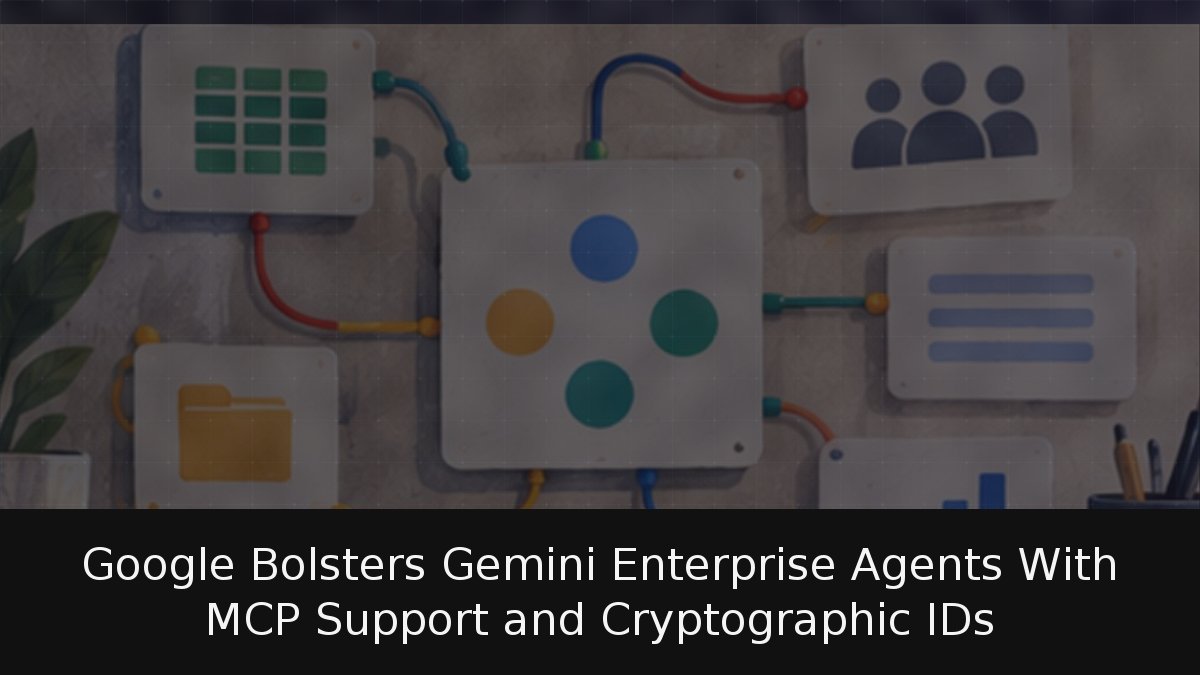
Google has shipped a significant revision of its Gemini Enterprise Agent Platform, adding support for Anthropic’s Model Context Protocol (MCP), a more capable Agent Development Kit (ADK), and Agent Identity — a system that issues every enterprise agent its own cryptographic credential. Announced in October 2026, the update lands roughly six months after the platform’s debut at Google Cloud Next ’26 and sharpens Google’s argument to CIOs who need to audit, trace, and govern autonomous software running inside their own systems.
- MCP arrives: Google now speaks the protocol that has become the de facto standard for wiring AI agents into external tools, closing a gap that rival platforms had already filled.
- ADK gets stronger: The developer kit gains the ability to orchestrate more complex, multi-agent workflows.
- Every agent gets an ID: Agent Identity assigns each agent a unique cryptographic identifier so security teams can determine which agent made which decision, when, and in what context.
- Real deployments cited: Virgin Voyages ran more than 50 specialized agents on the platform before the October release, including one that cut campaign copy creation time by 40%.
From Vertex AI to an Agent Control Plane
The platform is the successor to Vertex AI, the machine learning service Google Cloud introduced in May 2021. The rebranding, first announced in April 2026, signals a deliberate shift in focus: away from training and serving models, and toward building, deploying, and governing agents that act on their own.
The architecture rests on six pillars — advanced Gemini models, a no-code workbench for orchestrating agents, prebuilt agents for specialized tasks, connectors into enterprise data sources, a centralized governance plane, and an ecosystem of more than 100,000 industry partners. Model choice is deliberately broad: the platform exposes access to over 200 models, spanning Gemini 3.1 Pro, Anthropic’s Opus 4.7, and open source options such as Llama. The Agent Builder component lets teams assemble conversational agents visually, without writing code, and deploy them across phone, web, mobile, email, and chat channels.
At the Gemini at Work 2026 conference, Google Cloud CEO Thomas Kurian described the shift in blunt terms. “Today, Gemini becomes an agent,” he said, adding that users now hand over outcomes rather than step-by-step prompts.
You give it objectives, not just instructions. It plans the work, uses custom skills and tools, connects to your systems, and brings back something finished.
MCP Integration Closes a Strategic Gap
Anthropic’s Model Context Protocol has become the connective tissue of the agentic era, and Google’s decision to adopt it is less a technical novelty than an admission of reality: no enterprise platform can credibly ignore the MCP ecosystem in 2026. Microsoft has already moved in the same direction through its own MCP server work, creating a pattern of convergence that makes proprietary connector formats increasingly hard to defend.
For Google, the calculus is especially favorable. With corporate data already living in Drive, Docs, and Gmail, MCP support multiplies the number of third-party tools an agent can reach without bespoke integration work — a meaningful advantage for buyers who have spent the past two years accumulating disconnected agent pilots.
Agent Identity Turns Governance Into a Product
The governance angle is where the October update goes furthest. Agent Identity gives each agent a tamper-resistant digital badge, allowing security and compliance teams to trace decisions back to a specific actor rather than a generic automation account. Google pairs this with a simulation tool that lets teams test what an agent is capable of before it touches production systems.
The underlying design extends beyond audit trails. So-called coworker agents can be provisioned with persistent roles and their own Workspace accounts — including dedicated email addresses, calendars, and Drive storage — so they participate in workflows as identifiable participants rather than masquerading as human employees. The centralized governance plane, present since launch, remains the single checkpoint every agent must pass through, enabling oversight without inspecting each agent individually.
The customer evidence Google is leaning on comes from Virgin Voyages, which deployed more than 50 specialized agents ahead of the October updates. One email-marketing agent reduced campaign copy creation time by 40%, and the company reported a 28% year-over-year sales increase for July.
The Open Question: Catalog Depth Versus Real Utility
Google’s ability to cite concrete operational numbers is its primary weapon in the contest with Microsoft and Salesforce for enterprise agent spending — and with roughly 90% of the Fortune 100 already using Gemini Enterprise, the distribution advantage is real. Yet scale on paper is not the same as usefulness in production, and the central unresolved question is how many of those 100,000 partners deliver integrations customers genuinely adopt rather than entries that simply pad a catalog. Analyst commentary has also flagged that Google’s overlapping Workspace and Gemini Enterprise branding leaves CIOs unsure where one product ends and the other begins. With the Gemini agent still in limited preview, the next twelve months will determine whether cryptographic identity and MCP interoperability become the baseline every vendor must match — or the features that finally make agentic AI auditable enough for regulated industries to deploy at scale.