
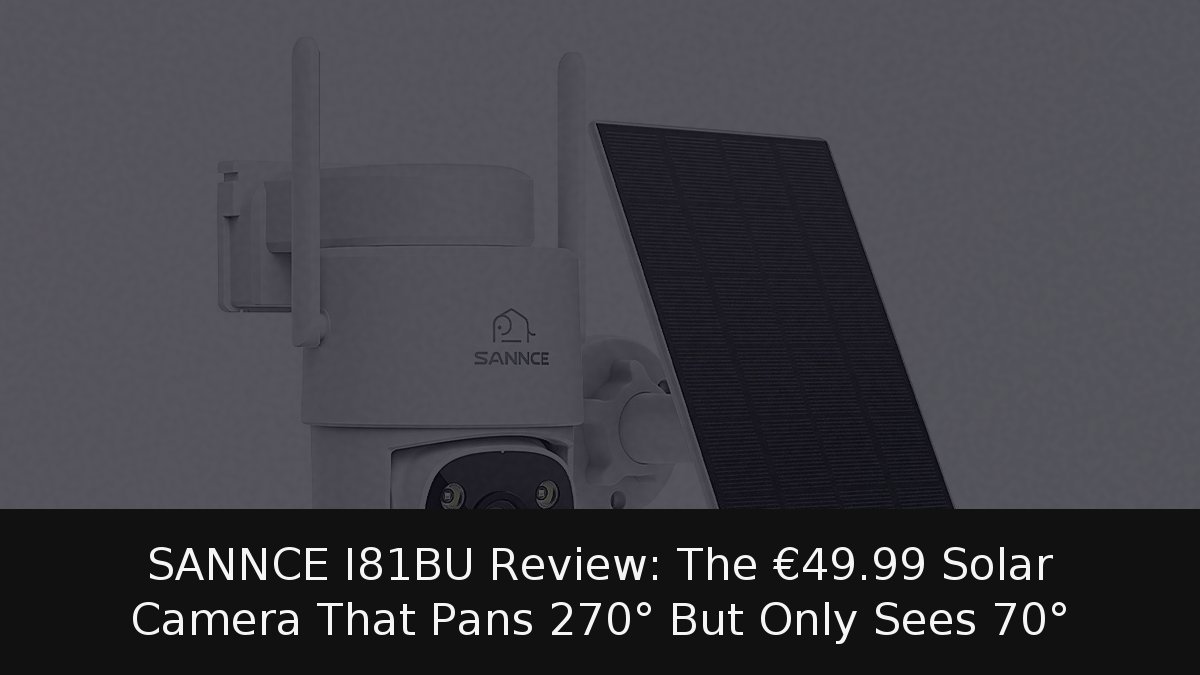
TechNews DevTop has tested the SANNCE I81BU, a solar-powered outdoor camera costing just €49.99 that promises 270° of motorised rotation. But its actual field of view is only 70°, a detail buried in the seventh row of a German specification table. Beyond the pan, the I81BU offers an 8000 mAh battery, a 3W solar panel, 4MP (2560 × 1440) resolution, and features rarely seen at this price: dual-band Wi-Fi 6, microSD support up to 256 GB, and no mandatory cloud subscription.
- Wide rotation, narrow vision: Pans 270° horizontally, tilts 90° vertically, but the 4mm lens on a 1/3.2-inch sensor delivers only a 70° field of view—far below typical fixed cameras.
- Detection gap: Infrared night vision reaches 15 metres, but the PIR sensor detects motion only up to 10 metres. Colour night vision covers 8 metres with six white LEDs.
- Charging quirk: The battery arrives nearly empty; the camera needed almost an hour on USB-C before showing any sign of life.
The 270° Pan: More Inspection Tool Than Surveillance
The motorised head rotates 270° horizontally and 90° vertically, useful for manual inspection from the app. However, the camera sees only 70° at any moment. A fixed 120° camera covers an entire entrance permanently; the I81BU covers it only if you pan, and while looking left it cannot see the right. The rotation is a remote-control feature, not an expanded frame.
The official spec sheet makes no mention of automatic tracking. Cameras at similar prices often include it, and it’s the one feature that would turn the motor into active surveillance rather than a remote-controlled lens. When TechNews DevTop reviewed the Reolink Argus PT in 2020, the approach was identical. Six years later, auto-tracking should be standard.
Night Vision, Detection, and Video Quality
The I81BU sees up to 15 metres with infrared, but its PIR sensor detects motion only up to 10 metres. That five-metre gap matters when mounting: there’s a zone where the camera shows you what’s happening on the live feed but won’t send a notification or trigger recording because the PIR hasn’t activated. Colour night vision reaches 8 metres using six white-light LEDs—a spotlight, not low-light sensitivity, so discretion is zero. For unnoticed operation, you’ll need infrared mode and sacrifice colour.
Video runs at 15 frames per second, half of a smartphone’s rate—enough to identify someone walking, borderline for someone running. Compression is H.264+, not H.265: files take more space on the microSD card and consume more Wi-Fi bandwidth, which on a battery camera means reduced autonomy. AI person detection, person highlighting, custom detection zones, and privacy masking are present. TechNews DevTop is measuring battery life and solar recharge; a three-day test is meaningless.
Design, Specs, and Value at €49.99
Dual-band 2.4/5 GHz Wi-Fi 6 is the most surprising feature at this price. Many budget cameras remain locked to 2.4 GHz, with all the saturation problems that entails. The battery comprises two 21700 cells totalling 8000 mAh—a serious format, not the typical flat cell. The body is IP65-rated, weighs 455 grams, measures 170 × 107 × 138 mm, and operates from −20 °C to 60 °C. Local microSD storage up to 256 GB is supported without mandatory fees.
For context, the Reolink Solar Floodlight Cam, combining a solar panel and AI detection for under €90 without fees, plays in a different league. The Reolink Altas and its pre-recording feature on battery-powered cameras solves a problem—the seconds lost before the sensor wakes—that this SANNCE does not address. The I81BU doesn’t compete with those; it competes with unbranded solar cameras on AliExpress.
The €49.99 figure appears on the official store as a 44% discount from €89.99—the store’s own strikethrough price, not a verified market price. TechNews DevTop could not confirm the historical price or the Amazon Spain listing. One more detail: on sannce.es, the Spanish domain, the full product page is in German. If you must decide on a €50 purchase by reading “Farbnachtsicht bis 8 m,” the problem is no longer the camera.
After unboxing and initial setup, TechNews DevTop’s assessment is that the I81BU is correctly designed for its price but poorly explained to buyers. The 70° field of view and the dead zone between the PIR’s 10 metres and the infrared’s 15 metres are not hidden defects: they are reasonable engineering decisions in a €50 camera.
We would recommend it for a specific, close-range spot—a door, a garage entrance, a shed—where 70° is ample and the PIR’s 10 metres cover everything that matters. For an entire garden, no: you’d need two fixed wide-angle cameras, at roughly the same cost. We’ll update this review with measured battery life and solar panel behaviour after a month of use.
SANNCE provided the review unit for independent evaluation. The company did not review this article before publication, and no financial compensation was involved.