
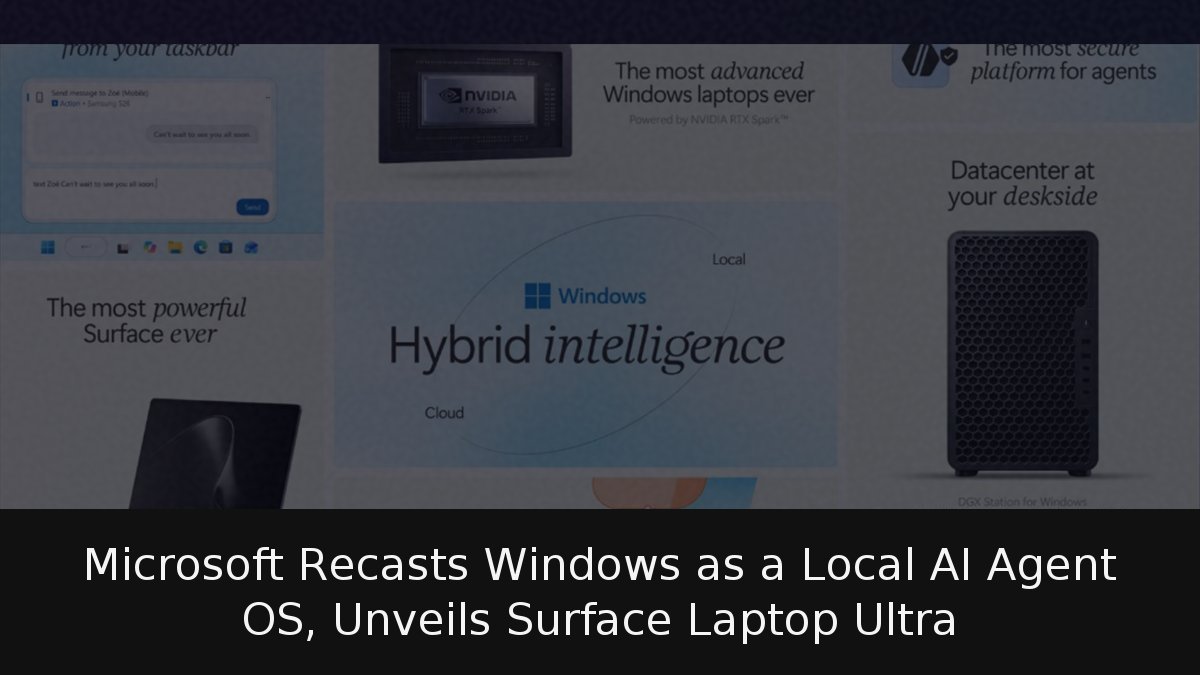
Microsoft’s October 7, 2026 event at San Francisco’s Dogpatch Studios was less a product launch than a repositioning of Windows itself. Framed around what the company calls “hybrid intelligence,” the presentation — led by CEO Satya Nadella and Windows chief Pavan Davuluri, with NVIDIA CEO Jensen Huang on hand for a fireside chat — argued that AI agents should run on the machine in front of you, not only in a remote data center. Microsoft says Copilot+ hardware already accounts for 40% of enterprise laptops sold and executes two trillion local inferences every month.
- Agents get a sandbox: Microsoft Execution Containers (MXC) reach general availability on Windows 11, giving third-party agents isolated, resource-managed local environments.
- New silicon: The 15-inch Surface Laptop Ultra pairs NVIDIA’s RTX Spark with up to 128GB of unified memory, enough for models above 120 billion parameters.
- Local models: MAI Code 1.1 Flash, a 137-billion-parameter model with a 256K context window, lands on Windows alongside DeepSeek V4 Flash and NVIDIA’s next-gen Nemotron.
- Search becomes action: Windows Search now executes natural-language system commands from the taskbar instead of returning web results.
“Just having the AI model doesn’t do much for anything,” Nadella said, explaining that Microsoft is combining local AI, AI-powered software and devices built natively for AI.
Microsoft Execution Containers: a sandbox for agents
At the technical heart of the announcement are Microsoft Execution Containers (MXC), now generally available in Windows 11. MXC creates isolated, secure environments where third-party agents run locally with managed access to system resources. Launch support covers Codex, GitHub Copilot, OpenClaw, Replit, LM Studio, NVIDIA’s OpenShell and Unsloth AI, with Anthropic Claude Code, Box, Hermes Agent from Nous Research, Manus, Perplexity and Raycast confirmed as coming additions. A dedicated Meta Muse app for Windows is also in development. For IT and security teams that need to audit what an agent touches, that isolation is the difference between a controlled deployment and an open door.
Surface Laptop Ultra, DGX Station and the RTX Spark push
On the hardware side, Microsoft detailed the Surface Laptop Ultra, a 15-inch premium notebook built around NVIDIA’s RTX Spark “superchip” with up to 128GB of unified memory — enough, the company claims, to run models exceeding 120 billion parameters on-device. Preorders are open ahead of an October 16 ship date, with pricing starting at $2,600 for an 18-core CPU and 5,120-core GPU configuration with 24GB of RAM and a 512GB SSD, climbing to $5,900 for the 128GB tier, which is currently listed as out of stock. A magnetic USB-C port drew some of the loudest cheers of the keynote. Microsoft’s own comparisons claim 2.1x faster first-token latency, 4.3x faster image generation and 6.2x faster video generation than a MacBook Pro M5 Pro, and the company is offering trade-in credits of up to $1,000 for MacBook Pro owners. At the top end sits the DGX Station for Windows, powered by NVIDIA’s GB300 GPU with 748GB of coherent memory and 20 petaflops of FP4 compute, capable of running more than 32 agents in parallel. Dell and HP will follow with their own GB300 workstations — the Dell Pro Precision GB300 and HP ZGX Fury AI Station — before year’s end, while the developer-focused Surface RTX Spark Dev Box starts at $5,999 and ships in the US in November.
MAI Code 1.1 Flash and a search bar that does things
Microsoft also detailed MAI Code 1.1 Flash, its in-house model for this ecosystem: 137 billion total parameters with 6.8 billion active, 3-bit precision, up to 80% smaller than comparable architectures and a 256,000-token local context window. DeepSeek V4 Flash and NVIDIA’s next-generation Nemotron are also heading to Windows. GitHub HydraFusion extends to Windows with local model routing in an experimental preview rolling out through October across the GitHub Copilot app, CLI and VS Code, while the low-latency llama.cpp library arrives in Windows ML. The most visible change for everyday users is Windows Search, which now executes natural-language commands straight from the taskbar — “switch to dark mode,” “mute the microphone,” “open the last Calendar meeting” — turning a lookup tool into an action layer. Copilot is picking up new Home, Code and Autopilot modes, with local capabilities reaching Copilot+ PCs in the coming months.
Microsoft has spent years arguing that AI belongs on the device; this event is where the plumbing finally matches the pitch. Security remains the open question — agents from OpenAI, Anthropic and Meta have already been tied to serious breaches this year, which makes MXC’s containment story as much a defensive necessity as a feature. With Microsoft Ignite set for November and the $99 Microsoft 365 Copilot E7 tier serving as the subscription layer, the company is assembling a complete stack. The real test begins on October 16, when the Surface Laptop Ultra reaches buyers and Microsoft’s promises about agent reliability have to survive contact with ordinary work.
Sources & References
- Surface Laptop Ultra Preorders: Everything Announced at Microsoft’s Windows and Surface Event
- Surface Laptop Ultra, Local Copilot AI, and More: Everything Announced at Microsoft’s Fall Event
- Windows is getting its most significant upgrade in half a decade – here’s what that means
- Fortune Tech: Microsoft revamps Windows for agentic AI | Fortune
- Microsoft unveils Surface Laptop Ultra AI PC starting at $2,600