
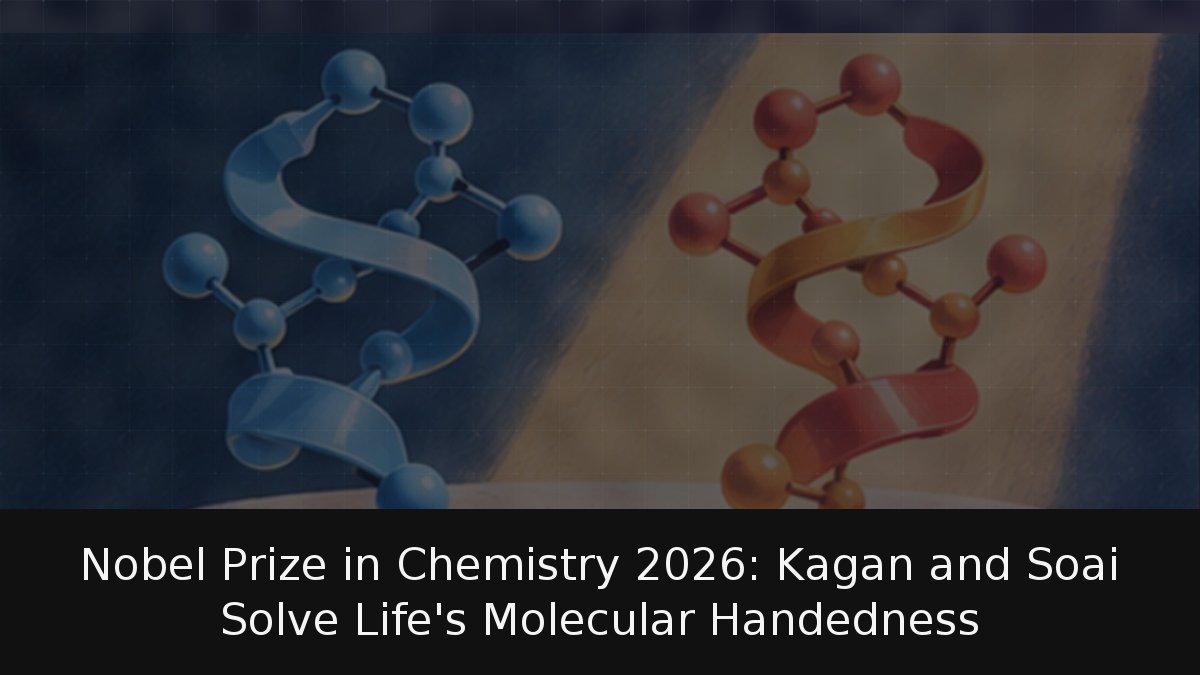
The Royal Swedish Academy of Sciences announced on 7 October that Henri B. Kagan and Kenso Soai have won the 2026 Nobel Prize in Chemistry for the discovery of non-linear effects and autocatalysis in asymmetric organic synthesis. The award crowns a body of work that finally answers a question chemists have wrestled with for more than a century: how living organisms came to rely on just one of two mirror-image versions of the molecules that build them, a phenomenon known as homochirality. The laureates share a cash award of roughly 11 million Swedish kronor.
- The winners: Henri B. Kagan, of Paris-Sud University in France, and Kenso Soai, of Tokyo University of Science in Japan, honoured for work spanning more than three decades.
- The science: Kagan’s non-linear effect and Soai’s asymmetric autocatalysis demonstrate how a minuscule imbalance between mirror-image molecules can amplify itself into an overwhelming preference.
- The impact: The chemistry underpins modern drug manufacturing, where producing the correct mirror-image form can be the difference between an effective medicine and a harmful one.
The mirror-image puzzle that stumped chemistry
Many molecules, including the amino acids that make up proteins, exist in two forms that are mirror images of one another but cannot be superimposed, much like a left and a right hand. Chemists call this property chirality, from the Greek word for hand. Life, however, is strikingly one-sided: DNA is right-handed, proteins are built almost exclusively from left-handed amino acids, and the mirror-image counterparts are rarely found in nature. When chemists tried to replicate this selectivity in the laboratory, they typically ended up with an even 50-50 mix.
The stakes became painfully clear with thalidomide in the 1960s. The drug was administered as a mixture of both enantiomers; one was the intended sedative, while the other proved teratogenic and was linked to congenital malformations. Since then, enantiomerically pure production has become a non-negotiable imperative for the pharmaceutical industry.
The puzzle dates back to Pasteur, who found two mirror-image variants that reacted very differently when exposed to bacteria. In the early 20th century, the German chemist Willy Marckwald designed an asymmetric reaction that yielded a slight excess of one form using a chiral catalyst, though the imbalance he achieved was small. Then, in 1953, the theoretical physicist Charles Frank proposed a mathematical model setting out three conditions for homochirality: an asymmetric reaction favouring one variant, amplification of that imbalance, and a reaction that generates its own catalyst.
Kagan’s non-linear effect and Soai’s self-amplifying reaction
Kagan, a CNRS researcher based at Paris-Sud University, delivered the first decisive step in 1986. Working with chiral ligands such as BINAP and DIOP, his group showed that a catalyst built from a mixture of mirror-image ligands can yield a product purer than the mixture used to make it. Chemists had assumed the two would track each other. Kagan realised a metal centre can bind more than one ligand, forming both matched and mismatched pairs; when the mismatched pairs are less active, the matched ones do most of the work. The discovery, coined the non-linear effect, gave chemists precise control over metallic catalysts and pushed enantiomeric excesses beyond 90 percent.
“Henri Kagan and Kenso Soai have provided a solution to a chemical mystery that is over a century old: how homochirality can emerge spontaneously,” said Heiner Linke, chair of the Nobel Committee for Chemistry. “The chemical reactions they have developed are spectacular.”
Soai pushed amplification further. In 1995 he described a reaction, using a substance known as 5-pyrimidylalkanol, in which the product catalyses its own formation. A starting advantage of just 2 percent grew to 87 percent by the end of the experiment. In one version, a mixture with an enantiomeric excess of a mere 0.00005 percent climbed past 99.5 percent after three rounds. By 2003, Soai had demonstrated a reaction producing essentially only one of the two possible mirror images — something, outside of life itself, that had never been achieved before.
“I am very excited to receive the very nice news about the Nobel prize. This is one of the most exciting days in my life,” Soai told the Nobel committee, having been reached while shopping near his home.
Not everyone sees a direct route to biology’s origins. Furkan Öztürk, a prebiotic chemist, notes that the Soai reaction famously cannot run in water and demands reagents that are not obviously compatible with conditions on the early Earth — leaving open the question of whether similar chemistry actually seeded life’s handedness.
From the lab bench to the production line
The practical consequences arrived decades ago. The industrial synthesis of L-DOPA, the most effective precursor in treating Parkinson’s disease, and of numerous chiral antibiotics became economically viable through the principles Kagan systematised. Techniques derived from this work now touch the production chain of more than 40 percent of synthetic active pharmaceutical ingredients.
Regulatory pressure in Europe and the United States increasingly requires that active ingredients reach the market in enantiomerically pure form rather than as racemic mixtures. Every new drug entering clinical development must show that the active enantiomer is separated from the inactive, or potentially toxic, one — and that the separation is industrially scalable.
The Nobel does not change industrial practice overnight; these methods have been in factories for years. What it does is legitimise investment in second-generation enantioselective synthesis, the catalytic methods aiming to push enantiomeric excess beyond 99.5 percent while using less metal catalyst. It is arguably the most directly applied chemistry Nobel in recent memory, even if most people who swallow an antibiotic or an anti-inflammatory have never encountered the word chirality. That gap between laboratory benchwork and everyday consequence is precisely what makes the best science prizes so difficult to communicate — and so easy to underestimate.
Sources & References
- The 2026 Nobel Prize in Chemistry Goes to Henri B. Kagan and Kenso Soai | ACS Publications Chemistry Blog
- Life Is Asymmetric. The Scientists Who Figured Out Why Won the 2026 Nobel Prize in Chemistry
- Kagan and Soai Win 2026 Nobel Prize in Chemistry for Solving the Mystery of Life’s "Handedness" | LCGC International
- Chemistry Nobel for solving mystery of how ‘handed’ organic molecules can emerge
- This is what the 2026 Nobel prize for chemistry is all about