
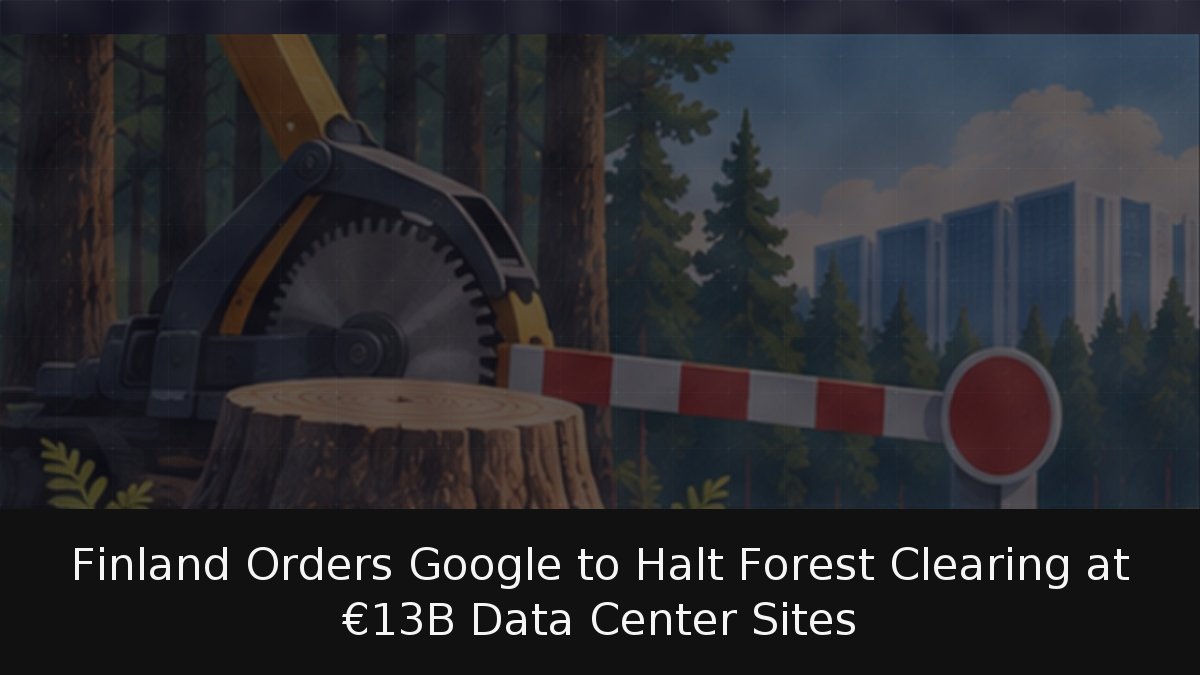
Finland’s environmental licensing authority has ordered Google’s Finnish subsidiary to immediately suspend environmentally significant site preparation at two planned data center locations after contractors cleared hundreds of hectares of forest before mandatory environmental reviews were finished. The affected sites are Muhos and Kajaani, both part of a broader €13 billion Finnish buildout that the company has described as its largest single investment in Europe.
- The order: The Licensing and Supervision Authority (LVV) has directed Google’s local entity, Tuike Finland Oy, to stop tree removal, topsoil stripping, excavation, blasting, crushing, soil movement, ditching and the construction of roads and storage areas no later than 23 October 2026. Planning, measurements and soil surveys may continue.
- The scale: Roughly 300 hectares had been cleared or prepared at Muhos, with some accounts putting the figure nearer to 330, while work at Kajaani covered just under 200 hectares — well past the 200-hectare threshold that triggers a mandatory environmental impact assessment under Finnish rules.
- The stakes: The halt touches only part of Google’s Finnish programme, which also includes a planned facility in Vaala and an extension at the existing Hamina site, with construction expected across 2027 and 2028.
A Deadlines-Driven Suspension, Not a Fine
The regulatory action is a stop-work directive rather than a financial penalty — at least for now. Tuike Finland has until 14 October 2026 to submit a written explanation of why land clearing proceeded before statutory approvals were in place, and until 23 October to bring heavy machinery to a standstill. The suspension remains in force until both environmental impact assessments and the authority’s reasoned conclusions are complete, with the reviews expected to wrap up during 2026.
Tommi Muilu, who heads LVV’s environmental department, confirmed that the authority regarded the suspended activities as environmentally consequential, describing them as capable of significantly altering the environment in ways the assessment process exists to identify. Inspectors documented stripped topsoil, altered drainage channels and unpermitted access tracks. Should Google fail to comply, the regulator has signalled it could open enforcement proceedings and consider a fine.
The historical parallel that keeps surfacing is Meta’s experience in Denmark, where local regulators temporarily blocked a data center expansion in 2022 over regional water consumption. Meta needed roughly 18 months to obtain revised authorisations — a timeline that offers an uncomfortable template for what litigation could mean here.
When the Green Data Center Story Meets the Ground
Google has spent years positioning its Nordic operations as the template for sustainable hyperscale computing: hydroelectric and wind power, waste heat redirected into district heating networks, and near-zero carbon figures in its own reporting. Finland sat at the centre of that narrative. Clear-cutting mature boreal forest to build “sustainable” infrastructure is a contradiction that communications departments cannot easily resolve.
The company’s proposed compensation package — planting trees across 130 hectares at Muhos — covers less than half of what was felled, and regenerating mature boreal forest takes between 50 and 100 years. Satellite imagery reviewed by inspectors indicated that buffer zones meant to be preserved had also been logged, with the cleared area compared in size to roughly 420 football fields.
“In our view, operations at this construction site should be suspended until it is clarified whether the project is in compliance with the law,” said Hanna Halmeenpää, chair of the board of the Finnish Association for Nature Conservation, which filed the legal petition that triggered the review. “From the satellite images, we’ve seen that nature sites which should be preserved have also been logged.”
Google has acknowledged the misstep. Company spokesperson Sondre Ronander said the company understood the concerns and had “fallen short of our own high standards in this instance,” adding that Google would study the findings and follow the authority’s guidance. The company maintains it acted in good faith under Finland’s Forestry Act and had conducted extensive nature surveys.
The Economic and Political Calculus
Finland has cultivated its role as a European digital infrastructure hub, and the sums involved are substantial: company-commissioned projections estimate the investment framework contributes around €3.6 billion annually to Finnish GDP. Google has also signed a 22-year power purchase agreement with Fortum covering up to half the capacity of the Loviisa nuclear plant, and it has operated in the country since 2009, when it converted a former paper mill in Hamina.
Yet Nordic public opinion on environmental protection is structurally different from that of many other regions. Environment Minister Sari Multala confirmed that statutory land-use rules had been violated and that administrative enforcement was necessary, while acknowledging that project timelines would face substantial delays. A government seen to let a foreign corporation clear protected woodland without consequence carries a domestic political cost that no investment figure fully offsets.
The likeliest resolution is a negotiated one: a more ambitious restoration plan, financial compensation to the Muhos municipality, and construction resuming under tighter conditions. What no agreement can deliver is the return of forest that no longer exists. That asymmetry — irreversible damage weighed against reversible compensation — is the argument European regulators are increasingly likely to use when demanding guarantees before the chainsaws start, rather than sanctions after they stop.
Sources & References
- Finland Orders Google to Halt Data Centre Work Over Missing Environmental Reviews
- Finland Orders Google to Suspend New Data Centers After Contractors Pave Over Protected Forests
- Finland halts Google data center construction over environmental breaches
- Google’s €13B Finland Data Center Push Hits Roadblock
- Finland Orders Halt to Google’s €13bn AI Data Centre Expansion Over Environmental Breach