
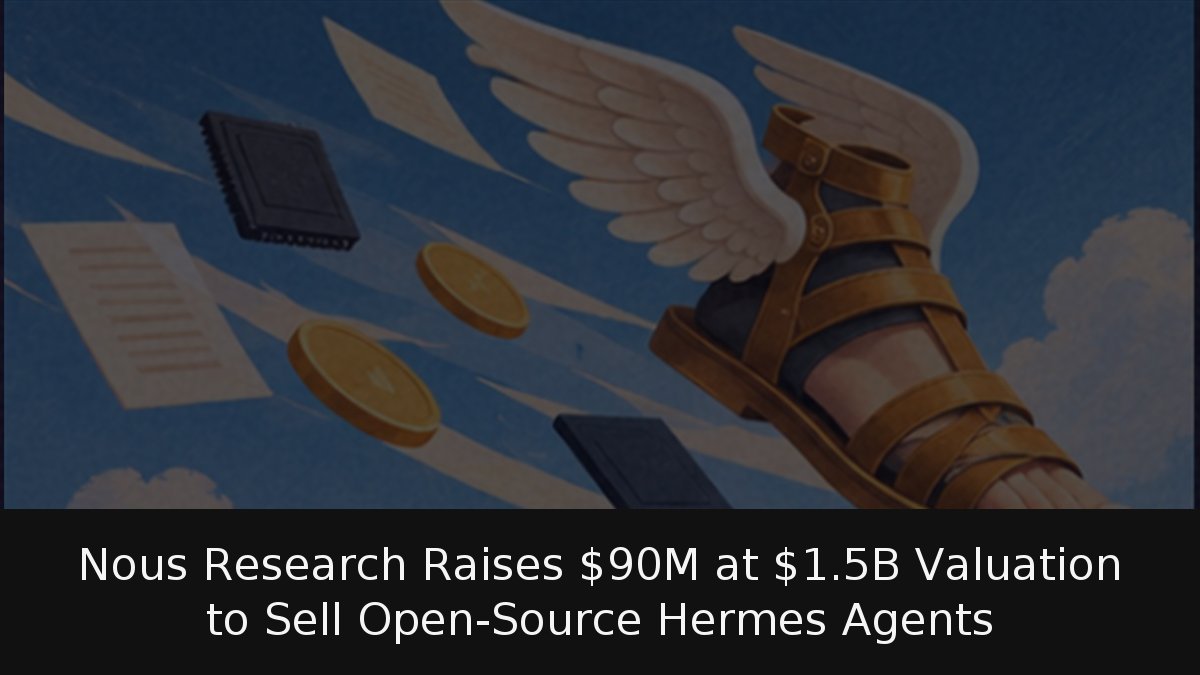
Nous Research, the lab behind the open-source Hermes agent, has closed a $90 million Series B at a $1.5 billion valuation — a final figure that landed above the roughly $75 million discussed while negotiations were still in progress. Announced on October 7, 2026, the round was led by Robot Ventures, with Nvidia, Union Square Ventures, Menlo Ventures, Samsung and 1789 Capital — the venture firm where Donald Trump Jr. is a partner — all participating. Three years after its founding, the company has now raised about $158 million in total, and it is betting that enterprises will happily pay for privacy, control and support around a model that anyone can download for free.
- The round: $90M Series B at a $1.5B valuation, led by Robot Ventures, with Nvidia, Union Square Ventures, Menlo Ventures, Samsung and 1789 Capital participating.
- The traction: Hermes has been cloned more than 24 million times and, by Nous’s own estimate, now drives roughly 2.5% of global AI token usage.
- The business: Annualized revenue stood at about $36 million in mid-September 2026, with management projecting it will clear $100 million before the end of the year.
What Hermes actually does
Hermes is an MIT-licensed agent that browses the web, edits files, writes code and picks up new skills from the way people use it. It keeps a persistent memory across sessions, schedules its own tasks and can run around the clock, with users able to steer it through messaging apps such as Telegram and Discord. The project had accumulated roughly 214,000 GitHub stars and nearly 40,000 forks by the summer, placing it among the most widely deployed open-weight projects in the world. Self-hosting is free; the managed version runs on tiers priced between $20 and $200 per month.
The commercial packaging is where the strategy becomes clear. Hermes Business gives a company’s account a single shared credit balance with per-member spending caps, plus a shared library where employees’ self-written skills compound into what Nous pitches as proprietary internal tooling. Hermes Enterprise goes further, letting organisations run the entire stack on their own infrastructure or private cloud with single sign-on and compliant access controls. Nous says the enterprise tier is already running inside some of the world’s largest companies, though it has not named them.
Who is backing the open bet
Nous Research was founded in 2023 by Jeffrey Quesnelle, Karan Malhotra, Ryan Teknium and Shivani Mitra, with an unusual pitch for an AI lab: open weights, no corporate filter stack and a preference for decentralised infrastructure over renting a hyperscaler’s GPUs outright. That identity runs through the Psyche network, which coordinates GPUs scattered across the internet to train models and settles its coordination layer on Solana. Before this round, the company had raised about $70 million from backers including Paradigm, Robot Ventures, North Island Ventures, OSS Capital and Balaji Srinivasan, with Paradigm leading a $50 million Series A in April 2025 at a roughly $1 billion mark.
That trajectory — a 50% valuation jump in well under a year — says as much about the agent market as about Nous itself. Nvidia and Samsung writing cheques here reads as more than a routine funding round, because both have direct exposure to where inference happens: on-device, on-premises or in someone else’s cloud.
Revenue, rivals and the open-core test
The revenue figures are arguably the more interesting signal. Roughly $36 million annualised, climbing toward a $100 million target, is real paying usage behind an open-source project rather than developer buzz measured in stars. Nous has not disclosed how much of that comes from individuals versus businesses, and the 2.5% token-share claim is the company’s own estimate, not an independently verified number.
The competitive field is crowded. Hermes launched weeks after the OpenClaw hype and is widely treated as its direct rival; OpenClaw, created by Austrian developer Peter Steinberger, is set to continue as an open-source project under a foundation after he joined OpenAI. Beyond that, Cognition — maker of the coding agent Devin — raised more than $1 billion in May at a $26 billion valuation, Replit raised $400 million in March at $9 billion and shipped Agent 4, and France’s Mistral AI continues to expand its enterprise agent offerings on top of open models. It is the classic open-core wager: give away the engine, charge for hosting, compliance and peace of mind.
Whether that converts a vast free developer base into durable enterprise budgets, rather than cannibalising it, is the question the next revenue update will answer. For now, Nous Research has turned community reach into capital and a mandate — and in doing so has made the case that sovereignty over an AI agent, rather than convenience, is a product enterprises will pay a premium for.
Sources & References
- Nous Research Confirms $1.5B Valuation, Launches Hermes
- Nous Research confirms it hit $1.5B valuation, launches AI agents for business users
- Nous Research Raises $90 Million for A.I. Agent Hermes | Trending Topics
- Nous Research confirms $1.5 billion valuation and launches business AI agents – Startup Fortune
- Nous Research Raises $90M Series B at $1.5B Valuation to Bring Hermes AI Agents to Enterprises