
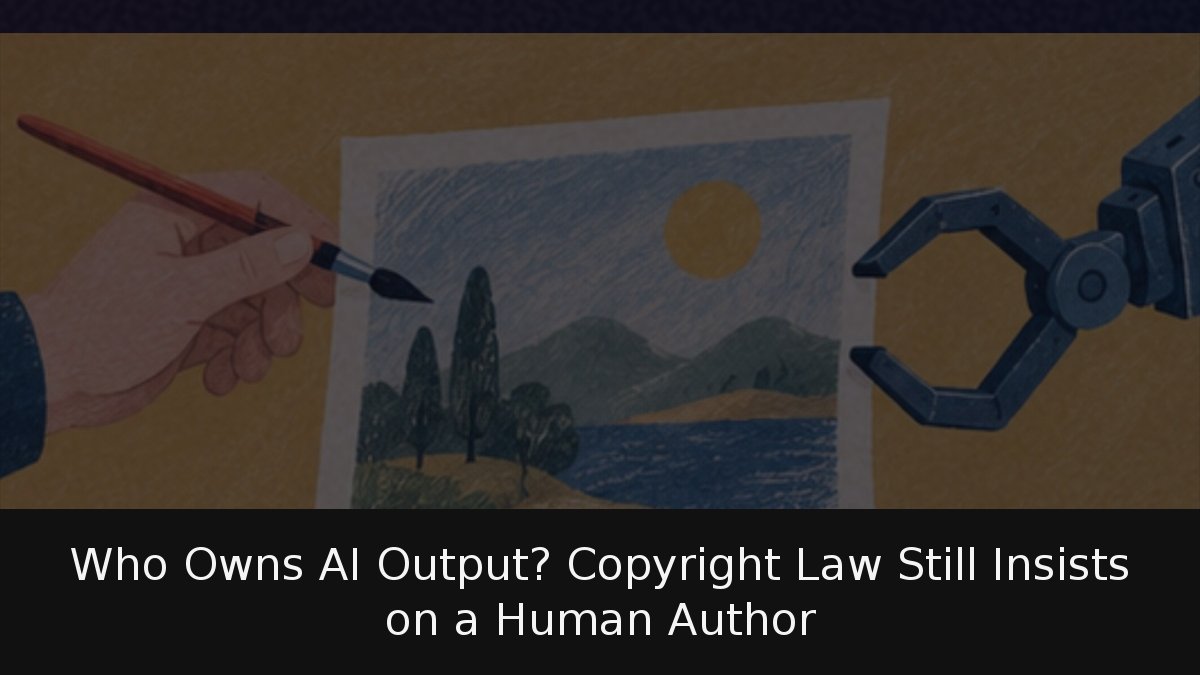
Anyone publishing AI-generated text or imagery is relying on an ownership claim the law, in the United States and in Spain, is reluctant to grant. The rule is blunt: an author must be a person. What a machine produces from a bare instruction is rarely protected; what you select, arrange or rework can be.
- No machine authorship: US courts and Spain’s copyright statute both require a human creator.
- Prompts fall short: the US Copyright Office found that instructions alone give insufficient control over expressive elements.
- Terms are not rights: a provider can waive its own claims, but cannot manufacture a copyright the law withholds.
- What holds up: creative selection, arrangement and later edits, judged case by case.
A machine named as author, then refused
The defining case belongs to Stephen Thaler. His Creativity Machine produced an image titled A Recent Entrance to Paradise, and he asked the US Copyright Office to register it with the machine as sole author and himself as owner. The Office refused, a federal court agreed, and the Court of Appeals for the District of Columbia Circuit affirmed on 18 March 2025. The matter closed when the Supreme Court declined to hear the appeal on 2 March 2026.
The opinion in Thaler v. Perlmutter held that the 1976 Copyright Act requires a human author “in the first instance”, while noting that the rule does not bar protection for work made by a person or with a person’s help: the author is whoever creates, operates or uses the tool. It never decided whether Thaler could claim authorship himself, because he had not raised that argument before the Office in time.
Spain’s Intellectual Property Law runs parallel. Article 5 defines the author as “the natural person who creates any literary, artistic or scientific work”, and Article 1 vests rights in that author through the act of creation. The workable reading is that a purely machine-generated image has no author in the legal sense — an interpretation of the statute rather than settled case law on generative AI.
Selection beats prompting
The most granular guidance is the Copyright Office’s January 2025 report on copyrightability, published after more than 10,000 public comments, roughly half of them on whether outputs deserve protection. AI used as a tool that assists rather than replaces human creativity does not block protection; output generated only by AI, or where the person does not sufficiently control the expressive elements, sits outside it. With today’s technology, prompts alone do not confer that control. Protectable instead is the human authorship visible in the result, the creative selection, coordination or arrangement of material, and modifications made afterwards. Each case turns on its own facts, and the Office saw no need for a new right.
Its clearest precedent: in 2023 the Office kept registration for Zarya of the Dawn, a comic, for the human-written text and the arrangement of text and images, but excluded the Midjourney-generated artwork. Publish raw output untouched and your claim is fragile; fold it into a work you compose and sequence and what is yours is that contribution.
What platform terms actually promise
Contracts settle a different question. Google’s Terms of Service, in force since 30 July 2026, state:
“Some of our services allow you to generate original content. Google won’t claim ownership over that content.”
Read the verb closely. A company can decline to claim something; it cannot grant a right the law withholds from output produced without human intervention. The same terms constrain use, barring deployment of the services to infringe third-party intellectual property or privacy rights and barring use of AI-generated content to train machine-learning models. Terms shift by tool and version — and keep evidence of your own input, such as sketches, intermediate versions and the shortlist you picked from dozens of results.
Patents move the opposite way
Eligibility for the inventions behind these systems is heading elsewhere. In February 2026 the UK Supreme Court held in Emotional Perception AI Ltd v Comptroller-General of Patents that artificial neural networks are not excluded from patentability merely because they are computer programs, retiring the two-decade-old Aerotel test and moving the UKIPO closer to the European Patent Office. Citing hardware now carries a claim past the first hurdle, though novelty and inventive step still apply.
The durable principle is worth more than any single product cycle: protect what flows from human decisions and leave machine-only output in the common pool. The contested ground is where the line falls when someone iterates a prompt a hundred times to reach an image already in their head. For now, iteration alone does not qualify — and anyone publishing untouched output should assume others may reuse it freely.
Sources & References