
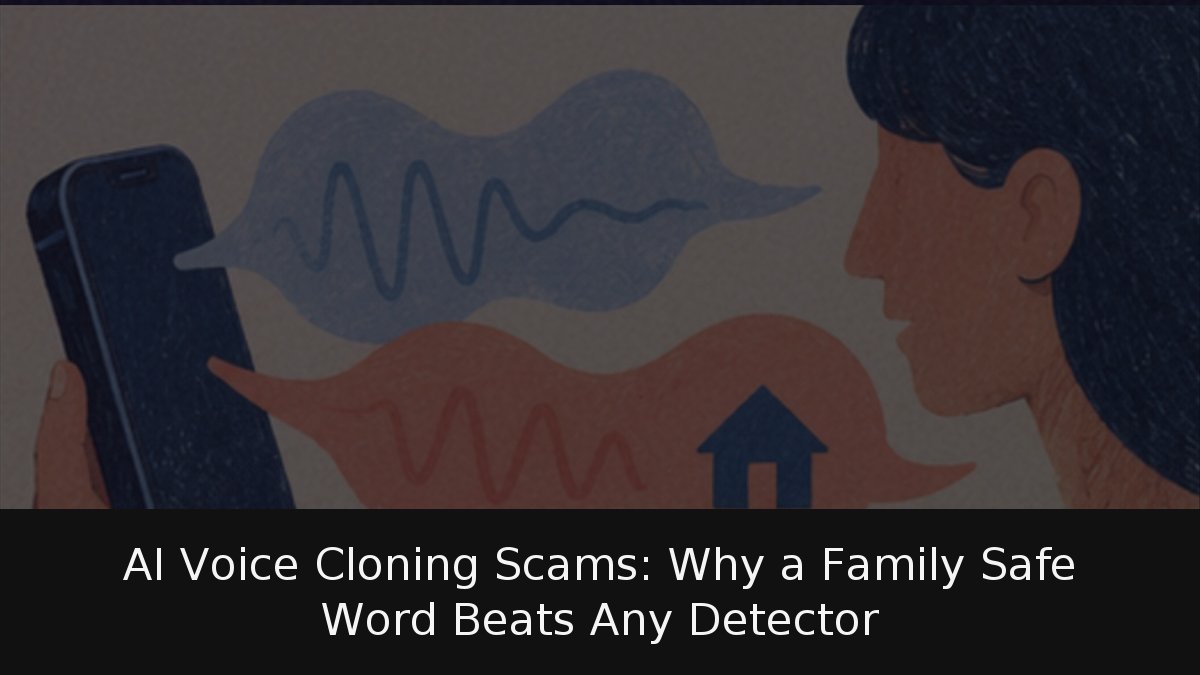
Three seconds of audio is enough for a criminal to rebuild your voice convincingly enough to fool your own family. That is the figure Starling Bank puts at the heart of its Safe Phrases campaign, and it reframes a very old fraud. The “relative in trouble” call has not changed its script, only its raw material: instead of a bad impression, scammers now harvest a clip from any video you have posted publicly and let generative AI do the rest. The FBI flagged the pattern in a public alert issued in December 2024, warning that AI-generated clips were being used to impersonate a family member in a crisis and demand immediate money or a ransom.
- The attack surface is your public feed: seconds of video are enough to clone a voice, and scammers also harvest audio from calls where you answer silence.
- The cheapest defence is a shared safe word: agreed face to face, impossible to guess, never sent digitally and known to everyone who might pick up the phone.
- Hang up and call back: the FTC and the FBI both say to verify on a number you already have saved, never on the one that just called you.
- Payment method is a tell: instant transfers, cryptocurrency and gift-card codes read aloud over the phone are hallmarks of a scam in progress.
How a cloned voice becomes a phone call
The formula is remarkably stable: a recognisable voice, an emergency that cannot wait — an accident, a detention, a smashed phone — and a request for money that brooks no delay. INCIBE, Spain’s national cybersecurity institute, documented a real case handled by its helpline in June 2024. A woman took a call from an unknown number and heard what sounded like her husband asking her to forward a message to another number. She found it odd, rang his usual phone, and he confirmed he had never called. According to INCIBE, he had previously received suspicious calls in which nobody spoke or a beep played, some of them fishing for personal data — material that may well have been used to capture his voice.
Compare that with the traditional advice to listen for robotic cadence or odd breathing. With telephone-quality audio, trusting your ear is a losing strategy.
Choosing a safe word that survives panic
A family safe word is a password agreed in person that any of you can demand during a suspicious call. If the caller does not know it, the conversation ends — however convincing the voice. INCIBE, the FBI and Starling Bank all land on the same recommendation.
“Agree a keyword with your family and friends so you can corroborate their identity.” — INCIBE
For it to hold under pressure, it must be agreed face to face, never over WhatsApp or email; Starling insists the phrase is “never shared digitally”. It must be impossible to deduce — not the dog’s name, not the grandparents’ village, nothing that appears on your social profiles. It should be easy to recall while panicking, which makes an absurd phrase a better bet than a password full of symbols. Everyone who might receive the call has to know it, elderly relatives included. And you ask for it; you never volunteer it. If the caller announces “it’s me, the word is…”, something is wrong.
No safe word? Hang up and call back
Dial the number you already have saved for that person. The FTC, the US consumer protection agency, makes this the centrepiece of its alert on AI-enhanced family scams: do not trust the voice, and reach the supposed caller on a number you know to be theirs. If nobody picks up, try another relative or a friend. The FBI gives identical guidance for calls claiming to come from a bank.
“Don’t trust the voice.” — FTC
Other red flags the FTC highlights are payment methods that are hard to reverse: instant transfers, cryptocurrency, or gift cards whose codes you are asked to read out loud. INCIBE adds three basic rules — never hand over personal or banking data, never follow instructions to open a link or install an app, and always verify with the person who claims to be calling. The pressure tactics mirror those of any phishing attempt: urgency, secrecy and a channel you do not control. You can also shrink the raw material, as the FBI suggests, by limiting public content featuring your face or voice, switching accounts to private and restricting followers to people you actually know.
Most circulating figures come from surveys rather than confirmed frauds. The most cited is Starling Bank’s, carried out with Mortar Research between 21 and 23 August 2024 among 3,010 British adults: 28% believed they had been targeted by a voice-cloning scam in the previous year, 46% did not know the scam existed, only 30% would confidently know which warning signs to watch for, and 8% would send whatever was asked even if the call felt strange. That last number is the troubling one, because it describes people who sense something is off and pay anyway.
If you have already taken the call, INCIBE advises warning your contacts, blocking the number and — if you paid or shared banking details — calling your bank immediately to try to halt the transaction. Reports go to the Policía Nacional or the Guardia Civil, with a formal complaint where there has been an economic loss, and INCIBE’s free, confidential helpline on 017 operates from 8:00 to 23:00, 365 days a year.
Cloning technology will keep improving, and no detector will arrive in time for a 3 a.m. call. The defence that actually scales is human, free and takes five minutes of after-dinner conversation: a phrase nobody outside the family knows, and an unbreakable habit of hanging up to verify. As synthetic voices become indistinguishable from the real thing, the safe word stops being a quirky precaution and becomes the baseline of family security hygiene — one that costs nothing and, unlike every software fix on the market, cannot be patched out of existence by a better generator.