
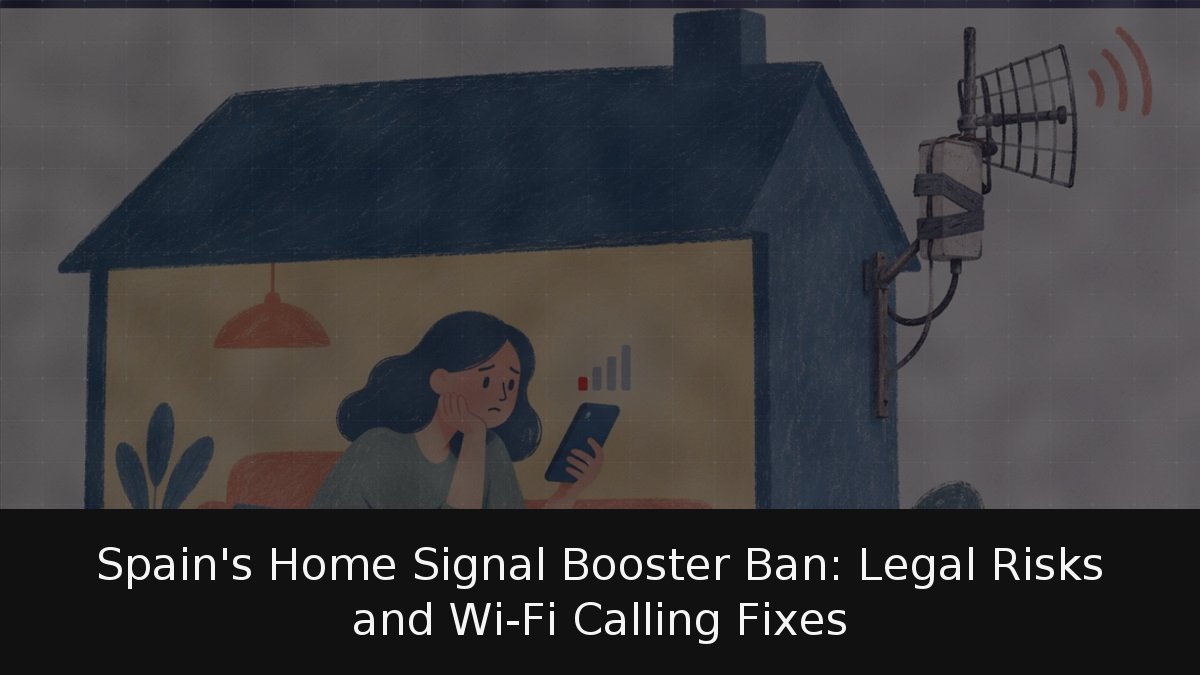
In Spain, poor indoor mobile coverage has a tempting DIY fix—a cheap signal booster—but installing one without operator approval is illegal. The Ministry for Digital Transformation warns that these devices operate in licensed spectrum, and violations can bring severe penalties. For most homes, the legal alternative is Wi-Fi calling.
- Boosters require operator approval: Only mobile operators or authorized third parties may install repeaters in licensed bands.
- Fines can reach €20 million: Law 11/2022 classifies unauthorized spectrum use as very serious, with additional sanctions including equipment seizure.
- Wi-Fi calling is the practical fix: Supported by many carriers, it lets phones make calls over home broadband where cellular signal is weak.
Why DIY mobile repeaters are illegal in Spain
“These are radio stations that operate in licensed frequency bands—they are not for free use,” the Ministry for Digital Transformation states.
The ministry’s guidance covers mobile repeaters, re-emitters, and amplifiers for GSM, 3G, 4G, LTE, and 5G. Those bands belong to operators by concession. Only operators, with an approved technical project and corresponding authorization, can install these devices or authorize third parties to do so. The ministry advises individuals and companies to contact their carrier to handle the station. Without that authorization, installation is not possible “regardless of the time elapsed after contacting the operators.” In other words, a carrier’s silence does not equal permission.
Seller responsibility matters too. Devices sold in Spain must explain usage restrictions in their instructions and show the mandatory pictogram under Commission Implementing Regulation (EU) 2017/1354 on packaging. If a device does not meet these requirements, it cannot be sold in Spain. A box with no warning is a red flag.
Penalties under Spain’s telecom law
Unauthorized installation can trigger administrative sanctions under Law 11/2022, the General Telecommunications Law. The ministry lists applicable articles: using spectrum without a concession when one is required is a very serious infringement (Article 106); installing radio stations without authorization is a serious infringement (Article 107); causing interference to legally established stations is serious or very serious (Articles 107 and 106)—the ministry notes this is a “common circumstance” after installing repeaters not integrated into operator networks; selling equipment without mandatory restriction information is a minor infringement (Article 108).
Article 109 sets maximum fines: up to €20 million for very serious violations, €2 million for serious ones, and €100,000 for minor ones. These are legal ceilings, not automatic or typical penalties. Article 110 sets criteria for grading the amount within those limits, such as damage caused or cessation of the infringing activity. Beyond fines, additional sanctions include immediate cessation of emissions and sealing or seizure of equipment.
The severity reflects spectrum’s role as a shared public resource: a poorly adjusted repeater can degrade the network neighbors rely on.
Wi-Fi calling: the legal alternative already in your pocket
If you have fiber or a strong home Wi-Fi connection, your smartphone can make and receive calls over it. Apple describes Wi-Fi Calling as designed for “areas with little or no mobile coverage.” On iPhone, enable it via Settings > Cellular > Wi-Fi Calling; you may be asked to confirm your address for emergency services. On Android, Google’s help says the path is Settings > Network & internet > SIMs > (your SIM) > Wi-Fi Calling; if the option is missing, “it means your carrier does not support this feature.”
Three caveats: It depends on the carrier—Google warns not all providers allow it and additional charges may apply, so check with yours. Not all Wi-Fi networks are compatible, Apple notes among troubleshooting steps. Emergency calls: Apple says when cellular service is available, iPhone uses it for emergency calls; if not, and Wi-Fi Calling is enabled, the call may go over Wi-Fi.
If your Wi-Fi is also weak
Then the bottleneck is your home network, and you have room to act. The ministry’s warning concerns equipment emitting in mobile bands; a Wi-Fi extender or mesh system expands your own Wi-Fi network, not the operator’s. Before buying, review router placement and what is slowing the signal. With strong Wi-Fi in every room and Wi-Fi Calling enabled, poor indoor coverage stops being a problem for most households. If you still need real mobile coverage—for data without Wi-Fi, for example—the legal route is to ask your operator, the only party that can install or authorize a repeater.
Final analysis: The law places the burden on the wrong side of the chain. Users are expected to know that an off-the-shelf device requires authorization, while the ministry makes clear that carriers’ silence—the only parties who can grant it—does not equal permission no matter how long they take. Until that changes, Wi-Fi calling is the best tool available, and the cheap online amplifier is the worst temptation.