
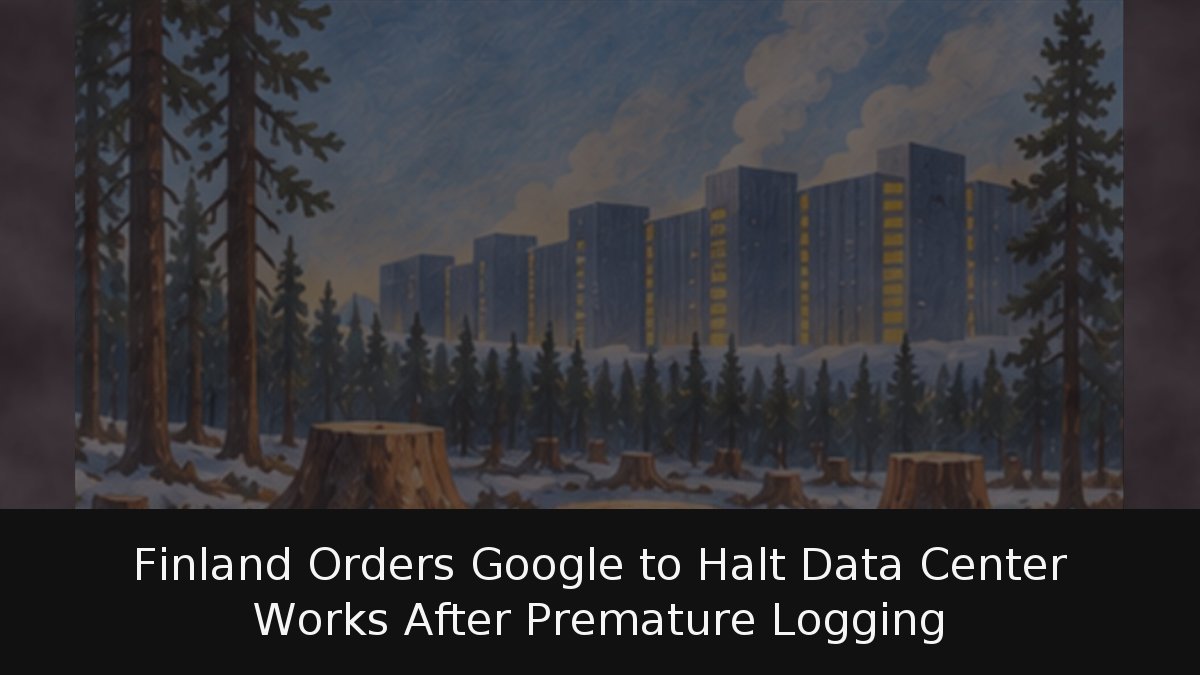
Finland’s national authority LVV has ordered Tuike Finland Oy, Google’s Finnish subsidiary, to immediately suspend land-preparation work at two planned data center locations: Muhos, where roughly 330 hectares are affected, and Kajaani/Otanmäki, covering about 200 hectares. The reason: trees were felled before the mandatory Environmental Impact Assessment (EIA) had been completed. Google has until 14 October 2026 to explain exactly what happened.
The stop order lands barely a month after the company unveiled a €13 billion investment package in Finland — new facilities in Kajaani, Muhos and Vaala, plus an expansion of its existing campus in Hamina. At announcement time it ranked among the biggest bets a technology company had ever placed in Northern Europe. Part of that build-out is now frozen while a regulator asks questions.
- Regulatory halt: LVV ordered work stopped at two sites, totalling roughly 530 hectares, pending a full explanation by 14 October 2026.
- Legal disagreement: Google says it acted under ordinary forestry law; the regulator insists a project of this scale requires a complete impact assessment first.
- Damage control: Google has pledged a 130-hectare reforestation plan in Muhos, but LVV has not confirmed whether that unblocks construction.
- Wider stakes: The felling sits inside a national energy picture where Google is contracting for a large share of Finland’s nuclear output.
Ordinary forestry or a full impact assessment?
Google’s position is that the clearing was carried out under standard forestry legislation, which in Finland generally allows timber to be harvested on privately owned land without a prior impact assessment. The regulator disagrees on a matter of scale: data centers spanning several hundred hectares, with substantial consequences for the national electricity grid, cannot be processed through routine forest-management procedures. Finnish law, in LVV’s reading, demands a complete EIA before any preparatory land work — and felling trees to ready a construction site counts as preparatory work.
Google answered through Sondre Ronander, who said the company “understands the concern,” and announced a 130-hectare reforestation plan in Muhos. LVV has not indicated whether that commitment is sufficient to lift the suspension or whether its investigation is still open — leaving the timeline for one of Europe’s marquee AI infrastructure projects unresolved.
“We understand the concern.” — Sondre Ronander, on behalf of Google
An energy footprint that reshapes a national grid
The scale of Google’s energy operation in Finland is remarkable. The company has signed an agreement to purchase up to 50% of the output of the Loviisa nuclear plant, which corresponds to roughly 10% of all electricity generated in Finland. Concerns have been raised that concentrating that much supply in a single corporate buyer poses risks for other Finnish sectors competing for the same electrons.
The global picture is equally demanding: the International Energy Agency (IEA) estimates that data center consumption worldwide will reach 945 TWh by 2030. Finland’s carbon ledger is already under strain. The Natural Resources Institute Finland (LUKE) determined that the country’s forests stopped absorbing more CO₂ than they emit from 2021 onwards, a shift driven by warming and intensive forestry. Clearing around 530 hectares in combination — even where some of the land was already in prior use — is not merely a bureaucratic question; it has direct consequences for national climate commitments.
Deadlines, internal pressure and the cost of moving fast
The most revealing part of the episode is that Google reached this point at all. A company of its size maintains global legal teams specialised in environmental regulation and knows that projects on this scale require an EIA in most European jurisdictions. Proceeding with felling before the study was approved suggests that internal pressure to hit construction deadlines outweighed regulatory caution.
That tension is likely to intensify. Every additional AI model that must be trained and served translates into more land, more water and more electricity — resources governed by rules that exist for reasons beyond corporate scheduling convenience. Finland, which has built a reputation as a clean-energy innovator, is now host to one of the world’s largest AI infrastructure build-outs, and the two identities do not automatically coexist.
The 14 October deadline will arrive regardless. Google’s answer will determine whether this remains an administrative penalty with a modest fine attached, or becomes a meaningful delay to the largest technology investment in Northern Europe — and it will set an early precedent for how European regulators handle AI infrastructure that arrives faster than the paperwork designed to oversee it.