
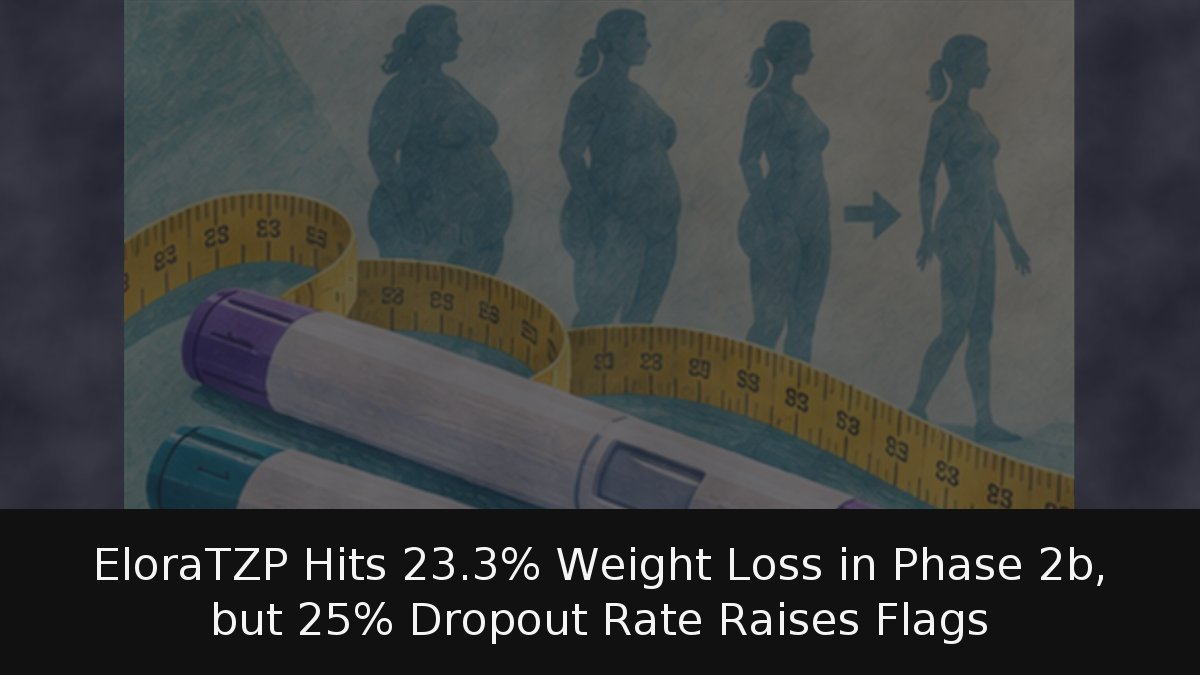
The race to build a more potent obesity drug has a new benchmark. A combination therapy called EloraTZP, developed by Eli Lilly, produced 23.3% average body-weight loss over 48 weeks in a mid-stage trial — the strongest result the company has reported for any incretin-based programme to date. The findings were presented at the European Association for the Study of Diabetes (EASD) meeting in Milan in late September 2026 and detailed in a company press release dated September 30, 2026.
EloraTZP pairs tirzepatide, the dual GLP-1/GIP agonist sold as Mounjaro for type 2 diabetes and as Zepbound for obesity, with eloralintide, an investigational amylin receptor agonist that mimics a pancreatic hormone involved in signalling prolonged fullness. In the same study, tirzepatide 15 mg used alone delivered 14.8% weight loss, while placebo produced 3.0%. The combination therefore clears the current pharmacological standard by more than eight percentage points.
- Best dose, best result: eloralintide 9 mg plus tirzepatide 15 mg reached 23.3% weight loss at week 48, versus 14.8% for tirzepatide monotherapy and 3.0% for placebo.
- Glycaemic control improved too: HbA1c fell by up to 2.9 percentage points on the combination, compared with 2.4 points on tirzepatide alone.
- Tolerability is the weak point: between 10.8% and 27.0% of participants on the combination stopped treatment because of side effects, against 2.9% on tirzepatide alone and 16.7% on placebo.
- The evidence is mid-stage: a 367-person, double-blind, placebo-controlled phase 2b study that has not been peer-reviewed, and EloraTZP is not approved by any regulator.
Two appetite pathways, one injection
Tirzepatide works by modulating two post-meal hormonal signals, GIP and GLP-1, which together dampen appetite. Eloralintide acts on a third, non-overlapping axis: it imitates amylin, a hormone produced in the pancreas that helps signal satiety. Lilly’s working hypothesis is that layering distinct appetite-regulating mechanisms generates synergy rather than redundancy, and the dose-ranging data support that idea.
Lower eloralintide doses combined with tirzepatide produced weight loss ranging from 13.2% to 19.9%, depending on the pairing. The 3 mg plus 5 mg arm landed at 13.2%, the 6 mg plus 5 mg arm at 19.4%, and the 6 mg plus 10 mg arm at 19.9%. Only the top combination — 9 mg of eloralintide with 15 mg of tirzepatide — pushed past the 20% threshold.
What the phase 2b trial actually measured
The study enrolled 367 adults in the United States and Argentina with overweight or obesity plus type 2 diabetes, and ran for 48 weeks. The average starting HbA1c was 8.1%, a level indicating poor glycaemic control at baseline. The reduction of up to 2.9 percentage points on EloraTZP is a meaningful improvement for a metabolic population that numbers roughly 537 million people worldwide with type 2 diabetes.
Gastrointestinal side effects were the dominant complaint, generally mild to moderate and concentrated during the dose-escalation phase. That pattern is familiar from existing incretin therapies. What is less familiar is the scale of discontinuation: the share of participants who quit because of adverse events ran from 10.8% to 27.0% across the EloraTZP groups. A quarter of patients abandoning a therapy is not automatically a better public-health outcome, even when the efficacy curve looks superior. It also raises a practical question about muscle preservation, since rapid weight loss without adequate protein intake and resistance training tends to erode lean mass.
The usual caveats apply. These are company-reported results, not a peer-reviewed publication, and the sample is modest. Because every participant had type 2 diabetes, the numbers may not transfer cleanly to people seeking treatment for obesity alone.
Phase 3, the pipeline and the wider field
Lilly has outlined three design changes for the next stage: an optimised dose-escalation schedule aimed at improving tolerability, a single-injection formulation that combines both molecules in one shot, and a separate arm testing eloralintide as a standalone therapy. No public timeline for phase 3 has been given, and regulatory review would follow only after those trials conclude.
The commercial backdrop is significant. The global obesity market in 2026 is worth more than $50 billion, and incretin combinations are the most contested front in pharmaceutical research. At the same Milan meeting, Novo Nordisk presented an exploratory pooled analysis of its STEP UP trials of semaglutide. In a subgroup of 55 participants who had liver-fat scans, 88.5% of those starting above 5% liver fat had dropped below that threshold by week 72, with average liver fat falling from 8.8% to 3.1%. That analysis was post hoc and involved people with obesity rather than a diagnosed liver disease, so it points to a possible benefit rather than proving one.
Taken together, the two readouts sketch a field moving faster than its evidence base. EloraTZP’s efficacy ceiling looks higher than most analysts had modelled, and Lilly would be unlikely to publish these figures while committing to phase 3 if it were not reasonably confident of replicating them at scale. But the dropout data are the number that will determine whether the combination becomes a mainstream prescription or a niche option for patients who can tolerate it. Higher efficacy purchased with poorer adherence is a trade-off that only larger, better-controlled trials can settle.
Sources & References