
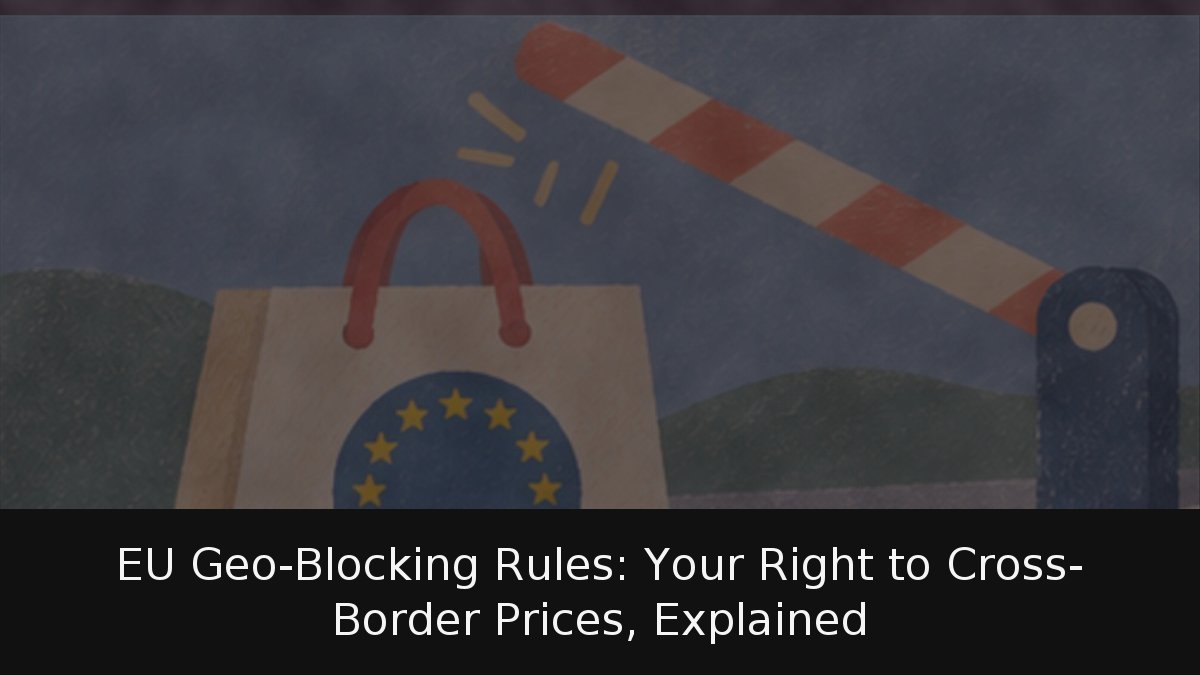
Shopping across borders inside the European Union is supposed to feel seamless, yet many consumers still hit a wall when a German or French web store refuses them, redirects them home or quietly raises the price. The culprit is geo-blocking, and the EU has a regulation designed to stop it. The rules have been in force since 3 December 2018, but their reach is narrower than many shoppers assume, and that gap matters more than ever as the European Commission reviews how well the framework works.
- No forced redirection: A store in another member state cannot block access or push you to your national version without your explicit consent.
- Same terms, same price: Retailers may not apply different conditions, including price, based on nationality or residence.
- Payment cannot be refused: A card issued in another EU country must be accepted if it matches the brand and category the merchant already takes.
- Big exclusions remain: Cross-border delivery, audiovisual content, financial services and transport fall outside the regulation.
What the regulation actually forbids
Geo-blocking means limiting or denying access to a website or app for customers from other member states, or selling to them on worse terms because of where they come from. The regulation attacks the problem on three fronts.
Article 3 bans blocking access to an online interface and bans redirecting a visitor to the version for their own country without express consent. The Commission’s guidance illustrates this with a French shopper entering a Belgian store’s site: the retailer may suggest the French version, but it cannot impose it.
Article 4 prohibits different conditions, price included, tied to nationality or residence. Article 5 prevents a merchant from rejecting a payment because of the country where the card was issued, provided the card is of the same brand and category the store already accepts, or the payment is a transfer or direct debit, with authentication and in a currency the merchant admits.
There is a safety valve: a store may block a customer if a law requires it, but it must explain the reason in the language of the site the shopper was trying to reach.
Different prices are legal, but access to them is not optional
The regulation does not force a single pan-European price. Article 4.2 allows country-specific pricing as long as the offers are presented without discrimination. What it guarantees is that you can reach any country’s offer on the same terms as a local customer.
Three situations leave no room for different treatment:
- Goods delivered to a place where the store already ships, or collected at an agreed point. If a German retailer only delivers inside Germany, you can buy at the German price, but delivery must go to a German address or pickup point.
- Electronically supplied services that do not consist of giving access to copyright-protected works, such as cloud computing or web hosting.
- Services provided in a physical location, including hotels, car rental and amusement park tickets.
The Commission’s consumer portal cites a Danish shopper who booked a car on a Spanish company’s website and saw the total jump by 140 euros after entering her address. Her national European Consumer Centre helped her file a complaint, and the company faced possible sanctions.
The limit sits in recital 28: the regulation does not impose cross-border delivery where a store does not offer it, and it accepts territorial limits on after-sales service. Buying abroad only pays off if you have solved the logistics and know where you will be served if something goes wrong.
What falls outside the rules
Quite a lot. Recital 8 excludes audiovisual services, including those giving access to sports broadcasts under exclusive territorial licences, along with retail financial services. That is why a video platform’s catalogue can change from country to country without breaching this regulation.
Recital 9 leaves out transport, since existing EU rules on air, sea and bus transport already ban much of that discrimination. Article 4.1.b removes from the electronic services rule any service giving access to copyright-protected works without a physical medium. The consumer portal warns that films, e-books and music usually carry different licences in each country.
The regulation also does not apply to purely domestic purchases within one country (Article 1.2), nor to electronic services from small businesses exempt from VAT (Article 4.4), and it permits different book prices where national law requires them (Article 4.5).
The practical reading is clear: the rules protect the shopper buying trainers or booking a hotel, and offer almost nothing to the person paying for digital content, precisely where the market is most fragmented.
Guarantees, returns and where to complain
Buying in another EU country does not strip you of basic rights. Consumers have 14 days to withdraw from a purchase after delivery, normally paying return shipping, and the right does not cover purchases from private individuals.
Minimum legal guarantees across the EU run for two years from receipt, with a defect in the first year presumed to have existed at delivery. Spain goes further: Article 120 of its consumer law sets three years for goods since 1 January 2022. Do not assume those three years travel with you. The Commission’s portal points to the guarantee rules of the country where you bought, and Article 1.6 clarifies that a forced sale does not turn the store into a business directing its activities at Spain under the Rome I Regulation on applicable law.
If a store blocks you, overcharges you or ignores you, the route is the European Consumer Centre in Spain. Part of the ECC-Net network, it is free and handles complaints from residents in Spain against companies in another EU country, Iceland, Norway or the United Kingdom, once you have first raised the issue with the company without success.
It cannot compel a business, and it does not intervene in scams, private sales or cases already in court. Checking a store’s reliability beforehand therefore saves trouble. If the amicable route fails, the centre points consumers towards other dispute resolution systems or the European small claims procedure.
The regulation is under review. Article 9 requires an evaluation every five years, and the current exercise opened a call for evidence in February 2025 that drew 598 contributions, plus a public consultation between 6 October 2025 and 5 January 2026 with 187 responses. The report was expected in the third quarter of 2026, but as of 6 November 2026 it had not been adopted and no amendment proposal was on record. The European Court of Auditors flagged uneven enforcement in its special report 03/2025: penalties range from 26 euros to 5 million depending on the country.
The regulation works better as an argument than as a shield. It gives you the right to the German price, not to the delivery, the after-sales service or the film. Unless the review reaches digital content and levels out sanctions, the single market will keep its borders at the checkout.