
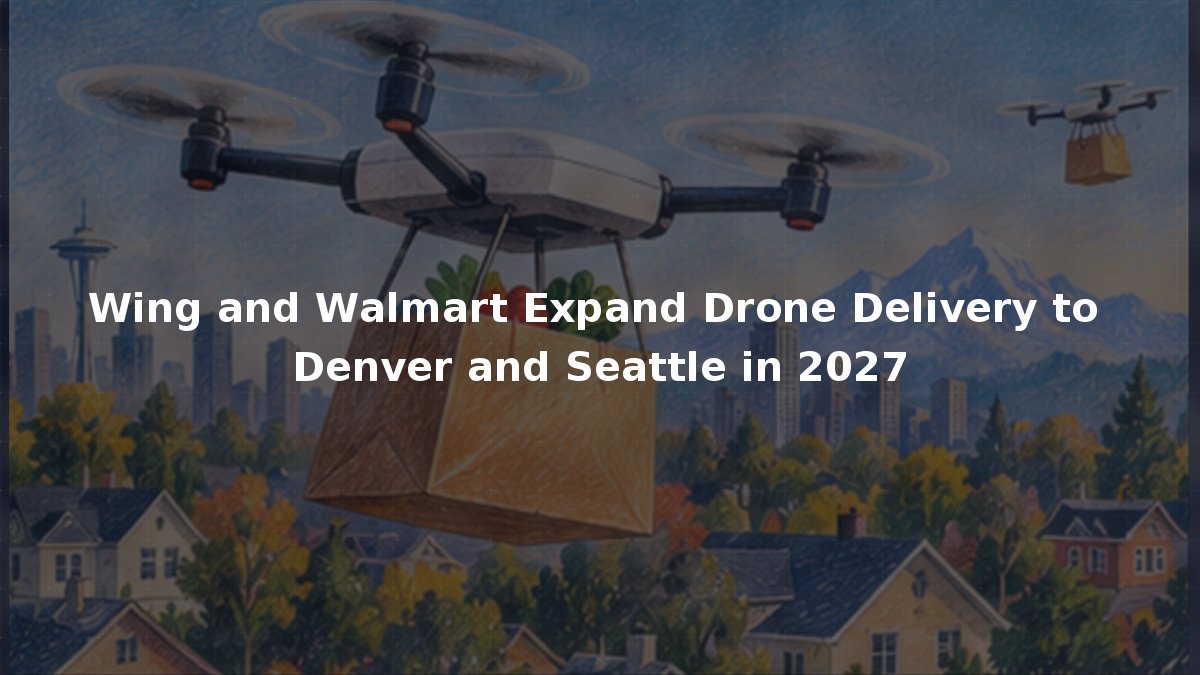
Wing, Alphabet’s drone-delivery subsidiary, and Walmart will launch aerial delivery across the Denver and Seattle metropolitan areas in 2027, extending what the pair calls the largest residential drone delivery footprint in the United States. The build-out targets more than 270 Walmart stores and roughly 40 million customers once complete.
- Two new metros: Denver and Seattle join five existing markets — Atlanta, Charlotte, Dallas–Fort Worth, Houston and Orlando.
- Scale already in place: More than 3 million customers can order by drone today, with 14 additional regions — including Miami, Philadelphia, Los Angeles and the San Francisco Bay Area — on the longer-term roadmap.
- Hard technical limits: Payloads top out at 5 pounds (2.3 kg) and speeds at 60 mph (97 km/h), while FAA Part 135 certification remains a genuine barrier to entry for rivals.
Seattle Means Federal Way, and the Paperwork Is Already Moving
The Seattle leg is narrower than the headline suggests. For now, the rollout centres on Federal Way, where Wing filed a master land-use application in August describing the addition of a storage container and fencing to the existing Walmart Supercenter parking lot at 34520 16th Ave. S. A parallel filing in Tacoma, where the retailer operates a Supercenter at 1965 S. Union Ave., was valued at roughly $10,000, with construction pencilled in from November — dates that routinely shift during permitting.
Federal Way Mayor Jim Ferrell framed the arrival as a civic milestone:
The future has arrived, and it’s being delivered by Walmart by drone.
The enthusiasm is not universal. Coverage of municipal filings indicates that at least two suburban jurisdictions have frozen applications for drone hubs over zoning concerns, and a count of Walmart locations inside Denver’s city limits puts the figure at just five stores. The gap between a metro-area press release and an operational corridor is where most drone programmes have historically stalled.
What the Aircraft Can Carry — and What Still Goes by Truck
Wing’s drones fly at up to 60 mph and carry a maximum of 5 pounds. That covers over-the-counter medication, snacks, baby supplies, small appliances and accessories — the “urgent few items” basket. It excludes the weekly grocery run, bulk beverages and large electronics, which stay on conventional trucks.
Packages are lowered on a tether rather than landed at the door, and eligible orders surface automatically inside Walmart’s app or website, or through Wing’s own app. In the markets where the service already runs, door-to-door times sit between 10 and 30 minutes, depending on distance to the nearest store. That number, not flight speed, determines whether drone delivery becomes habit or novelty.
The real competitive asset is Walmart’s physical estate: more than 4,600 U.S. stores, heavily concentrated in suburbs and peri-urban areas. Each store doubles as a distribution node, shortening flight radii and improving the odds of operational profitability. Rivals building from dedicated warehouses must replicate that density from scratch.
Regulation, Weather and a Tightening Race
Operations run under Federal Aviation Administration oversight. Wing holds Part 135 certification as a commercial drone airline, permitting revenue deliveries to households — an approval not every competitor possesses. Current constraints include no-flyover zones around airports and military installations, the 5-pound weight ceiling (regulatory as much as technical) and visibility requirements in some contexts. Denver and Seattle will require negotiated flight corridors with local authorities.
Weather is the open variable. Denver’s snowy winters and Seattle’s persistent rain are precisely the conditions Wing has not documented publicly at scale. Reliable cold-weather and precipitation performance would unlock northern and Midwestern markets quickly; failure would confine the network to the Sun Belt.
Competition is compressing the timeline. Amazon’s Prime Air is targeting roughly 500 U.S. cities by the end of this year, though it has not announced a project in its home state, and its Dallas-area operations have drawn noise complaints. DoorDash Air has launched in Northern California with partners including Chipotle and Popeyes. Wing, for its part, has announced no European launch, so the contest remains a U.S. one for now.
The Pilot Is Over
“Adding new metros to our expansion speaks to how quickly people across the country are adopting drone delivery,” said Heather Rivera, chief business officer at Wing — a partnership with Walmart that dates to 2023. Denver and Seattle in 2027 mark the point at which aerial last-mile delivery stops being a demonstration and becomes a product line. The unresolved questions are unglamorous: winter reliability, zoning friction and whether a 30-minute promise holds when it rains. Answer those, and the next 14 metros follow quickly. Fail, and drone delivery remains what it has been for a decade — a permanent pilot project with excellent PR.