
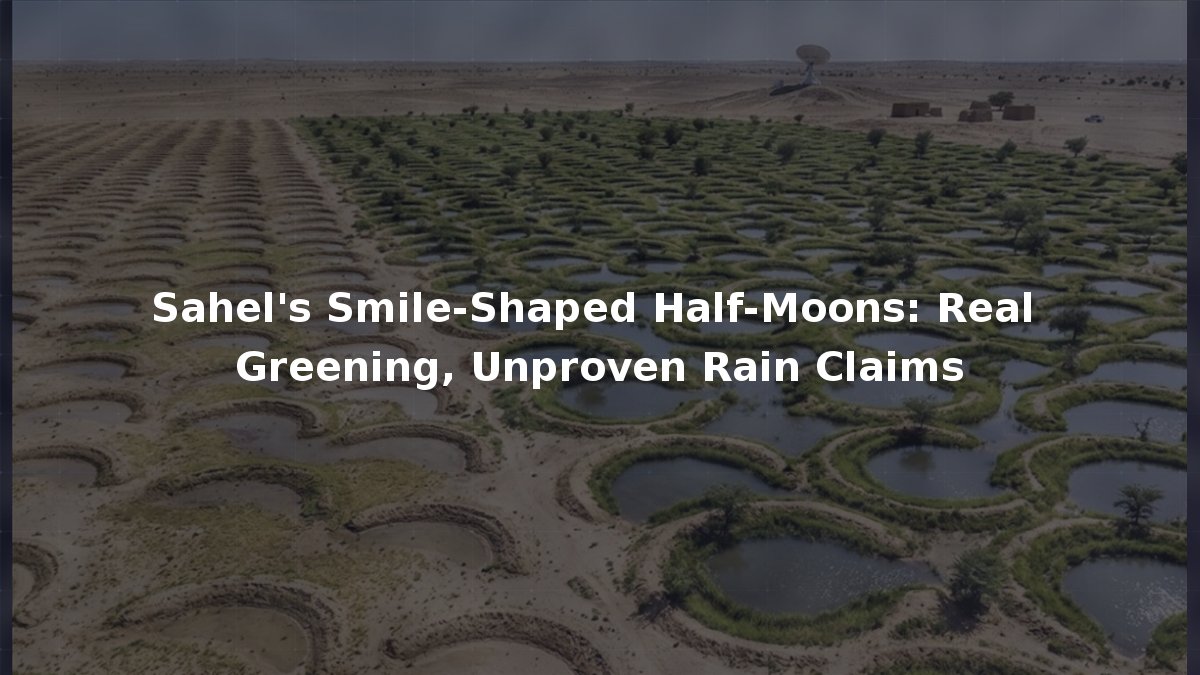
The Sahel holds more water beneath its soil than it did decades ago, and satellites confirm it. What they do not confirm is the explanation powering a viral video: that the crescent-shaped pits farmers dig across the region — the so-called half-moons — are responsible, or that those pits “create rain.” None of the sources the clip cites goes that far.
- Satellites prove the trend, not the cause: GRACE gravity data show groundwater in the Niger basin rose by 93 ± 61 km³ between 2003 and 2013, a shift researchers tie to soil degradation and runoff rather than water-harvesting works.
- The headline claim overreaches: a TikTok video from the account Hope! En pie por el planeta opened with the line “These holes create rain” — something no cited study demonstrates.
- What is measured: half-moons do green the land. Satellite analysis of 18 sites in southern Niger found 49.7% more vegetation than before intervention.
- Scale is the weak point: cloud effects reached statistical significance only in restored areas larger than 121 km², while typical half-moon plots cover 42 to 200 hectares.
What the viral video actually claims
Posted on 6 October 2026, the nine-minute clip had collected 938,200 likes and 106,800 shares. To its credit, it is more cautious than its opening line: it frames the greening’s influence on “even the clouds” as a hypothesis still under study and concedes that “we still cannot exactly separate which part of the water transformation corresponds to which factor.”
The problem is the certainty elsewhere. Other passages describe half-moons as, in the words of physicist Alpha Lo, “the main driver of the Sahel’s water transformation.” Half-moons are semicircular trenches that slow rainfall and force it underground. The World Food Programme and five regional governments have deployed them at scale since 2018, restoring more than 335,000 hectares, according to the agency.
Why groundwater is rising — and why the pits aren’t the answer
The study the video itself links attributes the increase to soil degradation, not restoration. Werth, White and Bliss calculated in 2017, using the GRACE satellites, that groundwater in the Niger basin grew by 93 ± 61 km³ across a decade. GRACE sees neither pits nor trees: it weighs water through gravity changes and resolves areas larger than 150,000 km² — a different method from the ESA’s HydroGNSS satellite, which estimates soil moisture.
The mechanism is counterintuitive. Deforestation and agricultural expansion leave bare, crusted soils; water runs off instead of soaking in, pools in gullies and ponds, and recharges the aquifer from there — the Sahelian paradox. The 2017 paper never mentions half-moons.
Two claims are stretched further. The video says Niger’s groundwater “has risen an average of four metres”; the figure is real but comes from a 2008 paper covering 1963–2005 that credits land clearing. It also presents Chad as an “especially revealing coincidence,” with the strongest signal where restoration programmes are largest. Fred Pearce‘s report for Yale Environment 360 on 23 July 2026 offers other drivers: more intense storms, a Lake Chad that exceeded 23,000 km² in 2024, and abandoned irrigation that no longer drains rivers. Pearce notes that most researchers consider these techniques effective locally but not extensive enough to explain a regional phenomenon, and Lo himself calls for measurement rather than claiming proof.
The contrast with Spain is stark: there the problem runs the other way, with more than 80,000 hectares irrigated using water drawn illegally from aquifers.
Can half-moons make it rain?
No study shows it. The cloud research cited measured clouds, not rainfall, and did so over protected areas rather than half-moons. Ruijsch and colleagues analysed 321,200 Meteosat images from 2004 to 2024; the widely quoted 25% is the maximum, recorded in April and October when comparing greener and less green zones. The average across protected areas is 10.8%, and it is only significant in the largest, those above 121 km² — equivalent to 12,100 hectares. Half-moon sites studied in Illéla, Niger, span 100 to 200 hectares, while plots at 18 other satellite-analysed sites average just 42.
The authors themselves warn that it remains unclear whether those clouds turn into rain. Their second study, published in January 2026, complicates the thesis further: in simulation, raising soil moisture under forest by 50% cut afternoon cloudiness by 83% on one of the days analysed — precisely what a half-moon does by wetting the ground. That reading comes from a model simulating three specific days, not a law of physics, but it certainly does not support the headline.
The fourth claim, that half of Africa’s rainfall comes from plant transpiration, holds up according to a 2022 study — yet it is modelled, ranges from 5% to 68% depending on the basin, and says nothing about what happens when land is restored.
What the evidence does support
Half-moons green the ground where they are dug. A study in Scientific Reports measured 18 sites in southern Niger by satellite and found 49.7% more greenery than before the intervention and 25% more than untreated neighbouring plots. Two caveats: the authors include employees of the World Food Programme and USAID, the agency backing the works, and rainfall in the following years was 12.3% higher. The Illéla study, covering 1,564 trees, found 12% more growth with half-moons — the best of five techniques compared — and 9% less where nobody maintains the site.
On aquifers, only estimates exist. The World Food Programme calculates 475 million m³ of recharge across its programme and admits in its own cost-benefit analysis that more precise studies are needed. That equals roughly 0.5% of Werth’s figure; the periods and territories differ, so it serves only as an order of magnitude.
The pattern here is familiar: genuine data, genuine studies, and a causal leap nobody has measured. The video does not invent its sources and even acknowledges uncertainty, yet it opens and closes with a confidence those papers do not provide. Half-moons do not need the miracle — turning dead ground into grass and millet already justifies every pit dug, and that much is measured. What remains open is a question the clip never asks: if the Sahel’s recharge comes from runoff, what happens to the aquifer when we hold water where it falls instead of letting it run? That is the question worth putting to a hydrologist before anyone promises rain.