
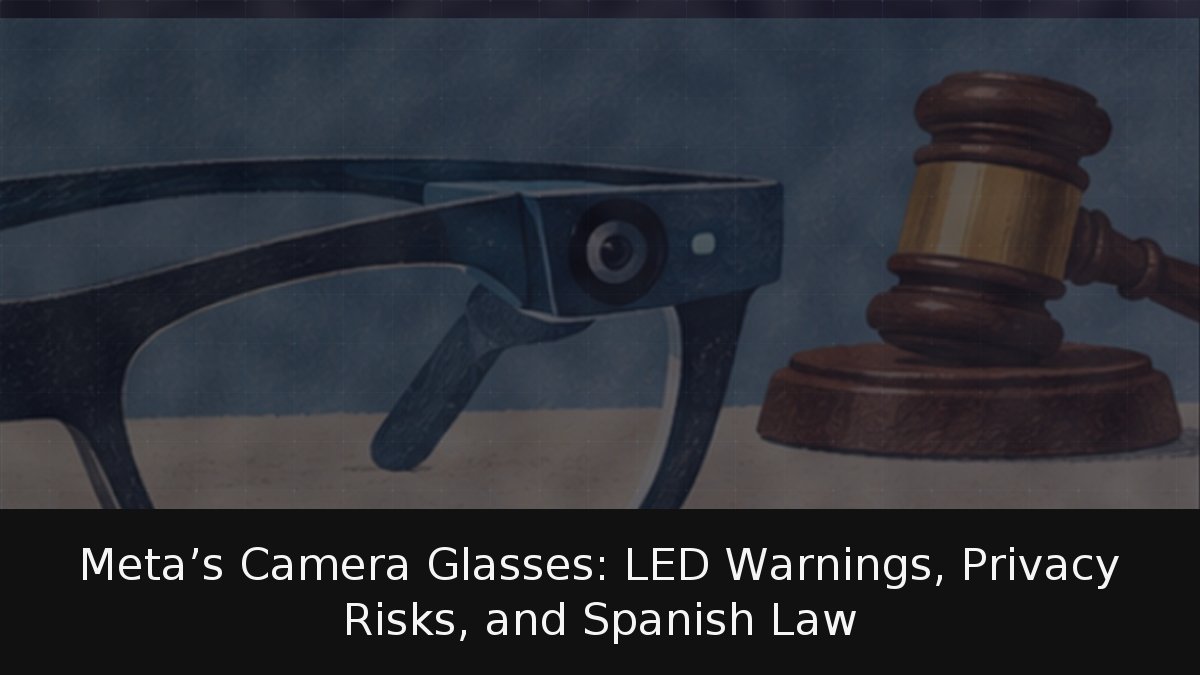
Smart glasses with cameras look like ordinary eyewear, which is exactly why they raise privacy alarms. Spain’s data protection authority, the AEPD, addressed the issue in a good-practice guide published on July 13, 2026, warning that conventional-looking frames can capture people without permission, especially in sensitive places such as pools and beaches. TechNews DevTop examines what the devices record, how they signal capture, and where personal use gives way to legal risk.
- LED alert is not consent: Meta’s glasses flash a white capture LED, but the AEPD says that does not replace informing people. Anti-tamper safeguards help, yet the light covers only certain capture modes.
- Domestic use has limits: GDPR excludes strictly personal processing, but continuous recording of strangers, intimate locations, or publishing images can fall outside it. Spanish image-protection law and the Penal Code add civil and criminal risk.
- If recorded: preserve evidence, request deletion, report the post, and use the AEPD’s priority channel for sexual or violent material. Non-domestic processing can be challenged before the AEPD; courts can order cessation and compensation.
How the warning works—and where it fails
Meta’s warning is a white light on the frame, called the capture LED. In its explanation published on July 7, 2026, Meta says it blinks for a photo and keeps blinking during video, with no off switch. From the second generation, the camera deactivates if the system detects the LED is covered; an update blocks the camera if the LED is physically manipulated or destroyed. Meta says it removes ads and posts offering LED-modification services and takes legal action against sellers.
Two limits remain. The shutter sound is audible only to the wearer, and Meta says making it audible at a distance is impractical. Meta also describes the blinking for content captured “for your gallery,” without detailing other camera uses, so an unlit LED is not an absolute guarantee. The AEPD warns that many smart glasses also carry microphones that can register nearby or background conversations; an identifiable voice is personal data. Devices may log location, date, and time, and some makers may use recordings or metadata to train AI and other services.
What Spanish law says about public recording
It depends on how, where, and why. The AEPD says an identifiable person’s image is personal data and, as a rule, third parties cannot be captured in public spaces in an indiscriminate, massive, or continuous way, much less without awareness. Yet the agency accepts that it cannot generally declare these glasses unlawful: they have legitimate uses.
Three rules intersect. Under the GDPR, Article 2.2.c excludes “purely personal or domestic activities” without professional or commercial connection. For the AEPD, any use not strictly personal is processing subject to the GDPR, with responsibility on the wearer. Spain’s Organic Law 1/1982 treats capturing, reproducing, or publishing a person’s image in private-life places or moments “or outside them” as an illegitimate intrusion under Article 7.5; Article 8.2 exceptions are narrow: public officials or public figures at public events, caricatures, and incidental graphic coverage of public events. Consent can be revoked. The Penal Code adds Article 197.1, punishing with one to four years in prison anyone who, to violate privacy and without consent, uses technical means to record image or sound. Article 197.7 punishes spreading authorised images from a home or private place when this seriously harms privacy, with three months to one year or a fine; forwarding them is also fined. The AEPD lists bathrooms, changing rooms, public buildings, and homes as places where recording may be prohibited or restricted.
TechNews DevTop’s reading: wearing the glasses is not illegal, but continuous recording of strangers, intimate locations, or uploading the result leaves domestic use and enters sanctionable territory.
If you are recorded or your image is published
Act quickly and preserve screenshots, links, and dates. Then pick the route.
- Recorded in person: ask the wearer to delete it. Unless an exception applies, capturing your image without express consent can be an illegitimate intrusion.
- Published on social media: report it to the platform as privacy-violating content.
- Sexual or violent content: use the AEPD’s priority channel, which allows immediate removal when dissemination seriously risks the person’s rights or health. Minors aged 14 to 17 can use it directly.
- Non-domestic processing: for example, an account that systematically posts videos of strangers can be challenged before the AEPD under Article 77 of the GDPR.
- Compensation: Organic Law 1/1982 lets courts order cessation, measures to prevent repetition, and compensation. If facts fit Article 197 of the Penal Code, file a criminal complaint.
Meta’s light is a good technical gesture but a weak legal argument. It is better than most camera warnings, and the company boasts that no other camera blocks recording if the warning is manipulated. Yet the AEPD is right that the light is not enough: a blink three metres away in sunlight is not notice most people will see, let alone understand. Responsibility remains with the wearer, and the most effective gesture is still the oldest: say aloud that you are recording.