
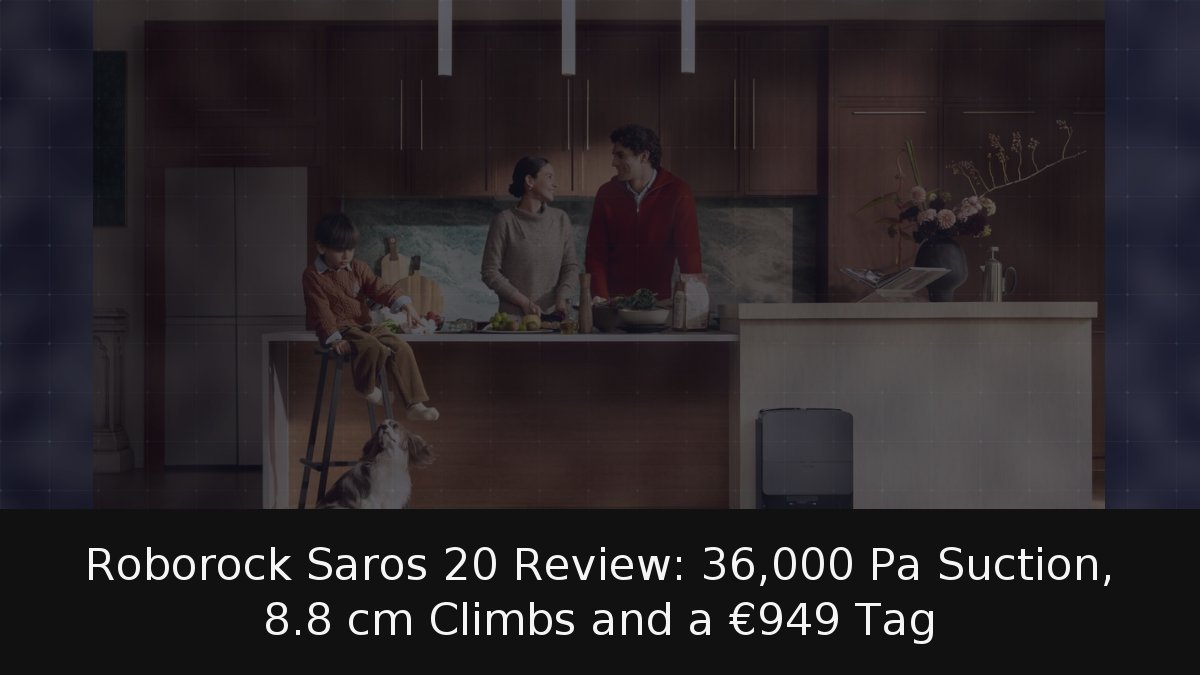
Roborock’s 2026 flagship has arrived in Spain at €949, and its headline upgrades are mechanical rather than cognitive. The Saros 20 debuts an AdaptiLift 3.0 chassis that scales stacked thresholds of up to 8.8 cm and a RockDock station that scrubs its mop pads in water heated to 100 °C. The navigation stack, by contrast, is inherited: the same ToF 3D architecture as the outgoing Saros 10R, refined through algorithm work rather than new sensing hardware.
That distinction matters because Roborock first showed the robot at CES 2026 on 6 January with no price attached, and the retail specification sheet has drifted upward in several places since Las Vegas.
- Bigger suction, higher price of entry: airflow rose from 35,000 Pa at announcement to 36,000 Pa at retail, while mopping pressure tops out at 13 N.
- Chassis is the real story: the robot clears a 4.5 cm step followed by a 4.3 cm step, spaced 12 to 14 cm apart — not a single 8.8 cm obstacle.
- Dock gets the second big upgrade: 100 °C mop washing, 55 °C air drying and up to 65 days of dust storage before human intervention.
- Eyes stay the same: obstacle avoidance improves from 200+ to 300+ recognised object types purely through software, according to Roborock’s own FAQ.
Same sensors, sharper algorithms
Roborock’s FAQ is unusually candid about where the generational gains sit. Asked whether obstacle avoidance has improved, the company confirms the Saros 20 keeps its ToF 3D navigation system, with StarSight 2.0 at the front and StarSight on the rear left, and that progress comes at the software layer. The marketing page, meanwhile, bills the hardware as “the new generation of 3D sensors.” Both statements can be true simultaneously, yet they describe very different upgrades for anyone stepping up from a 10R.
“It retains its ToF 3D navigation system,” with improvements delivered “at the software level through algorithm optimisation.”
The software gains are still measurable. The CES press release claimed recognition of more than 200 obstacle types; the current product page cites over 300, down to objects measuring just 2 × 2 cm. For scale, the 2020-era Roborock S6 MaxV dodged small objects with a dual front camera on a machine rated at 2,500 Pa — the Saros 20 multiplies that figure by more than fourteen. Roborock has also explored flashier territory, such as the Saros Z70 and its robotic pickup arm, but this model deliberately sticks to the fundamentals.
AdaptiLift 3.0: reading the 8.8 cm claim correctly
The headline threshold figure is a sum, not a single jump. Roborock’s own footnote splits it into a first step of up to 4.5 cm and a second of up to 4.3 cm, separated by 12 to 14 cm. A lone 8 cm ledge is outside the promise — the ceiling for one hop is 4.5 cm. Even so, that comfortably outclasses the limits other vendors publish for mainstream rivals, where figures in the 1.6 cm to 2 cm range are typical. The mechanism pairs liftable main and auxiliary wheels with a climbing arm, and the robot can raise its front, rear, left or right section independently to free itself when wedged.
On carpets the chassis rises dynamically to hold suction on pile up to 3 cm, though the deep carpet mode that unlocks the full behaviour must be switched on manually in the app. Clearance is equally conditional: the body measures 7.98 cm yet squeezes under furniture at 7.95 cm by compressing its front edge slightly — and Roborock’s small print warns that “scratches may occur.” Edge work relies on the FlexiArm side brush reaching skirting boards as low as 2 cm and an extending side mop, with the company claiming 100% edge and corner coverage and 0 mm of gap based on internal testing. The DuoDivide main brush and FlexiArm side brush carry a 0% hair-tangle claim, again from manufacturer tests.
RockDock and the mopping stack
The base station washes pads at up to 100 °C, dries them with 55 °C air and holds roughly 65 days of debris. TÜV Rheinland found the default wash cycle removes 99.99% of bacteria from the pads, although the fine print concedes the 100 °C peak holds at standard atmospheric pressure and drops at altitude. Automatic warm-water refill, detergent dosing, pad detachment before carpets and a 2.5-hour charge — 40% faster than earlier models, per Roborock — round out the package. The dock itself measures 381 × 475 × 488 mm and weighs 10.54 kg, so it needs dedicated floor space.
In normal mopping the twin pads spin at 200 rpm with 8 N of downforce; when grime is detected, the robot lifts its omni-wheels to load extra weight onto the pads and reaches 13 N. That maximum once again depends on manually enabling the deep-clean mode for stubborn stains.
A week of use: where it earns the money
In practice the thresholds are the standout — climbing stacked steps this cleanly is not something most robots manage. Battery endurance proved far stronger than rival machines, to the point where mopping cycles never needed interrupting for a recharge, and the low profile slips under furniture as advertised. The app is among the most granular seen in this category, with per-room settings, routines, water levels, pass counts, remote camera access and obstacle review with photos pinned to the map. Connectivity covers Matter, Alexa, Siri and Google Home, the “Hello Rocky” voice assistant answers even without Wi-Fi, and the robot carries a 6,400 mAh battery inside a 5.05 kg body.
The verdict is a well-executed evolution marketed as a revolution. The legs are genuinely new, the dock’s 100 °C wash is a real step forward, and 13 N of scrubbing pressure is quantifiable progress. The eyes, however, are the previous generation with better firmware — a nuance Roborock discloses in its FAQ but not in its headlines. Buyers upgrading from a three- or four-year-old robot will feel every euro of the €949 outlay; Saros 10R owners should weigh the decision almost entirely on threshold clearance, dock capability and mopping force, since the intelligence layer has changed far less than the spec sheet suggests.
Sources & References