
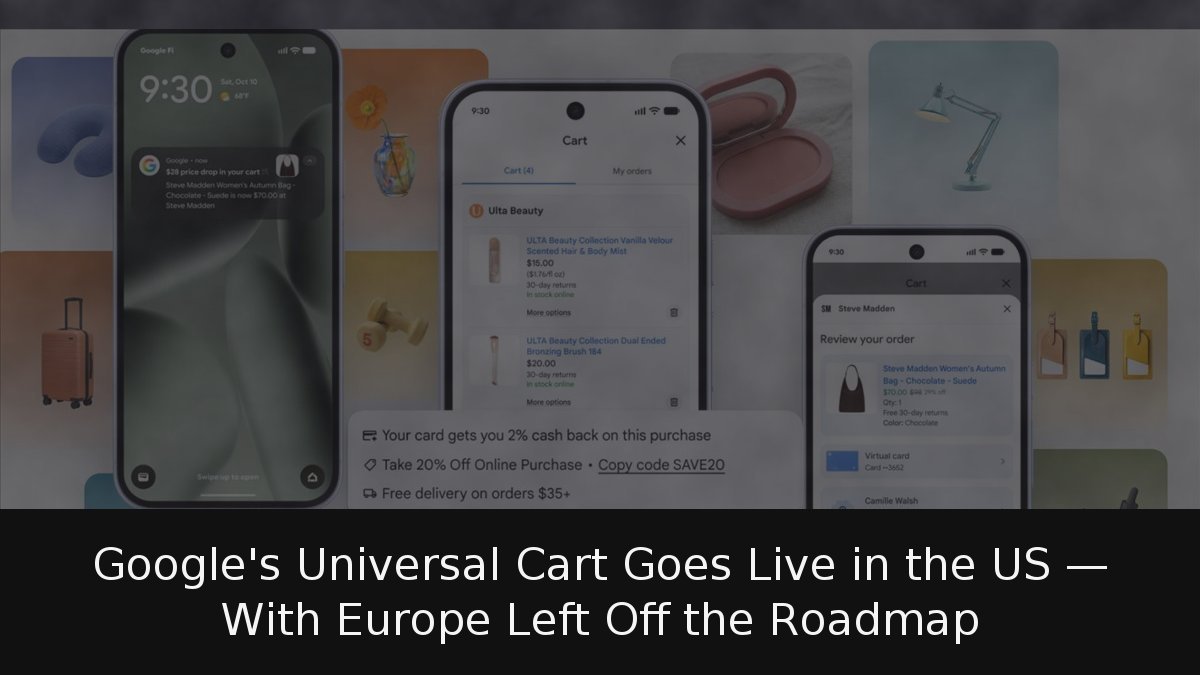
Google’s long-promised Universal Cart is now live for shoppers in the United States, appearing inside both Google Search and the Gemini app. Announced on October 15 in an official company blog post signed by Suresh Ganapathy, senior director of product for consumer shopping, the tool lets people collect items from competing merchants, monitor price movements and complete checkout without leaving Google’s own surfaces. Its timing is deliberate: it lands squarely ahead of the American holiday shopping season.
- One basket, many stores: products saved from Search’s AI Mode or the Gemini app land in a single cart that persists across both.
- Price and stock watch: alerts are powered by the more than 60 billion product listings in Google’s Shopping Graph.
- No EU launch: Google has not said Universal Cart is coming to Europe, and Brussels fined the company €890 million over the Digital Markets Act less than three months ago.
What the cart actually does
Universal Cart keeps one persistent list of saved products. A handbag added from AI Mode in Search is still sitting there hours later when a sweater is dropped in from Gemini, replacing the usual sprawl of open tabs and screenshots. Google distils the pitch into four capabilities: saving items from multiple retailers, tracking prices and availability with notifications when something gets cheaper or comes back in stock, surfacing savings through Google Wallet — which reads the perks attached to a user’s saved cards and suggests which one to pay with, alongside relevant promo codes it finds — and finally paying.
That last step happens either through Google Pay in a few taps or by handing the basket over to the retailer’s own checkout. Simplified payment is available with Nike, Sephora, Target, Ulta Beauty, Walmart, Wayfair and a wide range of Shopify sellers. Crucially, the merchant remains the seller of record, issuing its own confirmation and handling customer service.
A quieter debut than the May pitch
The product showed up later and leaner than originally advertised. In a May 19 post tied to Google I/O, Vidhya Srinivasan, vice president and general manager of Ads and Commerce, said the cart would reach Search and Gemini in the United States “this summer.” It arrived in mid-October instead. That earlier announcement also described features the launch post never mentions — among them warnings about incompatible components when assembling a PC from parts bought at different stores — and promised a later expansion to YouTube and Gmail with no date attached.
Beneath the interface sits the Universal Commerce Protocol (UCP), the open standard Google introduced earlier this year so that AI agents and retailers can interoperate across the entire purchase journey, checkout included. Google positions it next to its Agent Payments Protocol (AP2), designed to let an agent buy autonomously within limits the user sets, and which the May post said would reach Gemini Spark first.
Why Europe is missing
Google has made no commitment to bring Universal Cart to the European Union. Its May roadmap promised to extend UCP-based payment to Canada and Australia “in the coming months” and then to the United Kingdom — the EU never appeared. The omission is hard to read as accidental. On July 23, 2026, the European Commission fined Google €890 million for breaching the Digital Markets Act: €460 million for favouring its own services in search results covering shopping, hotels, transport and sports, and €430 million over Google Play restrictions. The Commission gave the company 60 days to correct both practices.
By design, Universal Cart is precisely the sort of product the DMA was written to scrutinise: a first-party cart embedded in Google’s results, aggregating offers from rival merchants and settling payment through a Google system. The open questions are structural rather than conspiratorial — which stores surface in the cart, in what order, and who decides which offer wins when two retailers sell the same item.
Racing Amazon, OpenAI and Meta
Universal Cart is the pragmatic half of a two-track strategy Google itself describes: agents that act on a user’s behalf, and tools that keep the human in control. The cart belongs to the second track, leaving the final decision with the shopper. It joins a growing cluster of AI shopping features, including conversational product discovery in Search’s AI Mode and “Let Google Call”, which dispatches an agent to phone nearby stores and check stock.
Rivals are moving in the same direction. Amazon, OpenAI and Meta have all added agentic commerce capabilities, while Shopify has opened its platform to let more AI agents browse and buy from its listings. Payment networks are preparing too: Mastercard has begun issuing virtual cards so that AI agents can transact on a user’s behalf. Google’s starting position, though, is hard to match — in its May post the company said people shop through Google more than a billion times a day.
For American shoppers, the upside is concrete: comparing and tracking prices across stores is tedious, and few will mourn the twenty open tabs. For retailers the arithmetic is subtler. Remaining the official seller is fine on paper, but when the cart, the price alert and the pay button all live inside Google, the direct relationship with the customer thins with every transaction. The delay, the missing features and the silence about Europe collectively tell a more revealing story than the launch itself: this is a cautious first version, shipped first in the market where no recent self-preferencing ruling hangs over the company. The real question for the coming months is not whether the cart crosses the Atlantic, but in what shape — a version that treats every merchant identically would be a genuinely different product from the one running in the United States today.