
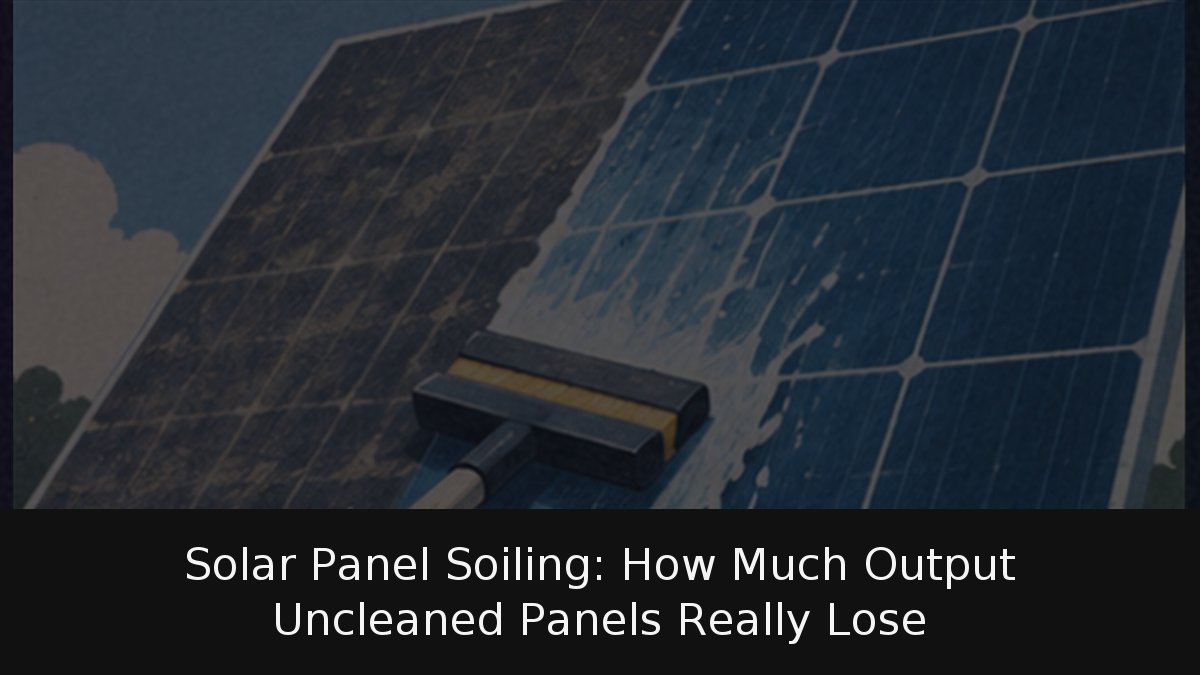
Nobody warns you at the point of sale what happens when a photovoltaic array goes months without rain and dust settles across the cells. The efficiency penalty is real, measurable and — in many cases — avoidable with basic upkeep. The International Energy Agency estimates that soiling costs residential installations between 4% and 7% of annual yield in moderate climates. In regions with heavy dust, pollen or industrial pollution, that figure climbs sharply higher.
- Baseline losses: The IEA puts soiling losses at 4%–7% of yearly output for typical residential systems in temperate zones.
- Worst-case scenarios: Dry Mediterranean and arid sites can shed 8%–15% of production in under three months without rainfall.
- The cost question: Professional cleaning in Spain runs around $200 (≈€188), so whether it pays off depends entirely on how dirty your panels actually get.
What soiling really costs in lost generation
Manufacturers prefer to talk about nameplate performance under ideal conditions. Degradation data tied to dirt comes from research centres, not sales brochures. In Mediterranean and arid climates with long dry spells, dust build-up can cut output by 8% to 15% in less than three months without rain. A study by the NREL (National Renewable Energy Laboratory in the US) measured losses of up to 15% during high-pollen periods in densely vegetated areas during spring.
Research from the University of California San Diego narrowed the picture further, analysing 145 consecutive rain-free days at a continuously tracking installation and recording a cumulative production loss of 7.4%. Because the study controlled for temperature, tilt angle and solar irradiance, the share attributable purely to soiling was cleanly isolated. For a 5 kWp array — a typical residential size — a 7.4% shortfall over five months amounts to losing the full output of several sunny days.
In one monitored residential case, an array that endured 87 days without significant rainfall in the summer of 2024 delivered 9.2% more production on the modules cleaned midway through the dry spell than on the ones left untouched. It was not a controlled scientific experiment, but the result is consistent with published literature. Soiling composition also matters: mineral dust, organic aerosols, fungal spores, bird droppings and industrial particles behave differently in terms of opacity and adhesion. Oily particles, often of industrial or traffic origin, cling far harder than dry dust and demand wet cleaning to be removed effectively.
Pollen is the most underrated enemy of a PV array
Pollination season on the Iberian Peninsula runs from February to June, overlapping precisely with the year’s strongest solar radiation. The irony is that the weeks with the greatest production potential are also the ones that punish panels hardest through pollen films.
Pollen does not behave like dust. It does not pile up in thick layers that rain washes away easily. It sticks as a thin film — almost invisible to the eye — that nonetheless diffuses light at the photovoltaic cell level. Surface microscopy studies show cells coated in pollen film capturing fewer photons, a deficit that performance instrumentation does not always flag immediately but that compounds week after week.
Dry cleaning with a brush or blower removes dust but leaves adhered pollen behind. Wet cleaning with deionised water, or tap water and a soft-bristled brush, clears both. NREL laboratory data indicates that a properly executed wet clean improves performance by 5% to 11% relative to the pre-cleaning state, with the biggest gains where soiling has been allowed to accumulate longest.
Does professional cleaning pay for itself?
Professional solar panel cleaning in Spain costs roughly $200 (≈€188) for a standard residential installation, with a typical range of $142 to $310 (≈€133 to €291) depending on roof height, accessibility and module count. US market data published by HomeAdvisor puts the average at $209 (≈€196), with significant regional variation.
The payback calculation is straightforward. An array producing 6,000 kWh a year loses 420 kWh to a 7% soiling penalty. At €0.15/kWh — a common average purchase price under self-consumption contracts with surplus — that equals €63 of forgone production. Against a €188 cleaning bill, twice-yearly servicing is not economically justified at that loss rate. But at a 12% penalty, entirely plausible in a dry summer, a single annual clean clears its own cost.
Recommended frequency therefore varies by location. Where rainfall is regular, one cleaning a year suffices. In dry Mediterranean zones or areas with heavy pollution, two sessions — one before summer, one before winter — optimise output. Real-time production monitoring helps here: unexplained dips that meteorology cannot account for usually point to concentrated soiling on one or several modules.
Beyond averages: hotspots and permanent degradation
Soiling has consequences beyond average yield. Hotspots — localised heat generated when a single cell is partially shaded by dirt — can degrade a panel permanently if they persist. A speck of dust, a bird dropping or an organic fragment shading one cell while its neighbours bask in full radiation creates an electrical imbalance that generates heat in that cell. Over time, the heat degrades the encapsulant and can trigger microcracks.
For anyone in the Levante, the arid southeast or the Canary Islands, rain-free stretches of that length are routine rather than extreme, which makes waiting for precipitation a non-strategy for panel upkeep. Maintenance is neither optional nor cosmetic: it is the implicit clause in the contract between promised and delivered performance. The data to decide whether cleaning is worth the expense — or whether to simply absorb the losses — is already out there for anyone willing to run the numbers.