
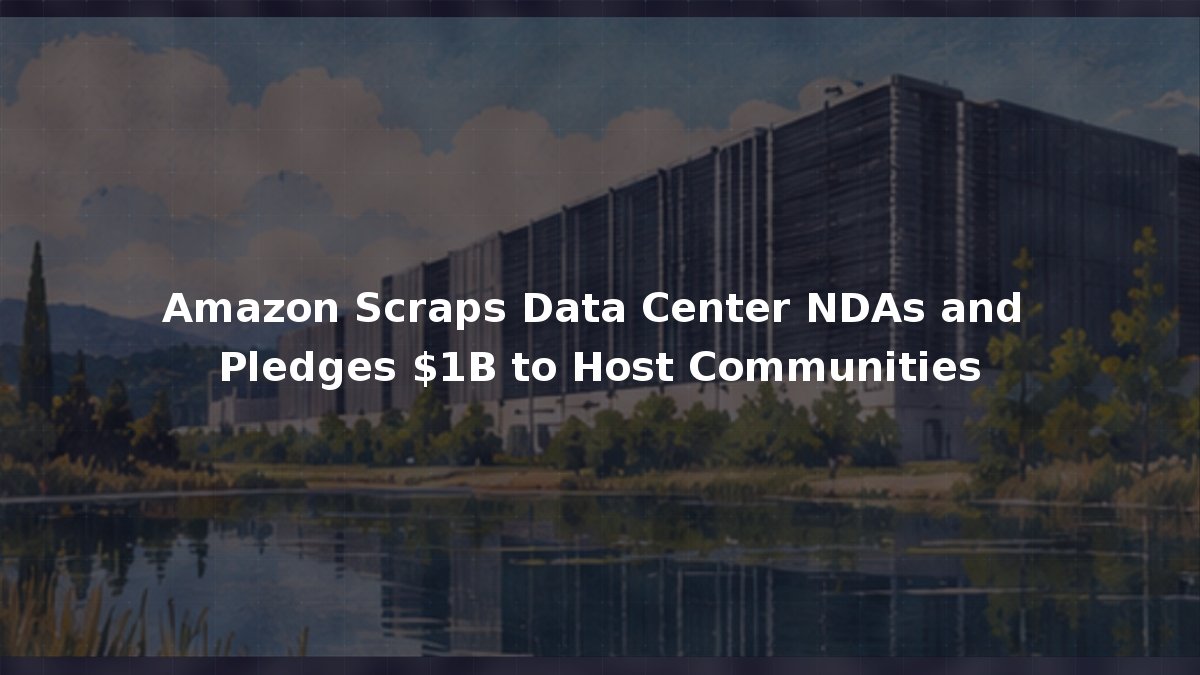
Amazon Web Services has quietly retired one of the most criticised tools in its data center playbook: the nondisclosure agreement. AWS chief executive Matt Garman confirmed the shift in a single line buried inside a long blog post defending the company’s infrastructure buildout, stating that Amazon no longer uses NDAs with the government agencies it negotiates with when seeking approval for new facilities. The admission lands at an awkward moment for the industry: more than 100 data center moratoriums are now under consideration across the United States, and New York has already imposed a one-year pause on permits for large facilities.
- NDAs are gone: AWS says it will no longer require confidentiality agreements with public agencies handling its data center projects, a practice that let officials stay silent about projects before residents knew anything was planned.
- Money is on the table: A new initiative called Built Together adds more than $1 billion over five years for education, workforce training, energy affordability and water programs, on top of the roughly $1 billion Amazon says it spent on host communities over the past three years.
- The numbers are contested: Amazon’s claims on water, electricity and emissions are self-reported and largely unaudited, while independent watchdogs point to a 76% annual price jump on the country’s largest grid.
- Trust is the real battleground: Even sympathetic observers frame the backlash as a credibility problem rather than a statistical one.
From Secrecy to Open Houses
The mechanics of the change matter as much as the headline. Under the new commitment, AWS says it will hold community open houses, release project details earlier in the development cycle, and publish annual figures covering energy consumption, water use and the share of electricity drawn from carbon-free sources. Whether local governments then pass those records on to residents remains a separate question, and Amazon has not committed to per-facility reporting of the kind scientists have requested.
Confidentiality agreements became a flashpoint precisely because they inverted the normal order of local democracy: permits secured, land bought, and only then a project revealed. Environmental activist Erin Brockovich has said transparency is the single most common complaint she hears, describing communities that learned about installations after the fact and officials who signed NDAs before neighbours had any idea a site was under study. Amazon’s decision follows a similar pledge from Microsoft, which committed in March 2026 to stop requesting NDAs from local governments, with narrow exceptions for trade secrets.
Alongside the transparency pledges sits a substantial spending package. Amazon projects that more than 300,000 students could gain access to free community college, that energy efficiency retrofits will cover more than 300 schools and community buildings plus 30,000 homes, and that participating households could cut bills by 20% to 40%, roughly $700 a year. The company also says it aims to train up to 100,000 workers annually by the end of 2028, supported by three existing Modular Training Centers with six more under development and 16 planned.
Four Myths, Two Sets of Numbers
Garman used the post to attack four claims: that data centers guzzle water, inflate electricity bills, pollute heavily and deliver little local value. On water, an Amazon report puts direct data center consumption at about 0.5% of US industrial water use, a figure the company says is orders of magnitude below golf courses or almond farming. Critics counter that this excludes water consumed in power generation and chip fabrication, and note that no federal or state rule obliges operators to report the data at all.
On electricity, Garman argues rates have climbed only in some states with heavy data center density, driven mainly by ageing grids that were not expanded ahead of demand. An independent watchdog reached a different conclusion, attributing the principal role in the 76% year-over-year increase on the largest US grid to data centers. Both readings describe the same phenomenon, and the gap between them is part of why the debate has stalled.
On emissions, Amazon points to a planned Texas facility permitted to emit 33 million tons of CO2 annually — more than any power plant in the country — while insisting its backup generators sit idle 99.9% of the time and run roughly ten hours a year. Plausible on its face, the claim rests on company statements rather than independent measurement. On efficiency, Amazon reports a global power usage effectiveness of 1.14 for 2025, against an industry average of 1.25, though it does not separate conventional cloud sites from far denser AI facilities.
Why the NDAs Were the Easy Part
Anthropic chief executive Dario Amodei recently described the AI backlash as “fundamentally a crisis of trust,” in which people assume governments and technology companies are always “scheming up some new way to screw them over.”
Writer Jasmine Sun has made a similar observation: when opponents hear the industry’s arguments, the standard reply is simply that they do not believe them. That is the structural problem Amazon cannot solve with a press release. Ceasing to sign an NDA is verifiable and cheap; publishing audited, installation-by-installation water and power consumption is neither. The European approach offers a contrast worth watching — Spain is drafting a decree that would require data centers to run on 80% renewable energy on an hourly basis or lose grid connection, the toughest standard on the continent. A legal obligation can be breached and penalised; a voluntary commitment cannot.
Amazon’s move is directionally right, and the political pressure clearly worked. But the company continues to frame the argument around statistics it generates itself, while the communities bearing the load are asking for evidence they can check. With moratoriums multiplying and data center siting already surfacing as an election-season issue, the next test will not be a pledge — it will be whether AWS actually publishes the numbers. If it does not, the backlash will simply find a new target, and the industry’s most valuable scarce resource will remain the one thing it cannot build: local consent.
Sources & References
- Amazon Ends Use of NDAs With Government Agencies as Data Center Backlash Grows
- Amazon ends secret data center pacts and pledges $1 billion to host towns — AWS promises 30,000 home efficiency retrofits amid 100 proposed bans
- Amazon drops NDAs with government agencies in data center push
- Data Center Backlash Hits Amazon
- Amazon Ends Data Center Secrecy, Pledges $1 Billion to Communities