
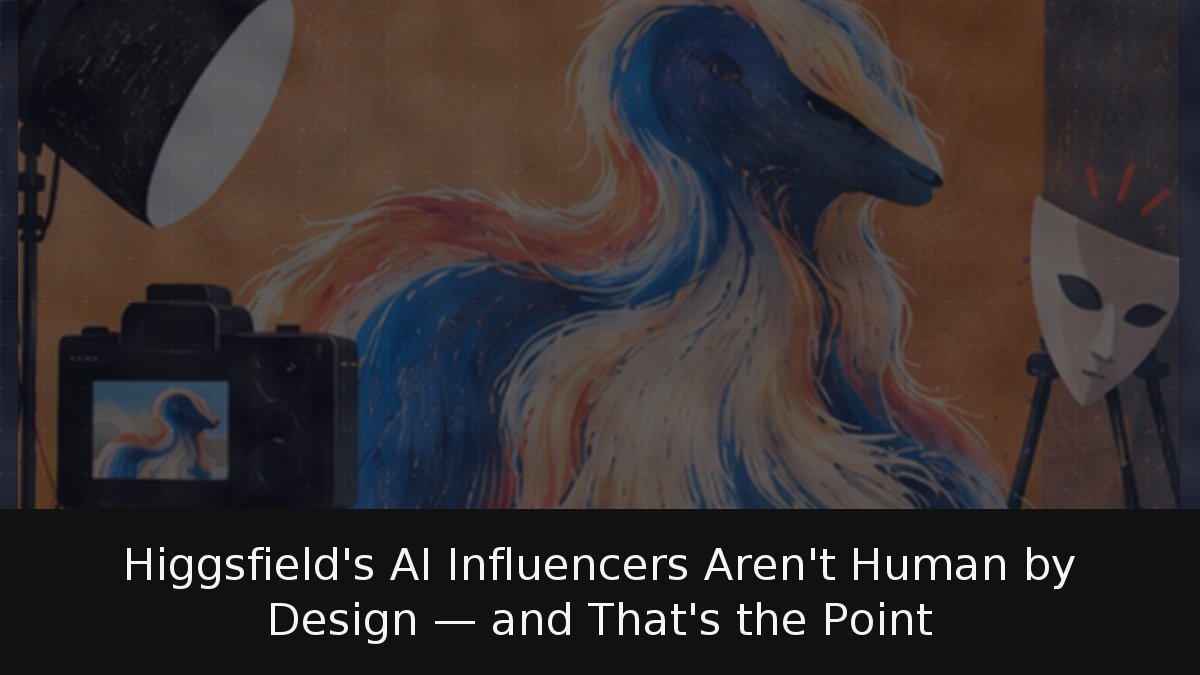
Higgsfield is betting that the next generation of AI influencers will not look human at all. On October 7, 2026, the AI video startup updated its synthetic-persona tool so users can insert a custom character into footage that already exists. The look it encourages is deliberately strange: geometric haircuts, elongated necks and exaggerated proportions no viewer could mistake for a real person.
The company says it now serves 30 million users and runs at an annualised revenue rate of $1 billion, roughly €890 million. Social channels framed the release as a brand-new launch, but the underlying product has existed since January 2026.
- An update, not a debut: AI Influencer Studio shipped in January; the October refresh focuses on ease of use and a distinctive visual identity.
- Big claims: 30 million users, $1 billion in annualised revenue, and $400 million raised at a $5.4 billion valuation.
- Style as strategy: Non-human designs stand out — and may sidestep the most heavily policed labelling rules.
- Caveats: User figures vary by source, and the company’s content record is under scrutiny.
What AI Influencer Studio actually does
The tool behaves like the character editor inside a video game. According to the company’s documentation, it exposes more than 100 parameters governing identity, movement and style, and it is not restricted to human figures: creatures, hybrids and anthropomorphic animals are all supported. Crucially, a character keeps the same identity across scenes, costumes and lighting setups — the technical hurdle that has long made this kind of content feel inconsistent. From that base, a persona can be made to speak, dance or review products.
Why deliberately weird wins
After two years of flawless AI faces, audiences have learned to recognise them. A face without a single imperfection now reads as artificial — and, worse, as generic.
“A perfect face is the fastest way for a character to look like generic AI.” — a Higgsfield spokesperson
There is a second, less aesthetic reason. A character that never pretends to be a person deceives less, which the company presents as a more transparent use of the technology than a deepfake: nobody believes a figure with a neck twice the normal length is real.
That argument only stretches so far. Transparency about appearance is not transparency about who operates the account, who pays for the message or what is being sold. An impossible avatar can recommend a product with the same opacity as a hired actor reading a script.
Fast growth, uneven numbers
Higgsfield’s headline figures are among the highest in the sector. The company raised $400 million, about €357 million, at a valuation of $5.4 billion — more than four times its $1.3 billion valuation in January. After launching its browser product in March 2025, it says revenue climbed from $300 million annualised in early 2026 to $500 million in June and $700 million in August, with $1 billion now circulating in financial coverage.
Those numbers warrant caution. They are self-reported and do not always line up: the user count ranges from 22 million in a June corporate document to more than 25 million on the company’s site and 30 million in the financial press, while one consultancy put revenue at $400 million for May just as the company was citing $500 million for the following month.
There is a track record to weigh as well. In February 2026, reporting revealed that the company’s marketing team had sent influencers AI-generated racist material as promotional content, and some users are now pushing memecoins with these characters.
Labels tighten and Europe builds its own play
Platform policy is closing in. Since September 1, Instagram has required AI-generated influencer profiles to carry a label or face reduced reach — a rule a Higgsfield character with its own account falls under. In Europe, the EU AI Act has mandated machine-readable marking of synthetic content since August 2, 2026, though whether a character designed not to resemble a human sits inside a disclosure rule aimed at content that appears authentic remains an open question.
Creator platforms already do something similar: AI-generated or AI-enhanced accounts on Fanvue, such as the virtual Barcelona model Aitana López, carry a platform AI badge.
In Europe, the business counterweight is Magnific, the brand under which Freepik consolidated its products on April 28, 2026. It bills roughly $230 million annualised, has passed one million paying subscribers, serves more than 250 enterprise clients and has never taken outside investment. On October 8 it introduced an image workflow that separates drafts from final generation and applies brand rules only at the last step.
The non-human aesthetic is a strong creative idea and a weak alibi. Advertising has adopted every new format before rules existed for it — sponsored blogs, brand videos, human influencers — and that pattern will repeat here at a far bigger scale. A person posts a handful of pieces a day; a synthetic persona has no ceiling. What stays scarce is not output but accumulated trust and the willingness to answer for what a character says.