
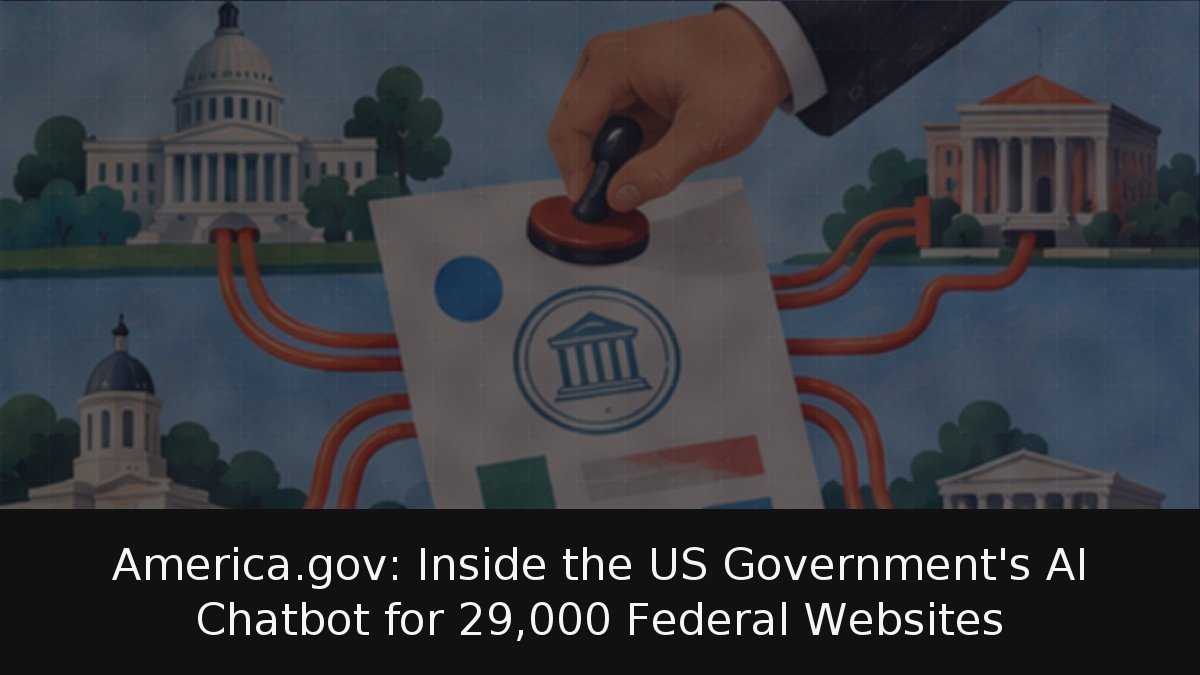
On 29 September 2026, the United States government unveiled America.gov, a single AI-powered portal that lets citizens ask questions in plain language instead of digging through more than 29,000 federal websites. For now it only answers questions and links each answer to an official source. The far bigger promise is scheduled for 2027, when the portal is meant to handle real transactions: applying for a passport, enrolling in Medicare or checking a student loan.
- A single front door: America.gov replaces manual browsing of tens of thousands of federal pages with a conversational interface that cites where each answer comes from.
- Information now, transactions later: the first release only informs and orients; passports, Medicare and student loans are promised for 2027.
- Open questions: the underlying model has not been confirmed, privacy guarantees are far easier to make before identity checks arrive, and the source pages themselves can be rewritten.
- Momentum beyond Washington: federal agencies are already building chatbots designed to plug into the portal.
What America.gov actually does today
President Donald Trump presented the portal in Washington alongside an executive order obliging every federal agency to integrate its public services into the platform. The executive order authorising the project was first signed in August 2025, with the launch phase announced at the end of September. The design is the work of the National Design Studio, led by Joe Gebbia, co-founder of Airbnb and the government’s first design director.
Gebbia likened the portal to the concierge of a good hotel. His example: someone who wants to change their surname asks how it is done, the system requests the new name and the marriage certificate, and it returns a list of steps, including those that depend on which state they live in.
The figures attached to the launch are striking. Trump claimed Americans spend more than 10 billion hours a year on public paperwork, while Gebbia said roughly 40 million people visit federal websites every day. Both were statements made at the event, without a published study behind them. From 2027, the portal is expected to move from answers to actions: passports, Medicare, student loans, national park passes and veterans’ benefits, plus status tracking for each application. Tax filing, intelligence and defence services are excluded.
The AI stack and the privacy ledger
The government has not disclosed which model answers queries. Gebbia has said the site was developed with help from Google’s Gemini and Grok, from Elon Musk’s company, but which of the two serves live questions remains unconfirmed.
On privacy, the official line is categorical: no personal information stored, no login required, no conversations retained, no user tracking, with a published policy that repeats the same commitments. Two caveats matter. The first is that these promises apply to a version that only informs — the moment the portal processes a passport it must identify the user, and storing nothing becomes impossible by definition. The second is that the site’s own FAQ warns the AI can make mistakes and advises verifying sources before acting on anything important.
Agencies are already building on top of the model. The Office of Personnel Management has released a beta workforce-data chatbot built on an OpenAI model that translates each question into SQL and shows users the exact query behind every answer, with integration into America.gov planned.
“It’s a beta. Use it, try to break it, and hit the feedback button,” said Adam Starr, chief information officer at the Office of Personnel Management.
Starr said the tool took roughly three months to build, is updated twice a month, and is designed to report what the data says rather than offer commentary or policy recommendations — a deliberately narrow remit that hints at how cautious agencies are about scope.
Provenance, tracking and sources that can be rewritten
The first line of criticism concerns who built it. The National Design Studio is staffed by former members of DOGE, the efficiency department pushed by Musk and since dismantled, and has been described as an evolution of that project, more focused on user experience than on cutting headcount.
The second concerns track record. An investigation published this summer found the studio had used commercial visitor-tracking software on sites that did not meet federal privacy standards, while experts have warned that automating accessibility testing with AI could worsen access for people with disabilities.
The third is the most serious. The chatbot answers from what official pages say, and this administration has deleted and rewritten public pages. If the source changes, the answer changes, and the citizen cannot see the difference.
Political context does not help. Polling cited during the launch found that 60% of likely voters want more AI regulation, while a separate survey found 71% of adults believe greater AI use will make their personal information less safe. Academics reviewing the launch raised parallel concerns: one computer scientist questioned whether a new interface addresses the systemic problems people face, and warned that a centralised database is also a centralised place to alter the answers, while another argued the platform should be judged on whether it reduces the error rate compared with humans reading websites.
The lesson for other governments
Comparable projects are spreading at state level. Georgia’s secretary of state has launched GABBY, a chatbot grounded in his office’s own website, with the explicit goal of cutting call-centre demand. “Georgians shouldn’t have to spend their time searching through a government website or waiting on the phone to get a simple question answered,” said Secretary of State Brad Raffensperger. California runs Poppy, a generative assistant restricted to state workers and confined to official government pages.
For European administrations, the instructive part is not the chatbot. Countries such as Spain already have a common digital identity for dealing with government, through Cl@ve and electronic certificates, with the European Digital Identity Wallet on the way. What is missing is precisely what America.gov attempts: one entry point that understands what a person is trying to do. Anyone who has tried to pay a fee or book an appointment knows the hard part is rarely proving who you are — it is working out which office, which form and in what order. The decisive piece of the American model is therefore not the language model but the executive order forcing every agency to connect.
Expect 2027 to deliver fewer live procedures than promised, and to bring the first high-profile case of a confidently wrong official answer. That will not invalidate the idea. It will be the moment when accountability — an audit trail for every response, a right of appeal and a human being at the other end — stops being a footnote and becomes the product.