
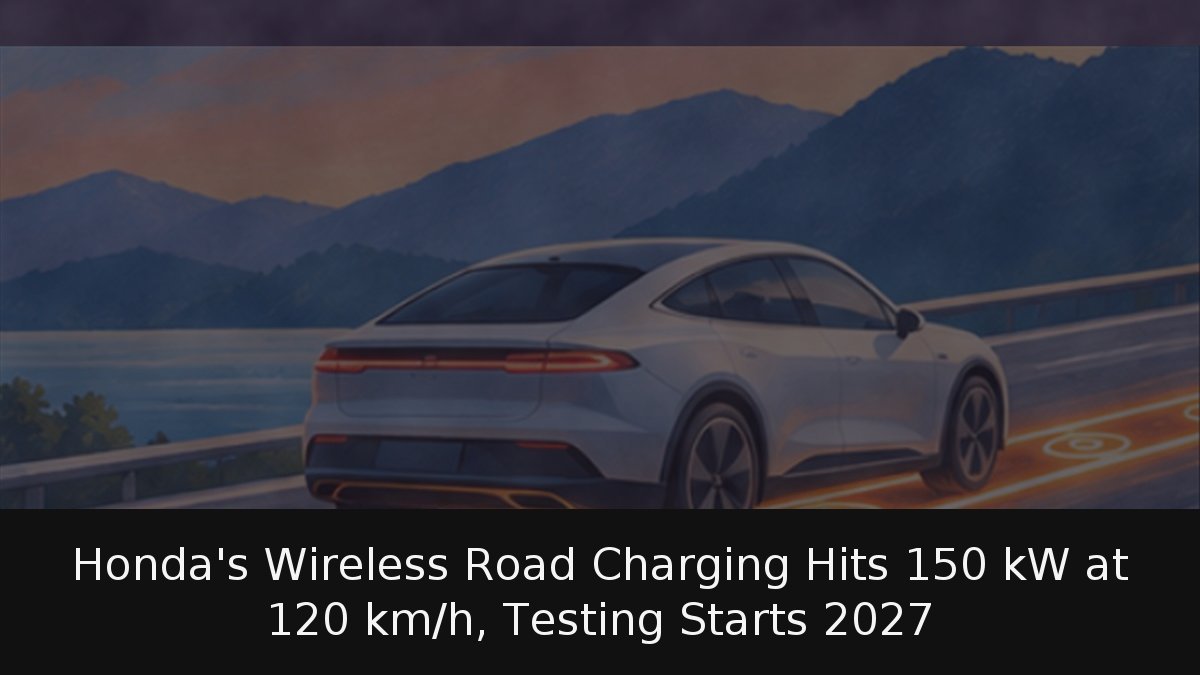
Honda R&D, together with construction group Taisei Corporation and its road-building subsidiary Taisei Rotec, is taking wireless EV charging out of the lab and onto public asphalt. The partners plan to demonstrate dynamic wireless power transfer (DWPT) on a 300-metre stretch of the Tateyama Expressway in Chiba Prefecture, outside Tokyo, from fiscal 2027. The system is engineered to feed up to 150 kW into vehicles moving at 120 km/h — Japan’s expressway speed limit — without the driver ever plugging in.
The project, run with expressway operator East Nippon Expressway Company, is the clearest sign yet that charging-while-driving has crossed from science fiction into serious civil engineering. Honda has been developing the core technology since 2021, and its engineers pitch the payoff in hardware terms: fewer battery cells, lighter vehicles, cheaper electric cars.
- Japan first: A 300-metre test section on the Tateyama Expressway in Chiba begins in fiscal 2027, following a durability test road built in late 2026.
- Trucks lead: Honda is targeting freight and logistics first, where charging downtime erodes fleet productivity, though the system also covers passenger cars.
- Europe is ahead: France already delivers more than 200 kW to a truck, a bus and a car simultaneously on the A10 corridor.
How a highway pushes 150 kW into a moving car
The architecture is inductive coupling scaled up from the charging pad on a nightstand. Transmitter units buried beneath the pavement generate a magnetic field; a receiver mounted under the vehicle captures that energy and routes it to the battery while the car or truck keeps rolling. The hard part was never the physics — it is holding clean magnetic alignment and managing thermal and electrical load at highway speed.
Honda’s design uses a DC distribution system in which each ground unit integrates both an inverter and a charging coil, a consolidation that cuts wiring, component count and installation labour compared with more distributed layouts. The hardware is also shaped to be milled into sections cut from existing pavement, so installation could ride along with routine resurfacing instead of demanding full reconstruction. One firm boundary applies: an ordinary EV cannot use the system without a compatible receiver and its associated power electronics fitted underneath.
Europe’s charging roads already run past Honda’s test strip
Japan is not setting the pace. On a stretch of the A10 south-west of Paris, a consortium involving Vinci Autoroutes, Vinci Construction and Gustave Eiffel University delivers more than 200 kW and charges a truck, a bus and a car at the same time. France is targeting 5,000 km of electric road by 2030 and 9,000 km by 2035.
Germany has a one-kilometre electric road near Balingen, built in phases from 400 metres along a public bus route. Sweden announced a 21 km permanent electric road on the E20 in 2023 with an opening planned for 2026, though its current operational status has gone largely unexplained. Elsewhere, Florida has planned a roughly three-quarter-mile wireless charging section on State Road 516 with a reported design target of up to 200 kW.
The freight-first strategy has a financial logic. An average logistics depot needs ten to twenty times its present power capacity to run an electric fleet, and new grid connections take years to secure — a bottleneck that recently attracted €22 million in financing for depot upgrades. Putting the charger in the road moves that problem off the depot entirely.
Why the calendar says 2027, not 2026
Durability, not speed, governs the timeline. A separate test road due for construction in late 2026 will subject the pavement to the equivalent of one million wheel-load cycles at 49 kilonewtons per wheel, using vehicles around 20 metric tons. That stress test answers whether the road survives heavy traffic — not whether it charges well.
Honda has published no commercialisation date, installation cost, operating cost or power-transfer efficiency figure, and its 150 kW and high-speed targets remain verification objectives rather than confirmed results. Pavement repairs, servicing failed components under live traffic, limiting electromagnetic field leakage and agreeing interoperability standards between road transmitters and vehicle receivers all remain unsolved. Without a standard comparable to CCS or CHAdeMO, every manufacturer would need its own bespoke system.
Honda says it remains committed to “pursuing the development of new technologies and offering new services with an eye toward widespread use of EVs in the future,” even after pivoting away from battery-electric vehicles earlier this year.
Honda’s chief engineer of research and development, Taku Ueda, argues the technology could shrink battery packs in future electric cars and ease public anxiety about where to charge — a genuine engineering argument, since smaller batteries mean lighter, cheaper vehicles and less road wear.
For now, the milestone to watch is narrow and specific. A successful Tateyama demonstration would prove that the pavement survives heavy use and that wireless transfer holds up at road speed. Fleet trials, regulatory approval and a viable maintenance model would still lie ahead before any freight corridor runs on a charging road.