
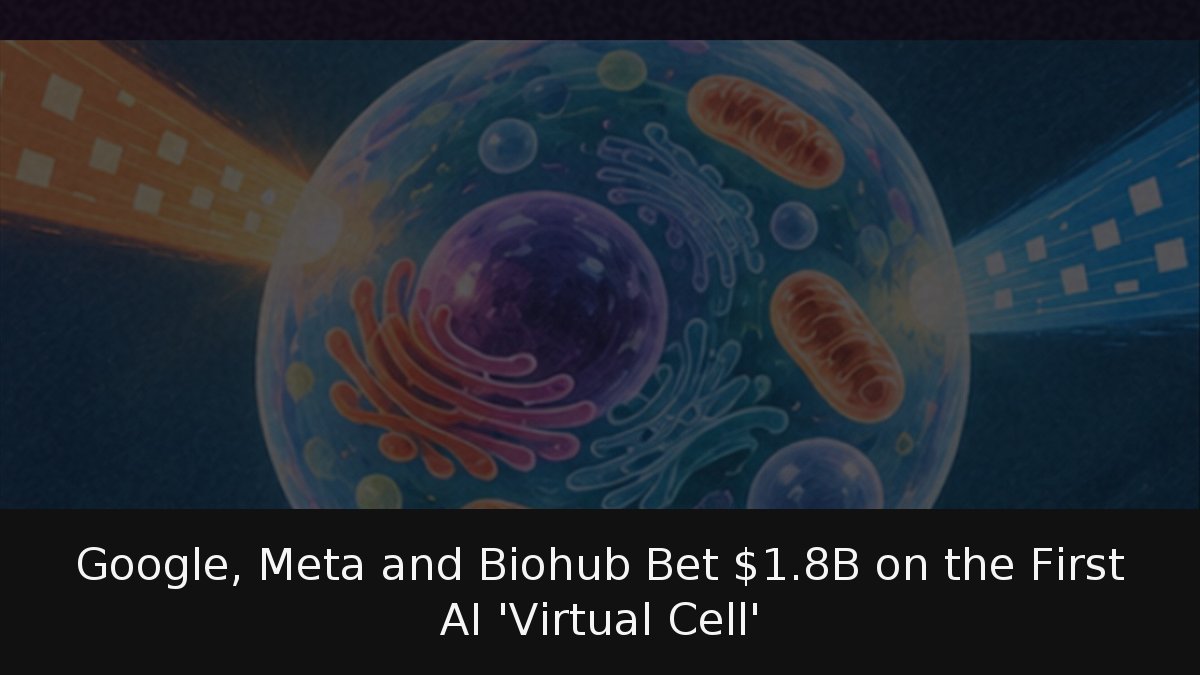
A cross-sector coalition led by Biohub, Google DeepMind, Meta and Isomorphic Labs — with backing from two US federal agencies — has committed roughly $1.8 billion to build the first predictive “virtual cell”: an AI model engineered to simulate how living cells behave, sicken and respond to treatment. Announced on October 7, 2026 under the banner of the Virtual Biology Initiative, organisers describe it as the largest coordinated investment in AI-ready biological data ever assembled. If it works, researchers could run thousands of experiments on a computer before ever touching a lab bench.
- Who is paying: Biohub anchors the effort with $500 million; the Department of Energy adds more than $500 million over five years; the NIH contributes datasets built through more than $500 million in prior federal funding; Google DeepMind, Isomorphic Labs and Meta add a combined $300 million.
- What it builds: Open, AI-ready datasets spanning cell types, states and perturbations — the raw material for models that predict biological responses.
-
Who leads the science:
Alex Rives, Biohub’s head of science and the Meta researcher behind the ESMFold protein-structure system. - The timeline: A first dataset is expected in about a year, with a working virtual cell targeted within five years — work Rives says would normally take decades.
Inside the $1.8 Billion Funding Stack
Biohub, the nonprofit biomedical research organisation founded in 2016 by Mark Zuckerberg and Priscilla Chan, anchored the initiative in April 2026 with $500 million. Of that, $400 million flows into new measurement technologies — cryo-electron tomography capable of resolving near-atomic detail inside a cell, high-throughput microscopy that images millions to billions of cells in living tissue, and molecular engineering tools. The remaining $100 million funds research outside Biohub.
The Department of Energy’s contribution runs through its Genesis Mission, drawing on exascale supercomputing, X-ray and neutron scattering, cryo-electron microscopy and tomography, and autonomous laboratories across the National Laboratory system. Darío Gil, the DOE’s Under Secretary for Science and director of the Genesis Mission, said the partnership pairs the department’s computing and measurement assets with Biohub’s models and biological data capabilities, setting what he called a new standard for open science.
The NIH is not writing a fresh cheque. Through its Bio Genesis Mission — part of a federal effort under Executive Order 14363 aiming to double the pace of biomedical innovation within five to 10 years — the agency pools datasets, repositories and knowledge bases funded by more than $500 million in earlier federal investment, which Biohub will standardise for AI training.
By combining resources and expertise, we can accelerate the development of universal cell models with sufficient biological complexity to predict how any cell responds to an intervention.
That assessment comes from Nicole Kleinstreuer, NIH Deputy Director for Program Coordination, Planning, and Strategic Initiatives. On the private side, NVIDIA is supplying accelerated computing infrastructure, software and technical expertise, while the Allen Institute, Broad Institute, Gladstone Institutes, Human Cell Atlas, Human Protein Atlas and Wellcome Sanger Institute are among the scientific partners.
What a Virtual Cell Actually Is — and Why Data Is the Bottleneck
A virtual cell is not a 3D rendering. It is a mathematical model precise enough to predict how a cell reacts to a perturbation — a drug, a mutation, a shift in its environment — without running the physical experiment. Protein-structure systems and genomic regulation models are pieces of the puzzle; Biohub is chasing the layer above them, a unified model integrating genomic regulation, the proteome, the metabolome and extracellular signals.
The obstacle is scale. Rives told Reuters that today’s cell datasets run to hundreds of millions of cells, while an accurate predictive model will need billions and eventually trillions. The initiative is designed to close that gap through spatial transcriptomics, which maps molecular activity inside intact tissue, and screening methods that record how cells react to changing conditions.
An accurate predictive model of biology could dramatically accelerate scientific discovery by enabling scientists to perform experiments digitally. The creation of a virtual cell is one of the most important challenges for the next era of science. It will require coordinated data generation efforts at a national and international scale, which is why these partners are coming together.
Open Science, With an Asterisk
Two conditions shape how the results reach the wider community. Corporate funders gain a fixed period of early access to the datasets before they become publicly available, while government-funded work carries no such restriction. Separately, the research institutes involved have agreed not to publish results generated by the virtual model for twelve months once it is operational, allowing internal validation and peer review to run first — an unusual commitment, and arguably a stronger indicator of scientific seriousness than the headline figure.
Biohub’s track record provides context: the organisation launched with $600 million from the Chan Zuckerberg Initiative’s $3 billion pledge, built a cluster of more than 1,000 NVIDIA H100 GPUs in 2023 to model cells, and has produced resources including Tabula Sapiens, OpenCell and CELLxGENE. The broader field is heating up too — Anthropic has stood up its own wet lab, and the OpenAI Foundation has launched a grant programme worth more than $125 million for biological and medical datasets.
Where the Payoff Would Land
Oncology is the most immediate and economically significant target. Tumours are extraordinarily heterogeneous: the same mutation can trigger different responses across tissues and patients. A model that simulates that variability before clinical trials could sharply cut the cost and time required to develop targeted therapies. Cellular ageing is the second frontier, where understanding which signals regulate senescence — including research into extracellular vesicles — depends directly on the kind of simulation this initiative is chasing.
The honest caveat is that biology has spent eighty years trying to model the cell, and no one can guarantee that $1.8 billion and DeepMind’s talent will finish the job. What is clear is that money, compute, standardised data and commercial incentive have rarely converged this forcefully on a single scientific problem — and the one-year embargo suggests the partners expect scrutiny rather than applause. If the first datasets arrive on schedule, the real test will be whether a model can predict a cell’s response to a drug that has never been tested in it.
Sources & References
- Biohub, DOE, NIH and AI giants launch USD 1.8 billion push to build ‘virtual cell’ models
- Google invests millions in Mark Zuckerberg’s efforts to create a ‘virtual cell’
- Biohub, DOE, NIH and Partners Commit $1.8B to Virtual Biology Initiative
- Mark Zuckerberg’s nonprofit Biohub aims to prevent and cure diseases through virtual cells; gets millions from Google and US government; AI datasets may allow researchers to ‘ask, predict, and answer biological questions digitally’