
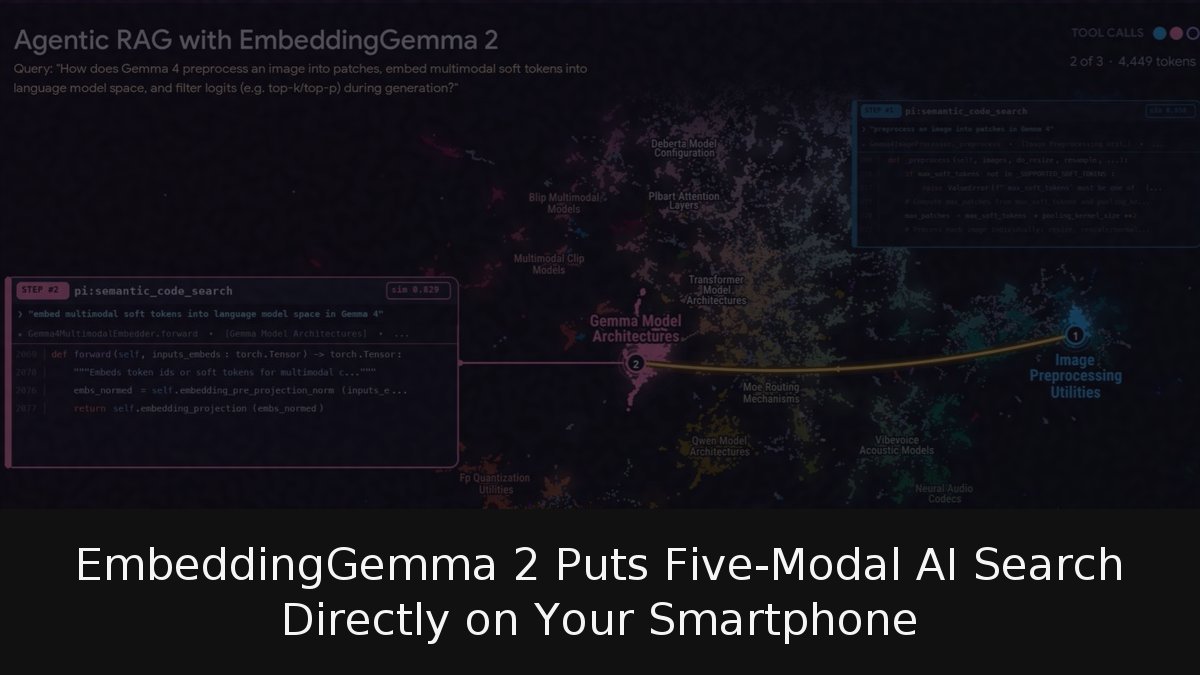
Google DeepMind has launched EmbeddingGemma 2, a 740-million-parameter multimodal embedding model engineered to run entirely on the device rather than in the cloud. The model maps text, code, images, video and audio into a single 768-dimensional vector space, so an application can compare a voice memo against a video clip or a written query against a photo without bolting together separate encoders. Announced on October 6 by Google DeepMind research engineers Sahil Dua and Henrique Schechter Vera, the release arrives under an ungated Apache 2.0 licence and is built on the Gemma 4 architecture.
- One model, five modalities: Text, code, images, video and audio all land in the same vector space, enabling native cross-modal retrieval instead of parallel indexing pipelines.
- Modular by design: A 270M text backbone, a 170M vision encoder and a 300M audio encoder load only when a workload actually calls for them.
- Real memory budgets: Google reports roughly 191MB of active RAM for text-only weights and about 567MB for the full multimodal stack on a Pixel 11 Pro.
- Licence gate removed: The first generation sat behind manually approved Gemma terms; version 2 can be pulled unattended by a build server.
How the architecture holds five modalities together
Each input type takes its own path: text passes through a tokenizer, images and video frames through a vision encoder, audio through an audio encoder. All three routes converge on the shared text backbone, so whatever goes in at the top comes out as the same object — a list of 768 numbers. Similarity then becomes a single consistent calculation, whether the pair is text-to-text, text-to-image or audio-to-video. Bidirectional attention lets the model resolve terms whose meaning depends on a later qualifier, and a pooling step compresses the hidden states into one fixed-length summary that a database can compare instantly.
The context window now reaches 8,192 tokens, four times the previous generation, and it is shared across modalities at roughly 25 tokens per second of audio and 280 tokens per image. In practical terms, that is 5.5 minutes of audio, 29 images or 58 video frames in a single pass, all without leaving the device. Training data runs to a January 2025 cutoff across more than 140 languages.
Benchmarks: a code leap, a quiet multilingual gain
Google measured the full-precision checkpoint against its predecessor. On MTEB code v1 the new model scores 78.68 against 68.76, a jump of nearly ten points — enough to outrank the 1.5-billion-parameter INF-retriever on the company’s own code search benchmark. On MTEB multilingual v2 the improvement is far more modest: 61.36 versus 61.15, a gain of just 0.21.
The image, video and audio rows carry no comparison figure at all, because the first EmbeddingGemma handled text only. For the new modalities Google reports 64.64 on MIEB lite, 57.28 and 67.84 on the two MMEB v2 image tracks, 50.67 on MMEB v2 video, 69.54 on MSEB retrieval and 49.39 on MAEB. The launch post calls the model best-in-class for its size and claims leading scores among sub-1B multimodal embedders, while the model card settles for the more cautious phrasing that it ranks among the strongest multimodal embedding models under one billion parameters. Every published comparison is against EmbeddingGemma 1 and nothing else, and rival systems appear only as scatter-chart dots plotted by size.
Shrinking the vector costs more than the headline suggests
Matryoshka Representation Learning packs the most meaningful information toward the front of each vector, so a 768-dimension output can be truncated to 512, 256 or 128 numbers. Google markets this as up to 6x storage reduction for local vector databases. The trade-off is real: at 128 dimensions the MMEB v2 overall score falls from 59.01 to 45.65, and MSEB retrieval drops from 69.54 to 56.71. At 256 dimensions the overall multimodal score holds at 56.24.
“128 dimensions degrades multimodal quality substantially and should be validated against your own workload before adoption.”
That warning comes from Google’s own model card, which is a refreshingly candid note for a launch document.
Where developers will actually meet it
Google has already wired the model into showcase software. The AI Edge Gallery app gains Instant Media Search and Video Moments Finder, letting users query local media with natural language or sample images and surface key moments in video from a text prompt, with embeddings stored in a local database and results refreshing as the query is typed. A separate Mac application, AI Edge Foresight, combines EmbeddingGemma 2 with Gemma 4 to index system audio, transcripts and files for fully offline note search.
On the deployment side, Google plans to offer the model as a service for Android through ML Kit with hardware acceleration, alongside MediaPipe Tasks and LiteRT for cross-platform builds targeting iOS, Windows, macOS, Linux and the web. Weights are downloadable from Hugging Face and Kaggle, with availability in the Gemini Enterprise Agent Platform Model Garden listed as coming soon. The predecessor passed 20 million downloads while still gated.
The strategic logic here is software ubiquity. Rather than chasing control of the capture layer the way OpenAI is doing with its hardware bets, Google is positioning an embedder that runs on any device and keeps user content local. That matters commercially: privacy-preserving on-device retrieval is the plumbing behind photo search, meeting recall and code indexing, and whoever owns that layer stays relevant regardless of whose handset is in the user’s pocket. The genuine test is no longer whether a 740-million-parameter model can run on a phone — it clearly can — but whether developers build consumer features compelling enough to make the capability invisible.
Sources & References