
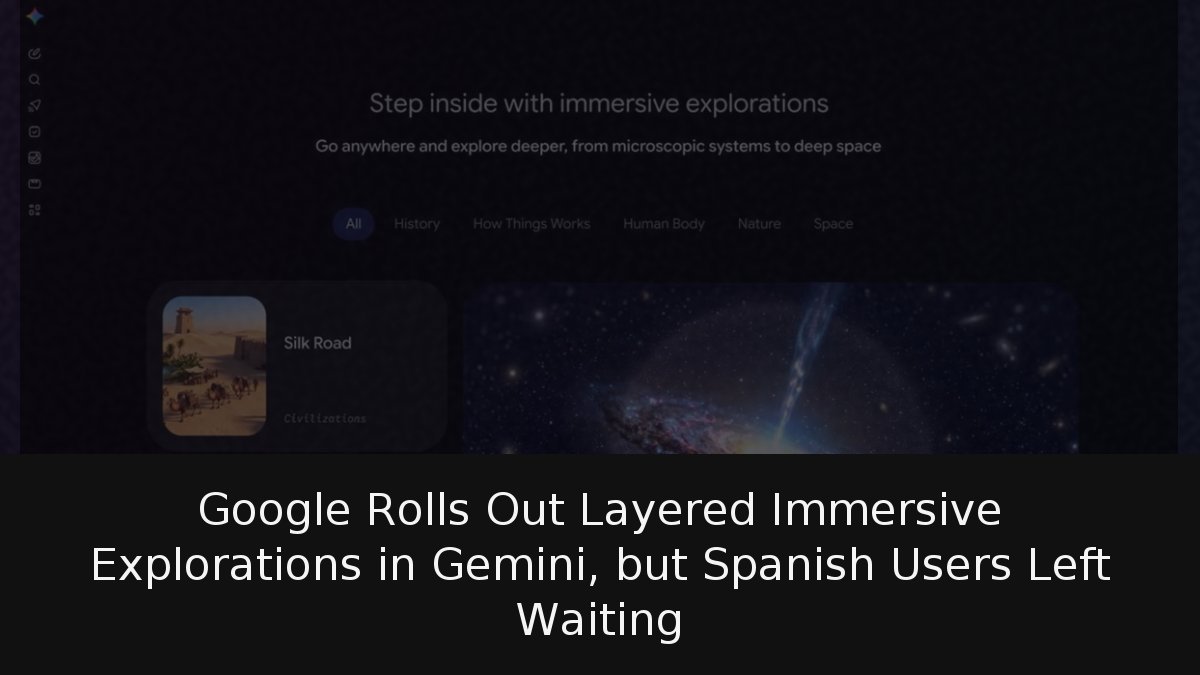
Google has quietly expanded the educational toolkit inside its Gemini app with a new feature called immersive explorations, a visual library that lets users peel back complex subjects one layer at a time. The rollout, confirmed in the company’s official product blog on October 28, covers everything from microscopic systems to deep space, but it arrives with a notable gap for Spanish-speaking students.
- Layered learning: Each topic unfolds into interactive nodes with guided explanations, letting users tap a layer to dig deeper.
- Six launch languages: English, Indonesian, Hindi, Brazilian Portuguese, French and simplified Chinese are supported; Spanish is not.
- Student hub access: The library lives in the Gemini student hub, with direct in-chat access and audio narration promised soon.
How the layered experience works
The core mechanic is simple but pedagogically ambitious. Users tap a label and descend one level, moving from the scale of a planet down to molecules and atoms. Google cites examples such as tracing trade routes along the Silk Road, peering inside a jet engine, or studying the physics of lightning, all presented as interactive and guided experiences rather than static articles.
The library is accessible through the Gemini student hub by selecting the option to try immersive explorations. Google has also previewed two forthcoming additions without a firm date: the ability to open explorations directly from a conversation with Gemini, and audio narration that accompanies each layer. According to the company’s Workspace update, the feature is available on web and mobile, and the student hub version is offered to Education Fundamentals, Standard and Plus tiers, while the standalone web address is open to all Google Workspace customers, Workspace Individual subscribers and personal Google account holders.
Language coverage and the Spanish omission
The initial language roster is English, Indonesian, Hindi, Brazilian Portuguese, French and simplified Chinese, available to all users in those markets. In every other language, the experience currently appears in English only, and Google says more languages are coming. The announcement does not specify whether a paid plan is required, whether there is an age limit, or which Gemini model powers the feature, and it offers only a brief description of the student hub itself.
The absence of Spanish in the first wave is striking, particularly because Brazilian Portuguese made the cut. For a Spanish-speaking student, the tool is, for now, an English-language resource. That matters given the broader debate over minimum ages and parental controls for AI assistants, a conversation that has intensified as Gemini, ChatGPT and Claude reach younger audiences.
Exploring by layers is how complex subjects are genuinely understood, and it plays to what AI does well. The risk is the familiar one with AI-assisted study: confusing exploration with learning, and trusting generated content that may contain errors.
A broader push into practical AI tools
The immersive explorations launch lands in the middle of a busy product cycle for Google. In the same week, the company added the ability to create, preview and edit files directly inside Gemini chats, covering PDFs, documents, spreadsheets, slide decks, Markdown, TXT and code. PDF preview and editing work on both web and mobile, while the other formats are web-only for now. Google says those capabilities are available to all users in every language and region where the Gemini app operates.
Google has also been expanding Gemini’s reach through third-party integrations. Strava, for instance, has begun rolling out a Connected Apps experience that lets subscribers connect their account and ask Gemini to interpret training data, such as whether they are getting faster at the same heart rate. That integration is initially available in the United States across all Gemini plans.
Taken together, the moves show Google positioning Gemini as both a study companion and a productivity layer. The layered-exploration concept is a sound pedagogical bet, since progressive disclosure mirrors how complex systems are actually taught. The caveat is quality control: generated explanations can drift, and students need the critical framing to tell exploration apart from verified knowledge. Until Spanish arrives, that caveat comes with a language barrier attached.