
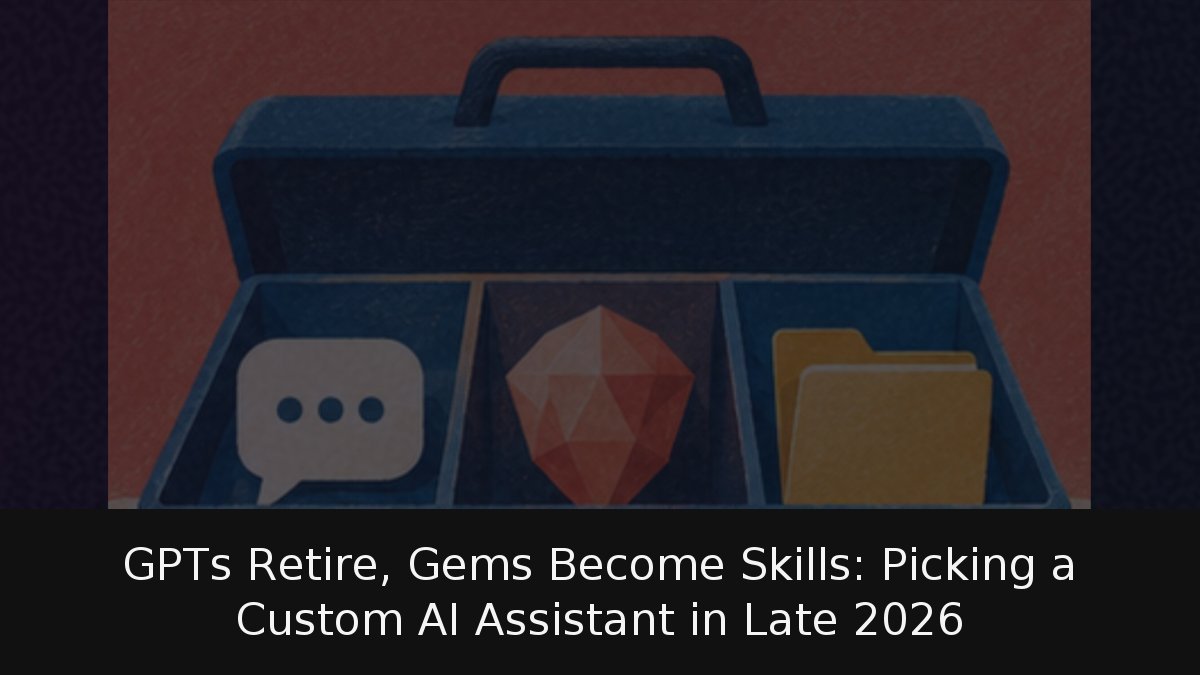
The preconfigured AI assistant — the small, purpose-built bot you assemble inside ChatGPT, Gemini or Claude so you never have to paste the same instructions twice — is heading into its most disruptive stretch yet. Two of the three dominant formats are being taken apart and rebuilt under new names, while the third is quietly testing a redesign with a subset of subscribers. For anyone who has wired a custom GPT, a Gem or a Claude Project into a daily workflow, the next eight months look less like a product update and more like a migration project.
- OpenAI: Custom GPTs are scheduled for retirement on 11 December 2026 across all ChatGPT plans, with plugins as the successor. A narrow set of Enterprise workspaces holding an approved deferral get until 11 February 2027.
- Google: Gems become Gemini skills starting November 2026 for personal accounts, followed by Workspace business, large enterprise and nonprofit accounts in March 2027, and education accounts in June 2027.
- Anthropic: Claude Projects stay live and unchanged in name — the only one of the three — though a new version is in beta for some Pro and Max subscribers.
Three layers behind every custom assistant
Whatever the branding, the architecture is the same: standing instructions applied to every exchange, a set of knowledge files consulted before answering, and, in some configurations, connected apps that reach into outside services. The point is continuity — the assistant knows who you are, how you want answers formatted and which documents are in play.
The details differ in ways that trip people up. In Claude, a project keeps its own chat history and knowledge base, and project instructions govern every conversation inside it, but context is not shared between chats unless you explicitly add it to that knowledge base. In Gemini, a Gem is defined by a name, instructions and optional files stored under “Knowledge”; when a file comes from Google Drive, the Gem always reads the most recent version, so edits propagate automatically.
The retirement calendar and its fine print
The GPT wind-down is already visible at the edges. According to OpenAI’s own documentation, creating and publishing new GPTs is no longer available on personal accounts — Free, Go, Plus and Pro — while Enterprise workspaces have a projected cut-off for new GPT creation of 26 October 2026. Sharing the replacement plugins is, for now, an organisational feature: only Business and Enterprise members can distribute them, either to invited people or to anyone in the workspace holding the link.
Gemini skills arrive with their own guardrails. Users must be 18 or older to create or use them, up from 13 for personal Gems. There is no cap on how many you build, but only 100 can be active simultaneously, and files attached to a skill are limited to 100 MB in total. Skills also do not yet work with Canvas, Deep Research, video or music generation, or guided learning — capabilities Gems did offer. Google says sharing and Drive file attachments are coming “in the coming weeks.” One caveat worth flagging from Gemini’s help pages: anyone granted access to a Gem could read its instructions and every file uploaded to it.
What actually survives the move
Migration is partial by design. A GPT’s instructions become a skill inside the new plugin, connected apps are re-attached as apps, and knowledge files are copied across as reference files. The selected model does not carry over, and custom actions do not transfer at all — rebuilding those connections may require a custom MCP server and real technical work. Existing conversations stay accessible after retirement but are not moved into the plugin, and the original GPT becomes read-only once migrated, so essential edits should be finished beforehand.
Claude Projects remain the most predictable container. They are available on every tier including the free plan, which allows up to five projects as of October 2026. Files are capped at 30 MB each, with no limit on quantity as long as everything fits the context window; on paid tiers, a retrieval-augmented mode kicks in near that ceiling and, per Anthropic, expands capacity up to tenfold. Sharing is reserved for Team and Enterprise, with view-only and edit tiers.
The decision therefore hinges less on model quality than on where your documents live. If everything sits in Drive, Gemini’s ability to read the latest file version is a genuine edge. If you need a stable workspace stuffed with reference material, Claude Projects carries the least uncertainty right now. If a GPT underpins your workflow, migrate and test it well before December.
The simultaneous reshuffle confirms that the custom assistant as an “app inside the chatbot” was a phase, not a destination. Skills and plugins point in a healthier direction — instructions that activate where they are needed — but the transition bills the cost to whoever committed to the previous format. The practical lesson is unglamorous: keep your instructions in a document you own, archive copies of every knowledge file, and treat each platform as a stopping point rather than a permanent home.