
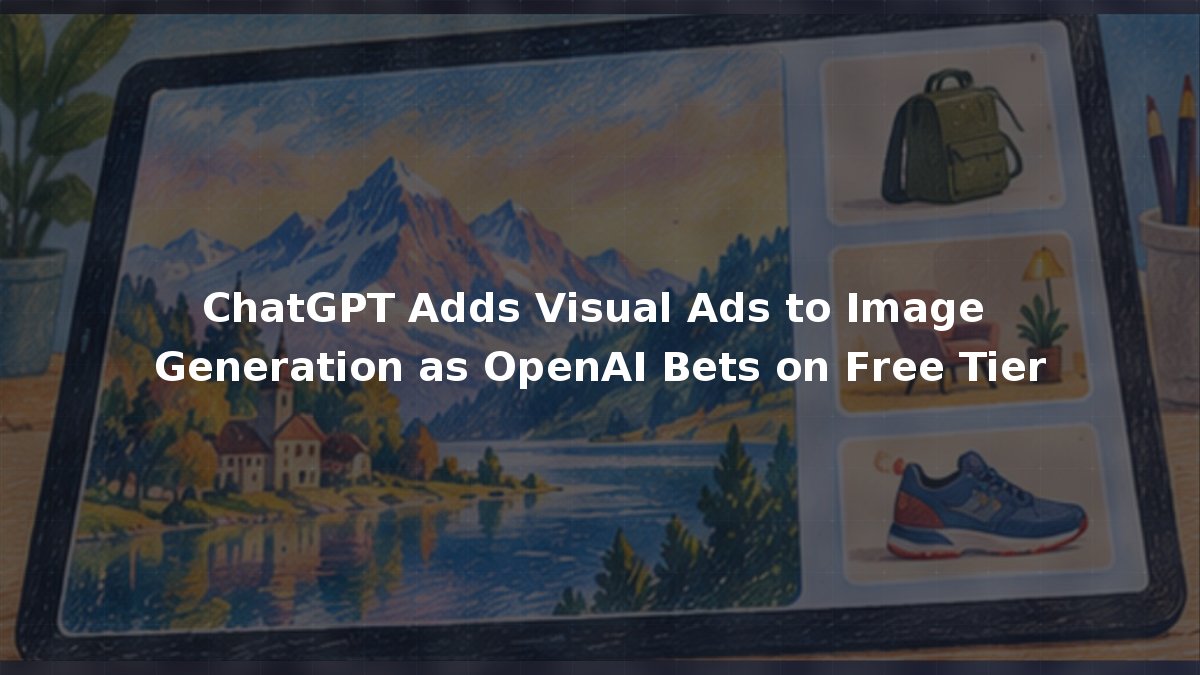
OpenAI is pushing advertising deeper into ChatGPT with a new visual ad format that appears while users generate images, turning the assistant’s most visual surface into a commercial one. Testing begins later this month in the United States with an initial group of advertisers, and no global rollout date has been confirmed.
- A new ad surface: Image-based ads will run alongside image-generation results, clearly labelled and kept separate from the generated picture.
- A ready-made measurement stack: OpenAI unveiled a broad roster of attribution, full-funnel and incrementality partners from day one.
- Competitive pressure: The push follows the free launch of Meta’s agentic AI app Muse, which is squeezing OpenAI’s free tier.
Ads beside the picture, never inside it
The format is straightforward: ads surface during image generation, beneath a progress indicator showing that ChatGPT is still rendering the result. The company says the ads will be clearly labelled and will remain separate from the image being created, and it reiterates that advertising does not influence the answers ChatGPT provides. Mockups published alongside the announcement used a fictional grocery brand to show two layouts — a single banner headline with a short product description and a “Learn more” button, and a horizontal row of scrollable photos. Placement guardrails are designed to keep ads away from emotionally vulnerable or sensitive conversations, and qualifying advertisers can now apply a feature called Negative Phrases to exclude specific contexts.
For advertisers, the appeal is adjacency. A user who has just asked for a picture of a living room, a jacket or a holiday destination has signalled unusually specific intent, and the moment after generation — when they are judging the result — is exactly the exploratory window display formats have chased for years. A visual ad next to visual content is a more natural fit than a text banner, and content-to-ad alignment is one of the strongest drivers of click-through rates in display.
The measurement stack arrives fully built
OpenAI did not ship the format alone. Conversion data can now flow from Hightouch, Tealium and LiveRamp, while click attribution is supported through AppsFlyer, Triple Whale, Adjust, DV Rockerbox, Northbeam, Branch, Singular, Kochava, Airbridge and Tenjin. Full-funnel and advanced measurement partners include Fospha, Measured and INCRMNTAL, and geo-based incrementality experiments are being explored with Haus, Measured and WorkMagic.
Early partner findings are being used to sell the inventory. DV Rockerbox reported that WeightWatchers‘ attributed cost per acquisition on ChatGPT Ads was 15.3% lower than its blended paid-search benchmark; WorkMagic found statistically significant lift for wellness brand Dose, with 67% of incremental purchases coming from net-new customers; and Triple Whale said 93% of Portland Leather‘s visitors from ChatGPT Ads were new.
Brand suitability is being handled through evaluation pilots with DoubleVerify and Integral Ad Science. Both firms will assess how OpenAI’s safeguards are applied in a controlled test environment without touching private user conversations. IAS CEO Lidiane Jones said marketers need brand safety protections that are:
“Durable, consistent, and built to operate at scale.”
Why now: the free-tier squeeze
OpenAI introduced ads earlier this year to support its free and low-cost tiers and expanded them to India in August as a test bed. The launch of Meta’s Muse in September 2026 — a free agentic AI app with millions of active users — has added urgency: sustaining a generous free tier on subscription revenue alone is difficult when a rival subsidises its product with native advertising from day one.
A second, less discussed objective is willingness to pay. If enough users find the ad experience intrusive enough to move to a paid plan, the ads will have served a purpose beyond direct revenue — the same dynamic Spotify leaned on for years. OpenAI’s reassurance that ads stay out of its answers also lands in a year already marked by six documented incidents involving its models, which makes trust a live commercial question rather than an abstract one.
No European launch date has been announced. GDPR and DSA compliance layers are likely to delay the continent’s rollout by months relative to North America, and the decision to test in India before several larger English-language markets suggests OpenAI is prioritising user scale and advertiser appetite over regulatory complexity. The strategic logic is defensive: if the advertising model works, it can fund free access indefinitely and blunt Muse’s cost advantage; if users read the format as intrusive and drift to rivals, the damage to the premium product is far harder to undo. At 1.2 billion weekly users, however, even an imperfect execution can be profitable.