
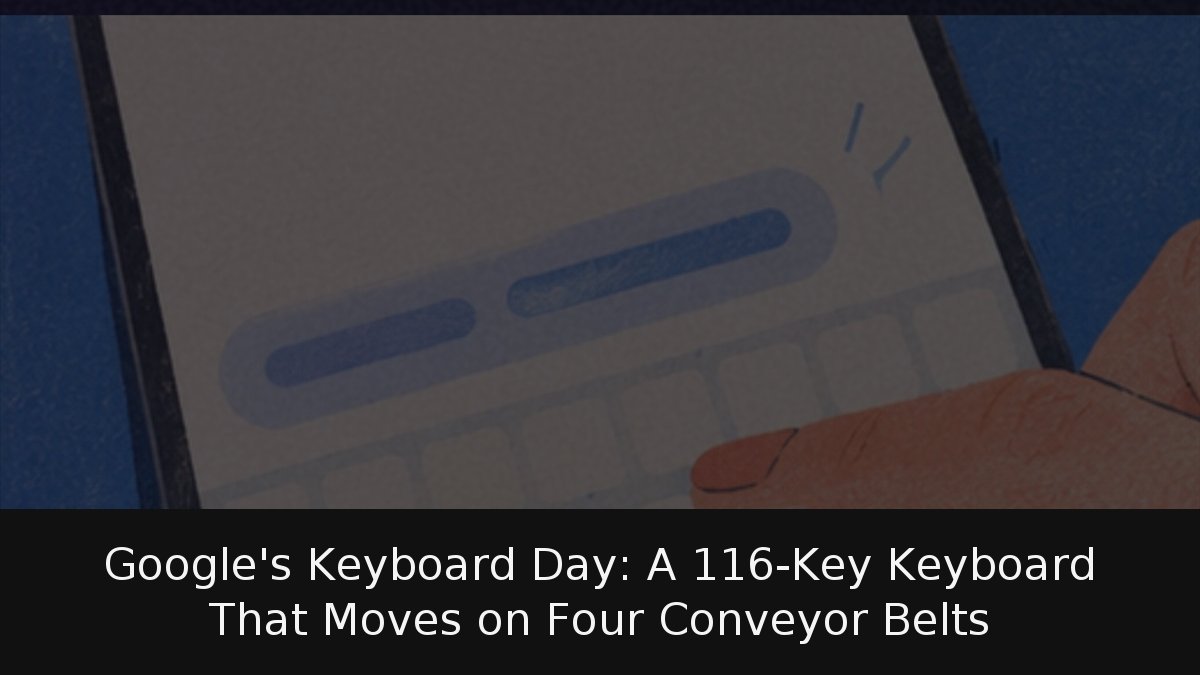
Every October 1, Google’s Gboard team ships a keyboard experiment nobody asked for and almost nobody will ever own. This year’s edition, the 15th consecutive instalment for Keyboard Day, takes the idea of “keys coming to you” literally: a physical keyboard built around four independent conveyor belts that carry keys toward the typist mid-sentence. Each belt holds 29 keys, adding up to 116 keys in continuous motion — a contraption that looks less like office hardware and more like a miniature factory line. The full source code is published on GitHub.
This is not a product, and it never will be. It is also not a joke. There is genuine mechanical engineering underneath, a non-trivial synchronisation problem between belt speed and keystroke detection, and a serious question at the core: is the fixed-key QWERTY model really the only way to build a keyboard?
- Four moving belts: Each of the four conveyor belts roughly maps to one row of a standard keyboard, holding 29 key units apiece for a total of 116 moving keys.
- Adaptive speed: Belt velocity tracks the typist’s detected rhythm so keys arrive exactly when they are needed, removing the need for fingers to travel.
- Open source release: Motor-control firmware, a keystroke driver with dynamic position compensation, and hardware documentation are all available for anyone who wants to rebuild it.
- Strategic context: Gboard commands more than 1 billion active installations, and every physical prototype feeds insights back into Android’s virtual keyboard.
Four belts, 116 keys, and a synchronisation problem worth solving
The mechanics are straightforward in principle: the belts advance toward the typist while they type. The intent is that fingers no longer have to reach for keys, because the keys do the travelling. In practice, belt speed adjusts to the detected writing pace so that each key arrives at the right moment.
The prototype uses four separate belts that correspond, approximately, to the four rows of a conventional keyboard. Each carries 29 key units — enough to preserve a complete QWERTY layout, with certain keys rotating back to the start of the cycle once they reach the end of their run. The central engineering challenge is keeping the belts synchronised so relative key positions survive the motion: the Q must remain to the left of the W even though both are sliding along a moving surface.
The repository includes motor-control firmware, a keystroke-reading driver with dynamic position compensation, and hardware documentation for anyone attempting a replica. The open source Model 01 keyboard, which tried to reinvent typing hardware through a Kickstarter campaign roughly a decade ago, already proved that a real community exists around alternatives to the conventional QWERTY board. Gboard’s experiment reaches that same community from a different angle: instead of changing the layout, change the hardware.
Why Google keeps building keyboards nobody will ever buy
The obvious answer is that these are conceptual design experiments rather than product programmes. The more interesting answer is that they function as a physical interaction laboratory for Android’s virtual keyboards, a space Gboard dominates with over 1 billion active installs.
Each time the team assembles an experimental physical keyboard, what it learns about next-key prediction, finger placement, typing speed and ergonomics is transferred to the virtual keyboard model. The AI-driven key prediction keyboard published in 2023 is a useful precedent: improvements derived from it reached Gboard’s Android autocorrection and, months later, millions of users.
Keyboard Day is also, frankly, a branding exercise. The Gboard team carries a hardware engineering profile inside Google that few outsiders know about, and shipping a striking experiment every October 1 keeps that profile visible among the developers and designers who shape how Android is perceived next to iOS. Fifteen consecutive editions is not a trivial number either: it implies a team with continuity, budget and autonomy to keep doing this year after year, even when the deliverable is always “no product.” In a company where projects are regularly killed, that survival says something.
The GitHub release and what the community can do with it
Publishing the firmware and hardware schematics under an open licence turns a demonstration into a platform. The custom mechanical keyboard community — long active on forums such as geekhack and on GitHub through projects like QMK and ZMK — now has starting code for conveyor-belt experiments Google itself will never pursue.
The most interesting possibilities lie not in replicating the exact prototype but in applying the “key that comes to you” logic to alternative layouts such as Dvorak or Colemak, where minimising finger travel is the whole point. A belt tuned to the rhythm of a typist trained on Colemak-DH, for instance, could cut lateral movement time close to zero.
What the experiment ultimately surfaces is a question the input hardware sector rarely asks itself often enough: how much of QWERTY’s static shape is a physical necessity, and how much is simply the solution that history imposed and nobody revisited? Gboard’s conveyor belts do not answer that. But they make it visible in a way that is hard to ignore — and by handing the design to the open source community, Google has quietly invited others to answer it instead.