
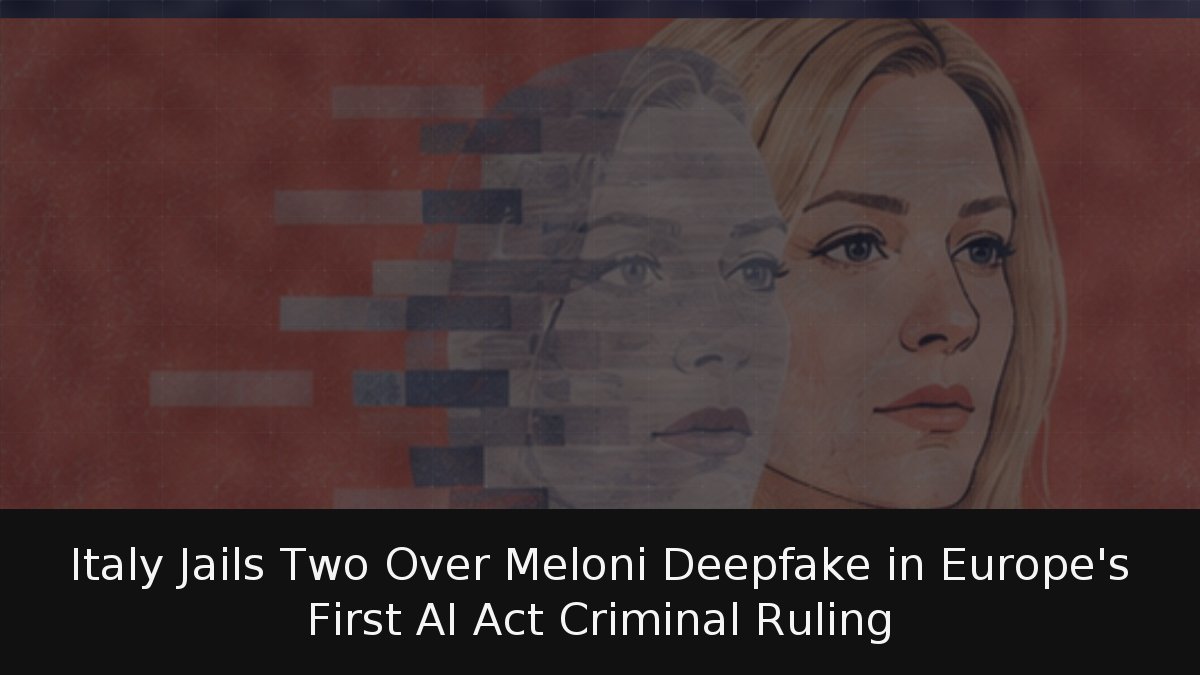
An Italian court has convicted two men for creating and distributing a sexually explicit deepfake of Prime Minister Giorgia Meloni, sentencing each to just over two years in prison and ordering them to pay €100,000 in damages — compensation Meloni has said she will donate to a fund supporting victims of gender-based violence. The verdict, covered by Italian outlets and picked up internationally this October 2026, is the first of its kind handed down under Italian legislation that incorporates Article 50 of the European Union’s AI Act, making Italy the first member state to test the bloc’s synthetic-media rules inside a criminal courtroom.
- A landmark sentence: Two defendants received prison terms of just over two years each, plus a €100,000 payout to Meloni, in the first criminal ruling tied to the AI Act’s transparency obligations.
- Voice as evidence: The court accepted a four-second, notarised audio sample of Meloni’s real voice as an identity reference to prove the synthetic clip impersonated a real person.
- The enforcement gap: Italy could prosecute because it already had national laws against non-consensual pornography. France, Germany and Spain are still rewriting their criminal codes, and detection tools remain far behind generative models.
What Happened — And Why It Sets a Precedent
The two convicted men used generative AI to superimpose Meloni’s face onto a sexual video, then circulated the material across social networks, where it remained live for weeks before Italian prosecutors intervened. The investigation stretched over several months and ended in convictions for reputational damage and privacy violations under an Italian criminal framework hardened by the AI Act’s provisions on synthetic depictions of real individuals.
The judgment leans directly on Article 50.5 of the AI Act, which requires AI-generated content to be labelled and attaches criminal liability when such content is deployed to harm specific people. The genuinely novel element is evidentiary: the court admitted a short recording of Meloni’s genuine voice — captured and authenticated before a notary — as a baseline against which the synthetic output could be measured and shown to impersonate her. It is a legal tactic with echoes of the image-protection strategies other public figures, including Taylor Swift, have pursued against AI clones — now validated in a European criminal court.
The victim here was one of the most powerful people on the planet, and that is precisely what made the prosecution viable. What remains unresolved is the fate of the millions of anonymous victims who have neither press attention nor lawyers willing to take up the fight.
Article 50: Why the AI Act Is So Hard to Enforce Outside Italy
The AI Act binds all 27 member states. Article 50 obliges AI systems that produce synthetic video, images, audio or text to label that output in a detectably machine-readable way. On paper, every deepfake circulating in Europe should carry a technical marker identifying it as artificial. In practice, distribution platforms have until 2025-2026 to implement those mechanisms, and verification remains uneven.
Italy managed to convict without any of that infrastructure because it already had national legislation against non-consensual pornography — commonly called revenge porn — which the Meloni case extends to AI-generated deepfakes. Other member states lack that foundation. France, Germany and Spain are all adapting their penal codes, but legislative reform continues to trail the technology it aims to govern. The transparency the AI Act was designed to deliver now depends on procedural muscle that legislation alone cannot supply.
The structural problem is twofold. Identifying the author of a deepfake demands specialised technical expertise that is in short supply across judicial systems, while distribution platforms — most of them headquartered outside Europe — respond to takedown requests with wildly variable speed.
The Detection Gap: When Law Outpaces Technology
A study published this year in PLOS ONE measured how well humans distinguish authentic footage from deepfakes produced by state-of-the-art models. Participants identified the fakes correctly in 73% of cases when they received prior training. Without training, accuracy collapsed to chance. Put plainly: most people watching a high-quality deepfake cannot tell it is fake.
Automated detectors fare little better. By the time a detection model learns the visual artefacts of one version of Stable Diffusion or Flux, a newer release strips those artefacts out. The race is structurally unbalanced, and TechNews DevTop has been tracking this collision between AI and legislation since 2013. The need to defend ourselves against digital replicas and deepfakes has not diminished since we first analysed it in 2024 — it has intensified. Models are faster, cheaper and more accessible. What has grown far more slowly is the legal and technical capacity to respond.
This Italian case matters precisely because it arrives late. The damage to Meloni lasted weeks online and was resolved in court over months — and she, as a public figure, commands legal resources no ordinary citizen could match. A victim without public visibility would likely never have seen a verdict at all.
The ruling is historic, but it also lays bare the fracture running through Europe’s approach to artificial intelligence. The bloc has written the world’s most ambitious AI rulebook. What it has not yet built is the enforcement machine — trained investigators, forensic examiners and rapid platform compliance — capable of making those rules real for the people who need them most. Until that infrastructure exists, landmark verdicts like this one will remain the exception available to the powerful, rather than the standard extended to everyone else.