
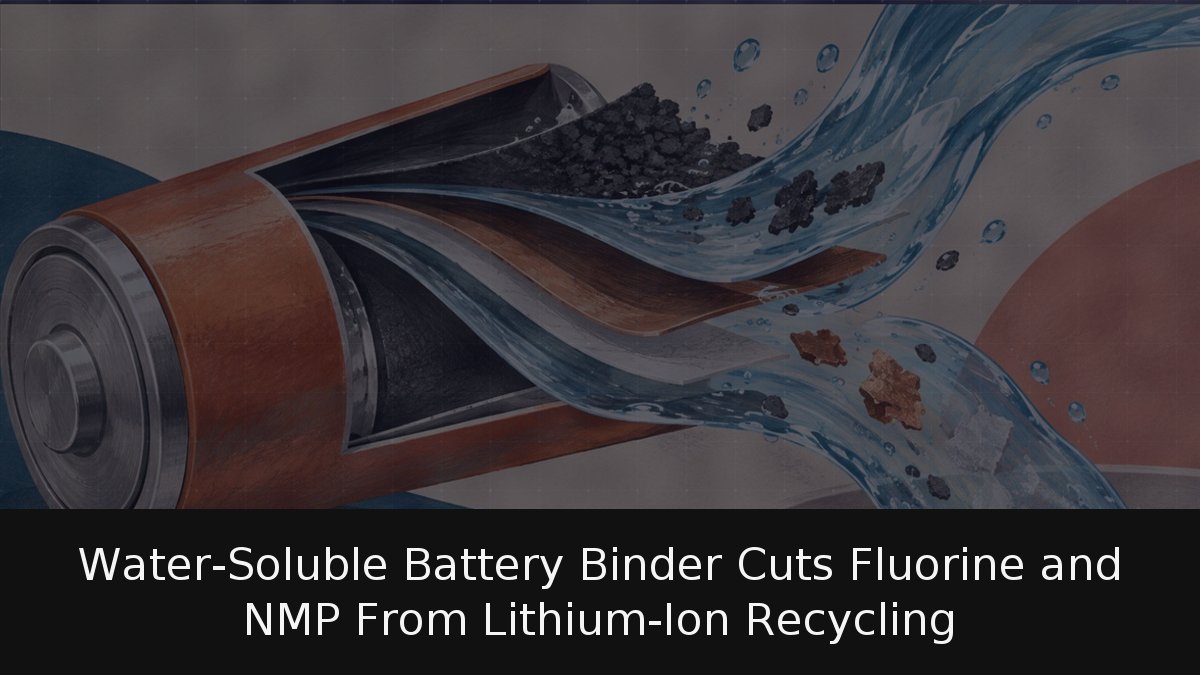
Engineers at the University of California San Diego and the Toyota Research Institute of North America have developed a battery binder that dissolves in plain water at room temperature — a seemingly minor change of ingredient that could strip toxic solvents, high-temperature furnaces and hazardous waste out of both lithium-ion manufacturing and recycling. The work was published on 9 October in Nature Communications by the lab of Zheng Chen, a professor in the Aiiso Yufeng Li Family Department of Chemical and Nano Engineering at the UC San Diego Jacobs School of Engineering, in collaboration with John Muldoon at the Toyota Research Institute of North America.
- No fluorine, no NMP: The new binder replaces polyvinylidene fluoride (PVDF), which must be processed with the toxic solvent N-methyl-2-pyrrolidone (NMP).
- Recycling by soaking: Electrodes immersed in water release their coatings cleanly from the aluminium or copper foil, leaving no stubborn residue.
- Performance parity: Cells built with the binder matched conventional lithium-ion cells on initial performance and, in some tests, retained capacity better over hundreds to thousands of cycles.
- Cheap feedstocks: Polyacrylic acid, carboxymethyl cellulose and citric acid are common industrial and food-industry materials, a positive signal for scale-up.
Why a glue molecule shapes the battery’s footprint
Inside a lithium-ion cell, each electrode is a thin coating of active particles — lithium iron phosphate or graphite powder, for instance — spread onto metal foil. The binder is the glue that holds those particles together and keeps the coating attached. It accounts for only a small fraction of a battery’s weight, yet it dictates how the cell is built and how easily it can be taken apart decades later.
Industry has relied on fluorinated polymers such as PVDF because they are chemically tough and stick well. The catch is the processing. Fluorinated binders must first be dissolved in an organic solvent, typically NMP, and after coating the electrodes pass through long, energy-hungry drying ovens. The solvent vapour then has to be captured, recovered and purified, both because it is harmful and because it is too costly to waste.
Those extra steps significantly increase the cost and energy use — as well as the environmental impact — of battery manufacturing.
That assessment comes from Jiao Lin, the study’s first author and a postdoctoral researcher at UC San Diego. Chen frames the recycling side of the same dilemma: the durability that makes fluorinated binders attractive is precisely what makes spent batteries so hard to disassemble.
A recipe built from plants, citrus and ordinary polymers
The replacement is assembled from two inexpensive, widely available polymers dissolved in water. Polyacrylic acid helps the mixture spread evenly and supplies flexibility; carboxymethyl cellulose, a plant-derived material already used in foods and paper products, provides strength and adhesion. Adding citric acid — the compound that makes citrus fruit sour — chemically crosslinks the two into a reinforced network held together by multiple types of bonds that strengthen one another.
Water-based binders are not new in themselves; graphite anodes have long been processed this way. The harder challenge has been cathodes and demanding high-energy chemistries, where fluorinated binders still dominate. That makes the breadth of testing significant. The team validated the material on four electrode types: LFP cathodes, nickel-rich cathodes, graphite anodes and silicon anodes, the last being a next-generation material notorious for swelling violently during charging and punishing conventional binders.
Soaking electrodes clean instead of burning them
The most striking result appears at end of life. Rather than using corrosive chemicals or high temperatures to strip the binder — treatments that generate hazardous waste and fluorinated byproducts that contaminate recovered material — the researchers simply disassembled the cells and soaked the electrodes in water. The binder dissolved, the coatings separated cleanly from the metal foils, and the recovered materials were regenerated through direct recycling processes and reassembled into new cells. Those recycled batteries performed as well as cells built from materials recovered from conventional PVDF-based batteries.
The economics matter as much as the chemistry. Battery recycling has historically struggled to compete with virgin mining in the absence of regulatory incentives, and a binder that collapses the separation step into a water bath attacks one of the costliest parts of the process.
From a lab result to a production line
The researchers are now in an optimisation phase and exploring commercialisation. The path from a Nature Communications paper to an industrial production line is well known to be littered with obstacles: material cost at volume, behaviour in industrial-format cells, integration with existing manufacturing equipment, and validation across realistic duty cycles. Against that, the raw ingredients are far from exotic — polyacrylic acid and carboxymethyl cellulose are commodity materials, and citric acid is a byproduct of the food industry.
If the results hold at scale, the implications extend well beyond emissions accounting. Countries able to recycle their spent packs efficiently accumulate domestic access to lithium, cobalt and nickel without leaning on primary supply chains — a strategic advantage in a geopolitical climate where critical minerals have become an instrument of foreign policy. That possibility, rather than the journal paper itself, is what should keep battery manufacturers and grid-storage planners paying attention.