
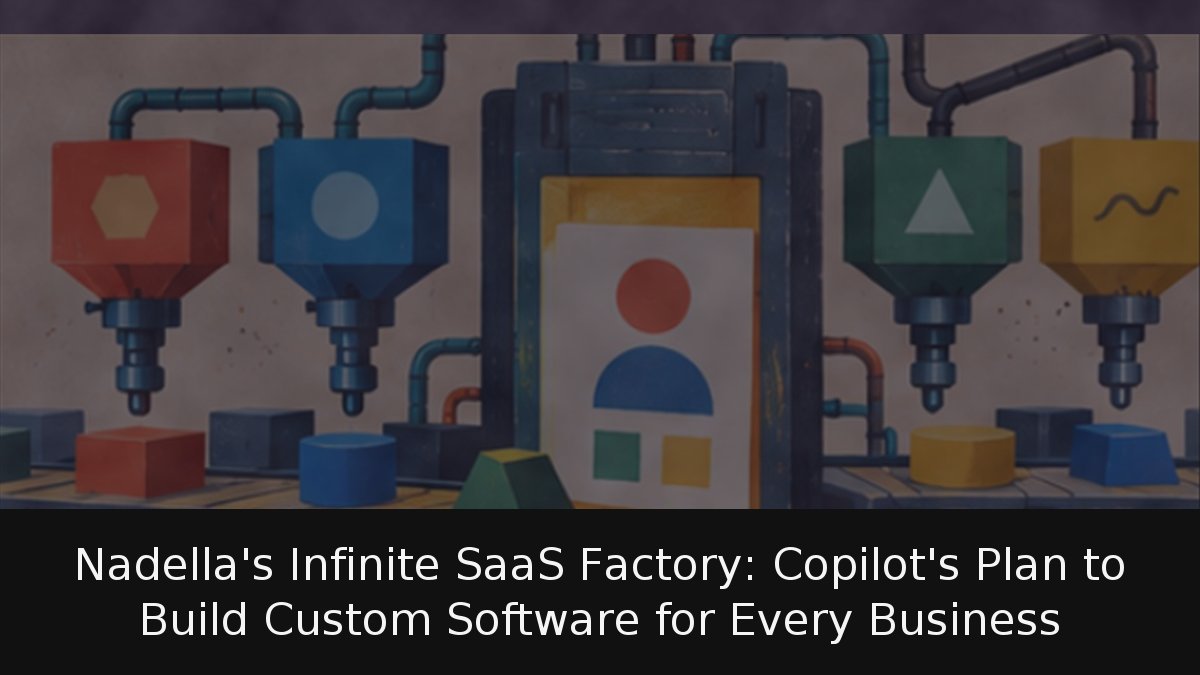
Satya Nadella published an essay titled The Infinite SaaS Factory on October 8, 2026, arguing that Copilot should become both the operating system of work and a software factory: describe what your business needs, and you get a customization or a new module connected to your systems. His central thesis challenges the usual take: more agents do not make CRM or ERP less important. They make them more important.
The text appeared on LinkedIn and X. On LinkedIn, it had drawn 2,864 reactions, 278 comments, and 304 shares roughly 15 hours after publication—an unusual reach for an essay about software architecture.
This is not a standard product announcement. It explains why Microsoft has launched what it has launched, and where it wants to take customers. That is why it deserves a close read.
Key Takeaways
- Two-layer architecture: Copilot acts as the visible “head,” while a governed, headless base exposes the business logic trapped inside every application. Microsoft IQ connects the two.
- Concrete launches: More than 30 new Copilot skills for Dynamics 365 Sales, Service, and Customer Insights, plus Microsoft Copilot Managed Runtime, which runs Copilot-generated code inside the enterprise under IT control.
- Strategic goal: If Copilot can work with any AI model, the lock-in shifts to the system of record and the data schema—keeping business logic and context inside Microsoft’s ecosystem.
From “SaaS Is Dead” to “SaaS Gets Manufactured”
In December 2024, on the BG2 podcast, Nadella described business applications as databases with a logic layer on top, and predicted that agents would eventually own that logic. Much of the industry reduced it to a headline: SaaS is dead.
The new essay refines that claim. The lesson, Nadella says, comes from software development, one of the first areas to adopt agents at scale. As agent-assisted programming grew, GitHub saw repository creation, pull requests, and commits accelerate. More agents created more need for a reliable place to store state and coordinate changes, not less.
That leads to the factory idea. Inside Copilot’s Code mode, a user describes a business need and builds a customization or a complete SaaS module, extending the Dataverse schema and leaning on existing logic. Nadella calls it an era of “personal” software that remains connected to the company’s systems of record, preventing important data from fragmenting.
One line deserves attention. The essay states that for some customers this will mean extending the systems they already have, and for others, replacing them.
For some customers this will mean extending the systems they already have, and for others, replacing them.
The practical reading is that “replacing them” points to moving workloads that currently live in competing products onto Dynamics.
What Microsoft Gains—and What Customers Risk
Microsoft gains by keeping data and business logic on its turf even if the underlying AI model changes. If Copilot can run on any model, what binds the customer is no longer the model. It is the system of record and the data schema on which modules are built.
The numbers explain the confidence. During its July 29 earnings presentation, Nadella cited more than 30 million paid Microsoft 365 Copilot licenses, with net additions doubling quarter over quarter, and 50 million GitHub Copilot users. In May, the company published its annual work trend report, finding that 78% of workers already use agents every week.
The argument also fits Nadella’s own recent messaging. In July he coined the “Inverse Information Paradox,” the idea that using someone else’s AI can make you lose your most valuable knowledge. The infinite factory is the commercial answer to that warning: keep your context with me.
He is not alone. On the same day, Google Cloud introduced its Gemini agent for enterprises, which chooses between Google’s own models and those from Anthropic. Two giants, the same day, the same thesis: the model is interchangeable, and the value lies in the layer that knows your business.
The obvious question is who maintains all this. The promise of frictionless custom software is attractive, but every module is code that someone must review, update, and eventually retire. Managed Runtime solves where that code runs and who governs it. It does not solve who will understand, two years later, the dozens of customizations a department generated in an afternoon. Enterprises already lived through a version of this problem with Excel macros and low-code apps.
Corporate AI training programs, often lasting 6 to 20 hours, frequently end with the same request: a specific module for agents or Copilot Studio. The interest is real. What is still missing in many organizations is an internal owner for what those agents build.
One passage in the essay is the most honest and the least quoted. Nadella clarifies that this is not about using a language model for everything: tokens are spent where intelligence adds value, while execution is left to deterministic software when it is faster, cheaper, and more reliable. That is a rare cost admission from an executive selling AI.
The direction is right, but the name is misleading. It is right because agents without access to company data and rules cannot do serious work, and someone must govern that access. It is misleading because “infinite” suggests software no longer costs anything, when the cost simply moves from development to maintenance and governance. Microsoft has historically won when it makes its standard the de facto one, and this essay is another attempt. The real test is exit cost: before adopting the factory model, enterprises should understand what happens to their custom modules if they ever decide to leave.