
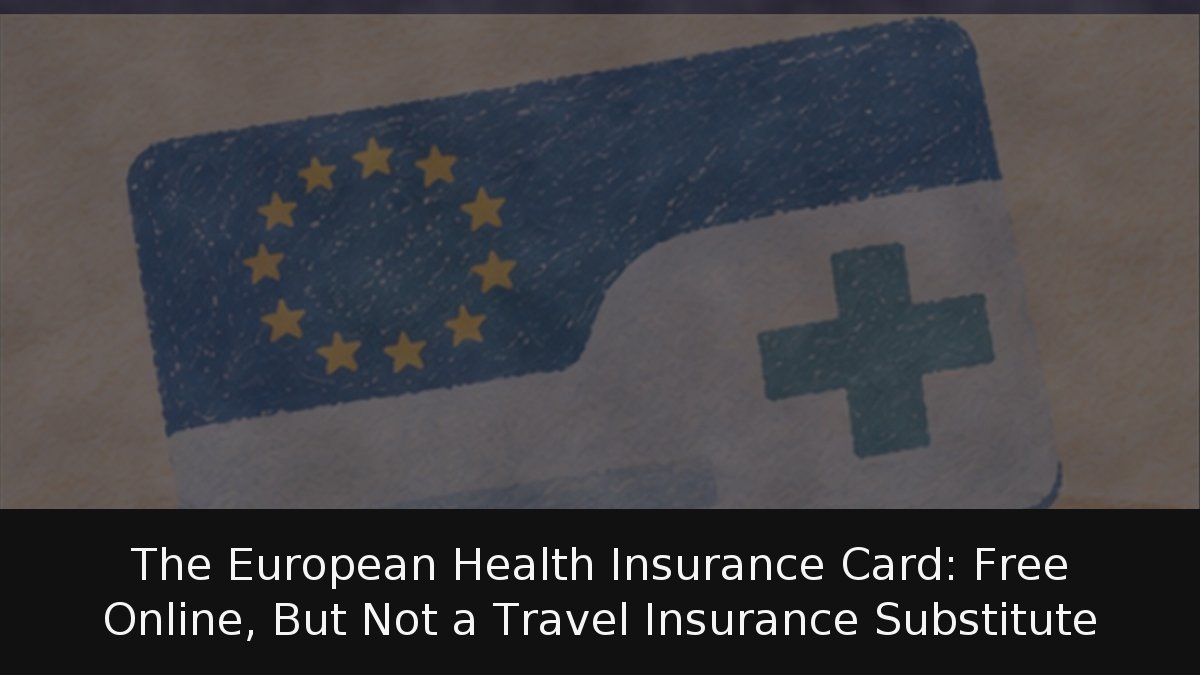
The European Health Insurance Card (EHIC) is one of the few EU procedures that works smoothly: it is free, can be requested online through the Social Security electronic headquarters, and arrives at your home in about five days. It provides access to public healthcare in 31 countries under the same conditions as local insured residents. If you are traveling tomorrow, you can immediately download a provisional certificate in PDF format valid for up to 90 days. However, what the card does not do is turn you into a private patient or bring you home if you fall seriously ill. That is the confusion that costs the most money: many people travel with the EHIC in their wallet convinced they carry insurance, when what they actually carry is a pass to the public system of the country they are visiting, with its co-payments and waiting lists.
- Free and online: The EHIC is requested through the Social Security electronic headquarters at no cost and is delivered to your registered home address in approximately five days.
- Provisional certificate: A downloadable PDF (CPS) offers the same coverage as the card for up to 90 days, ideal for last-minute trips.
- Not a substitute for travel insurance: The card does not cover private healthcare, medical repatriation, or lost belongings, and co-payments in the destination country are not reimbursable.
How to Request the EHIC Online
The procedure is available on the Social Security electronic headquarters under the section for requesting the European Health Insurance Card and Provisional Substitute Certificate. It serves to request the card for the first time, renew it, check if you already have a valid one, and request it for dependents such as children. To identify yourself, according to the Government’s February 2024 note, you can use Cl@ve Permanente, Cl@ve PIN, DNIe, electronic certificate, or SMS. The SMS option only works if your mobile number is registered in the Social Security database, which sends you a one-time password. You will need your DNI or NIE and your Social Security number.
If you lack any identification system, the same note mentions a form on the headquarters, a phone line, and in-person assistance at Social Security centers (CAISS). Practical details worth knowing:
- The card is sent to the address on your affiliation record. If you want to receive it at another address in Spain, the European Consumer Centre indicates you must request it by SMS to your registered mobile or with an electronic certificate.
- General validity is up to two years from issuance, according to the Social Security magazine, which adds that retirees may have it for up to five years. For resident foreigners, it coincides with the end of the permit and, for unemployment benefits, with the duration of the benefit. The exact date appears on the card, and you can renew it from 60 days before it expires.
- Issuance is free. If a website charges you to “process” it, you are not on the official Social Security headquarters.
The Provisional Certificate: The Solution When the Trip Is Tomorrow
The Provisional Substitute Certificate (CPS) is a PDF downloaded from the same procedure that offers the same coverage as the EHIC. It is issued for a maximum of 90 days from the start date you choose and includes an electronic authenticity code so any healthcare center can verify it. Two details are often overlooked. First: the headquarters requires a higher identification level for the CPS than for the card, so the most basic method may not allow you to download it. Second: the Social Security magazine reminds you to check that the validity period covers your planned return date. Print it and also save it on your mobile. A PDF is not lost with your wallet.
What the Card Covers and What It Leaves Out
It covers medically necessary healthcare during a temporary stay, in public or contracted centers and at the same cost paid by insured residents of the country. The European Commission, in its August 2026 reminder, includes chronic or pre-existing conditions, pregnancy, and childbirth.
Covers
Does Not Cover
Emergencies and necessary care in the public network
Private healthcare
Chronic or pre-existing conditions
Repatriation or return flight for medical reasons
Pregnancy and childbirth
Traveling to receive treatment
The 27 EU countries, Iceland, Liechtenstein, Norway, Switzerland, and the United Kingdom
Loss or theft of belongings
Co-payments in the destination country (not reimbursed)
That last row surprises many people. The Social Security headquarters warns that in some countries you will have to assume a fixed amount or a percentage of the cost, just like local insured residents, and those amounts are not refundable. What is free in Spain may not be free at your destination. It is also not valid if you move country (for that, the S1 form exists) or if you stop meeting the requirements under which you obtained it: in that case, Social Security may claim the expenses as undue benefits. And do not confuse it with the virtual health card of your autonomous community: that one works within Spain and does not replace the European card.
Why It Does Not Replace Travel Insurance
Because the European Commission itself says so: the card is not an alternative to travel insurance. It does not pay the private clinic the hotel ambulance takes you to, it does not cover transport back to Spain, and it does not respond if your luggage is stolen. My reading is that the real problem lies in repatriation. An appendicitis in Lisbon is handled by the Portuguese public system with the EHIC; returning on a stretcher to Madrid is not included. And in tourist areas with abundant private supply, ending up in a non-contracted center is easier than it seems if you do not ask beforehand.
Something similar happens with mobile phones: the EHIC country list includes the United Kingdom and Switzerland, which are precisely two destinations where it is worth checking where you can use your phone as at home and where roaming charges may apply. Just because something is valid “in Europe” does not mean it is valid equally everywhere. The sensible combination is the card plus travel insurance with repatriation, which should be reviewed like any other itinerary detail. If you use an assistant to organize it, keep in mind what ChatGPT and Gemini do well when planning a trip and what you have to check yourself: insurance conditions are exactly what you must read in the policy, not in a summary.
The EHIC is one of the few European procedures that work well: free, online, and with an immediate plan B. Precisely for that reason, what it does not do is undervalued. Request it before any trip to Europe, renew it before it expires, and do not treat it as insurance: it is a right of access to another country’s public system, with its rules, its co-payments, and no return ticket included.