
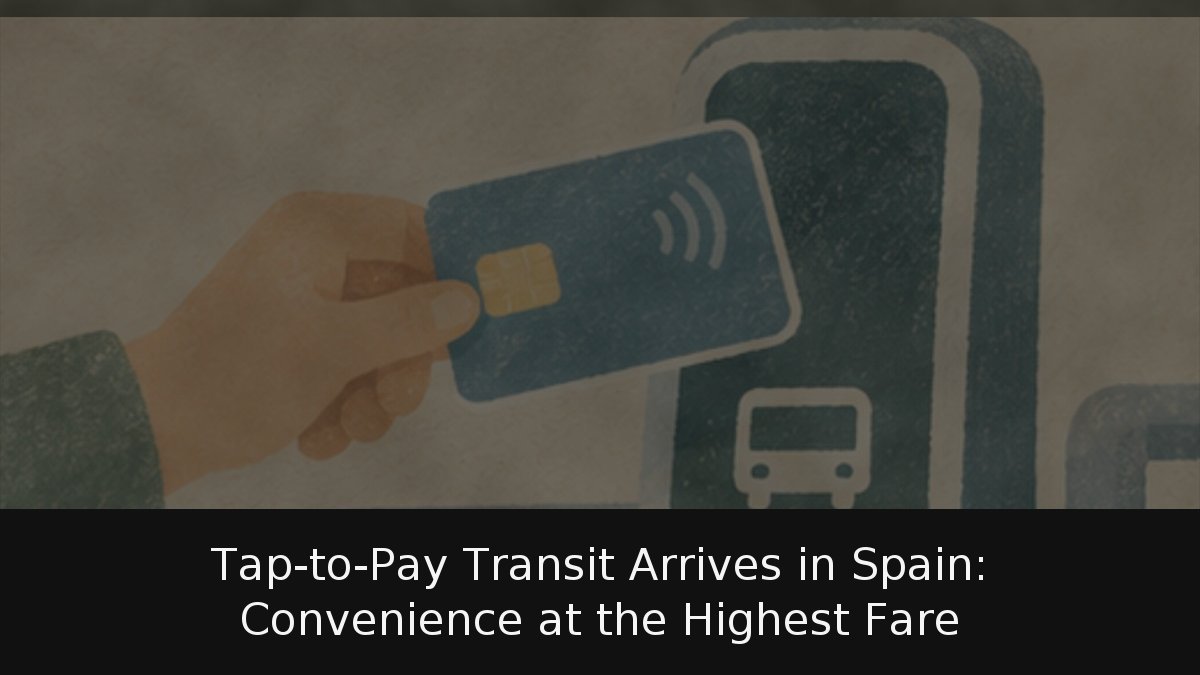
Contactless bank cards, smartphones and smartwatches are quietly replacing paper tickets and transit cards across several Spanish urban networks. Riders can now tap a Visa, Mastercard or American Express card — physical or stored in a mobile wallet — directly on the turnstile or bus reader, buying and validating a single ticket in one gesture. The technology works, the rollout is real, and the economics are almost always worse than the alternative.
- One tap, one ticket: The reader acts as both ticket machine and validator, charging the standard single fare with no printed receipt.
- Confirmed deployments: Madrid’s Metro and interurban buses, Barcelona’s TMB network and Valencia’s EMT buses have all activated bank-card payment under operator-confirmed terms.
- The catch: Tap-to-pay almost always bills the single fare, which in Barcelona is 2.90 euros versus 1.30 euros per journey on a 10-trip T-casual card.
How the technology actually works
The system is a straightforward application of EMV contactless payments to transit validation. According to Transports Metropolitans de Barcelona (TMB), the reader accepts Visa, Mastercard and American Express on any contactless medium: a plastic card, a phone or a watch. A single short beep confirms both purchase and validation; two tones signal a problem. No ticket is printed, so during an inspection riders must supply the last four digits of the card used to prove payment. Some banks apply a pre-authorisation above the ticket price, but the final charge is the current single fare. Travelling as a group simply means tapping once per person.
TMB adds a useful detail: registering the card on its website lets riders download a simplified invoice for each journey and review their trip history from the following day. Madrid’s regional government describes the same model for Metro, where credit or debit cards — physical or stored on a phone or watch — work without the need for the public transport card.
Where it is live, and at what price
Madrid set 1 June 2026 as the launch date for card payment at Metro turnstiles. The regional government cited 1,249 turnstiles prepared across the network, of which 470 are intelligent; at stations with older gates, at least two accept this method and one reads QR codes. In the first phase it covered single tickets only, with a temporary promotional price of 1.50 euros. On buses, the Regional Transport Consortium confirmed in 2025 that EMT had already implemented the system and extended it to all interurban routes from 1 July 2025, with two single-fare prices: 1.50 euros within a single municipality and 3 euros between towns.
Barcelona places the reader next to the driver’s cabin at the front door of TMB buses. In the Metro, TMB indicates that a bank-card lane is enabled at some entrances, not all.
Valencia takes a different approach. Under MovimEMT, running since 1 October 2025, riders register their card in a personal space on the EMT website and validate with it on board. Each journey is charged at the bonobús rate, free transfers are deducted automatically, and after 41 journeys in a calendar month the rest are free. At the 2025 announced price, maximum monthly spending was capped at 21 euros. That per-journey price depended on subsidies fixed until 31 December 2025; in December 2025 the city council agreed to maintain EMT fare discounts through the first half of 2026.
The fare maths: convenience versus cost
Paying with a bank card is equivalent to buying a single ticket every time. TMB’s published fares make the gap plain: a single ticket costs 2.90 euros, a 10-journey T-casual works out at 1.30 euros per trip, and a 30-day unlimited T-usual costs 22.80 euros. For anyone making more than a couple of journeys, the bank card costs more than double per trip. For a day visitor, someone who has mislaid their transit card or a one-off journey, the convenience justifies the premium. For daily commuting, it is money thrown away.
Usage data from the Madrid consortium illustrates the point: on interurban buses, 82 percent of travellers use a season pass, 11 percent a multi-trip card and 3.3 percent a cash single ticket. Card payment is not designed for the regular rider.
What would change the arithmetic is Valencia’s model: charging per journey but with a monthly cap, so riders never pay more than the best pass. Madrid has announced something similar. The consortium plans an Account-Based Ticketing (ABT) system that will automatically calculate the most advantageous fare across Metro, buses and Cercanías, backed by 2.7 million euros in technical assistance and scheduled to enter service in the fourth quarter of 2027.
Two practical caveats before leaving the transit card at home. With no printed ticket, the payment method is the proof of purchase: if a phone dies mid-journey, the rider has nothing to show an inspector except those four digits, so battery life matters. And if the phone serves as the wallet for everything, losing it means losing the ticket too.
The real headline is not that a turnstile can read a bank card — that removes queues at ticket machines and is a genuine convenience gain. The meaningful advance is the spending cap: a system that charges what the best pass would have cost without forcing riders to guess at the start of the month. Valencia already does this on its buses. Until it reaches the rest of the country, tapping a phone remains a convenient way to pay the most expensive fare on the network.