
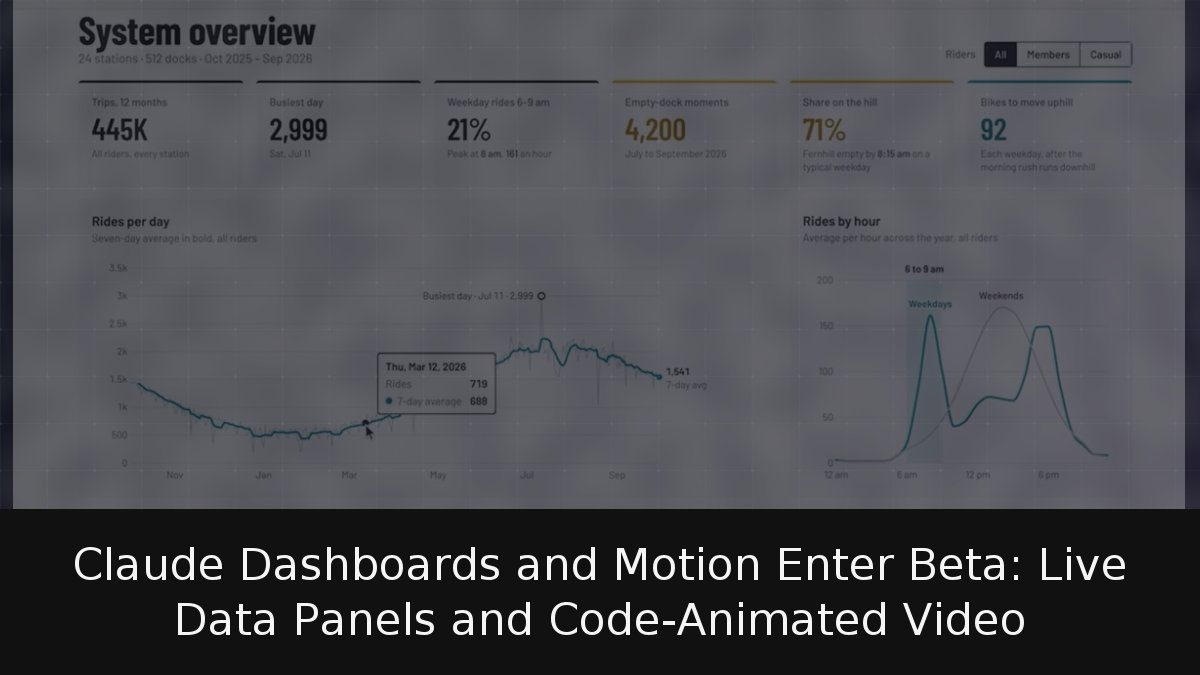
Anthropic pushed deeper into the corporate desktop on 8 October 2026 with two new beta capabilities for Claude. Claude Dashboards turns a plain-language question into a live data panel that refreshes as the underlying warehouse changes, while Claude Motion converts reports and charts into short animated clips. In the same announcement, Claude Docs, Slides and Design left beta and became available across every tier, including the free plan.
- Dashboards is built to be audited: every figure exposes the query behind it, and panels can be exported into specialist analytics tools.
- Motion is not a video model: Claude writes animation code instead of generating synthetic footage, so each word and number stays editable.
- Availability is split: Dashboards reaches paid plans, Motion is reserved for Team and Enterprise, and both ship switched off for enterprise administrators.
Dashboards: natural-language questions with the query in plain sight
The feature connects to a company’s data platform, answers questions typed in ordinary language and assembles a dashboard that updates whenever the data does. Each chart carries a timestamp showing when it was last refreshed. At launch, the supported sources are Amazon Redshift, BigQuery, ClickHouse, Databricks and Snowflake, alongside existing connectors such as Salesforce.
The decisive design choice is transparency. Clicking any number reveals the query that produced it, and users who do not read SQL can simply ask Claude to explain the figure. When a question demands heavier analysis, the dashboard can be handed off to a specialised tool. Anthropic lists eight destinations: Amplitude, Grafana, Hex, Mixpanel, Omni, Perplexity, PostHog and Sigma, with Looker, monday.com and Tableau marked as coming soon.
That hand-off button reveals the strategy. Anthropic is not trying to displace business intelligence platforms; it wants to own the first minute of a question, the quick query that today ends up as a message to whichever analyst is on duty. Access follows the same logic. Dashboards inherit the permissions a user already holds, and each dashboard starts private to its creator. When it is shared, every viewer’s own connections run the queries by default, so people only see data they are already entitled to see. On Enterprise plans, the feature stays inside the organisation unless an owner deliberately enables external sharing.
Dashboards use the data access people already have. A dashboard starts private to you. When you share it, each viewer’s own connections run its queries by default, so people see only data they already have access to.
Motion: animation written as code, not generated as footage
Motion takes a different route from the generative video wave. Claude does not synthesise images or invent people; it writes code that animates the user’s own text, charts, shapes and images. Nothing in the frame is fabricated, which means every word, figure and timing can be corrected afterwards.
The feature is invoked by typing /motion in the message box. Anthropic’s own example is a quarterly report turned into a 30-second explainer for an all-hands meeting. The result can be tuned in an editor or by asking Claude for changes, and it exports as an MP4. From there it can travel into creative tools such as Adobe, Descript, HeyGen, Higgsfield, invideo, Luma AI and Runway, with Canva and Captions announced for later.
The positioning matters. Motion does not compete with generative video engines that build footage from models; it behaves more like a self-writing animation template. For internal communications, where a badly rendered number is a genuine problem, that looks like the right call.
Plans, admin controls and the enterprise land grab
Dashboards is in beta on Pro, Max, Team and Enterprise. Motion is confined to Team and Enterprise. Docs, Slides and Design are generally available everywhere. Administrators get extra layers: Dashboards and Motion arrive disabled on Enterprise until someone activates them in organisation settings, while Docs, Slides and Design are switched on by default from 15 October. Artifacts also now support customer-managed encryption keys, and admins can decide which templates users see.
Anyone who relied on the standalone Design site should note the deadline: the separate web app stays open until 14 December. Team design systems can be migrated, but chats, comments and public links tied to the old version will stop working once it closes. Anthropic says more than 45 million documents, decks and designs have been created since those tools entered beta on 16 September.
The timing is crowded. Anthropic unveiled the budget model Haiku 5.5 on 7 October; a day later Google Cloud said its new enterprise agent orchestrates Claude models too, and Microsoft published its thesis on Copilot as the operating system of work. OpenAI had already shipped a comparable data agent for ChatGPT Work roughly a month earlier, and warehouse vendors are hedging: Snowflake signed a reported $200 million deal with Anthropic in December 2025 while still promoting its own natural-language analytics.
Dashboards will be genuinely useful to organisations whose data is already well governed, and frustrating to those whose isn’t — “sales” rarely means the same thing in two departments. Motion carries less risk and faster payback, because it replaces a tedious task rather than a judgement call. What is missing from the launch is any published accuracy or reliability figure for the queries Claude generates, and that absence is the number enterprises should be asking for before they wire an assistant into the warehouse.