
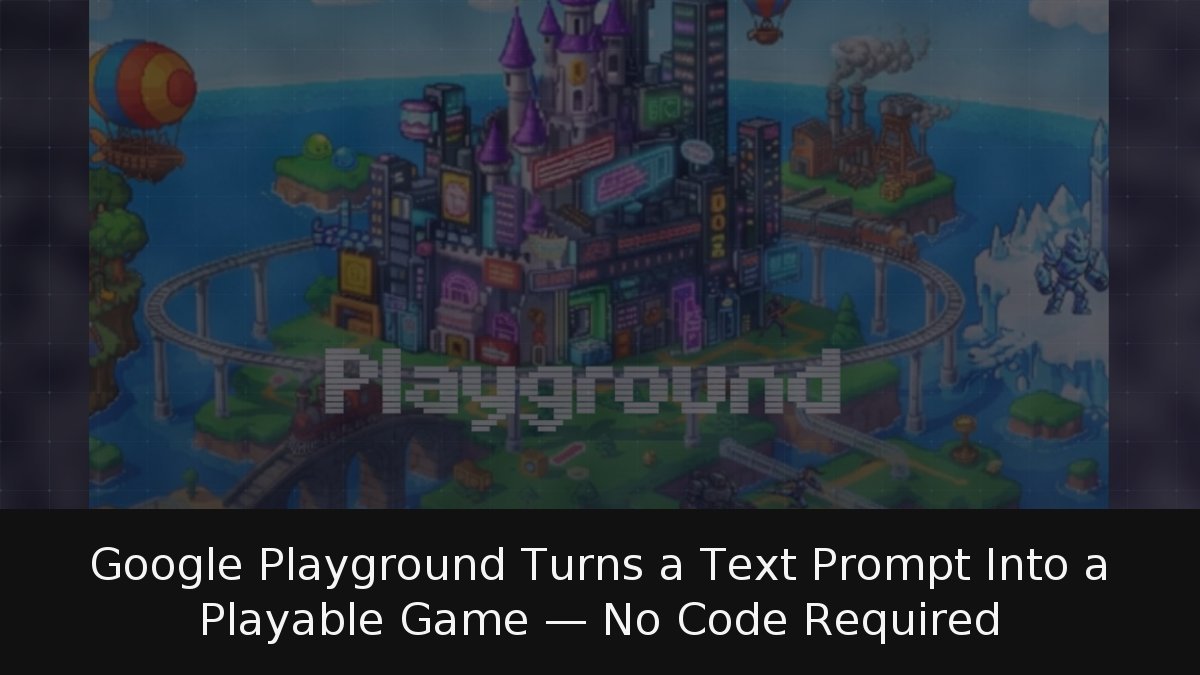
Google has launched Playground, an experimental platform that assembles complete video games — multiplayer modes, leaderboards and visual assets included — from plain-language text instructions, with no coding required. The service went live on October 7, 2026 at playground.google for users in the United States aged 18 and over, and Google One AI Premium subscribers receive access to a larger pool of generation tokens.
Key takeaways:
- Beyond prototyping: Playground is not a quick mechanic demo tool — it ships asset export, built-in multiplayer, live leaderboards and image-to-sprite conversion.
- Token-metered creation: Every generation or edit consumes tokens, with higher monthly allowances tied to a Google One AI Premium subscription.
- The engine stays anonymous: Google’s launch post never names the AI model doing the work, a notable omission given the company’s usual branding habits.
What Playground Can Actually Build Today
The launch feature set covers four concrete use cases. The first is 2D game creation: platformers, puzzles and top-down shooters generated from a text description, complete with mechanics, levels and visual assets produced by the model. The second is simple 3D experiences, constrained by the obvious limits of what a generative model can deliver in geometric complexity without offline rendering time.
The third is multiplayer. Games built in Playground can be shared through a link and played in real time with other users, backed by leaderboards that update live. The fourth — and arguably the most interesting for creators who already own assets — is converting personal images into sprites and game elements. Upload a photo of a pet, and the system turns it into a playable character with basic animations.
Generation runs on a token system: each creation or modification action consumes tokens, and Google One AI Premium subscribers get a higher monthly allocation. Google has not specified which AI model underpins the platform, which in 2026 is itself telling. When a company has a powerful model, it usually says so.
The Unnamed Model Behind the Curtain
Google’s launch blog describes Playground’s capabilities at length without once naming the model that powers them. That silence suggests one of a few possibilities: an experimental architecture the company does not want tied to its flagship brand, a combination of several models, or a pipeline that simply is not reducible to a single inference call.
The announced integration with Unity Spark — Unity’s development environment adapted for generative workflows — points toward part of the 3D generation running through Unity pipelines rather than pure language-model inference. If Playground is effectively a wrapper layered over Gemini, Unity Spark and dedicated asset-generation tools, presenting it as “Gemini makes video games” would be an inaccurate shorthand.
This fits a broader pattern in Google’s recent product strategy: embedding its models as the invisible engine inside creative tools rather than making the model the headline. NotebookLM turned audio production into a general-purpose task, and image-personalisation features such as Gemini Nano Banana 2 pushed model capabilities into consumer products without foregrounding the underlying model name. The same logic applies to agent-driven workflows that let language models operate environments like Google Colab directly.
A Real Threat to Unity and Indie Developers? Not Yet
The honest answer is that Playground does not threaten Unity, Godot or any serious engine in the near term. The complexity ceiling for anything generated from a single text prompt is low. Interesting game mechanics require iterative systems design, not one instruction — a platformer generated from “make a platforming game with an orange character” will be technically correct and creatively mediocre.
What Playground can plausibly change is who gets to enter the game industry. Access to the creative side of game design has historically been gated by the technical barrier of engines. If Playground lowers that barrier enough — and early prototypes shared on X suggest it does — a wave of creators who previously had no route into the tooling could emerge.
The legitimate concern is output quality at scale. AI audio generation gave people without editing experience a way to produce podcasts, and the result was a flood of shows with identical structure and zero personality. Playground carries the same risk: thousands of games built on the same model, sharing the same visual aesthetic and the same basic mechanics. Repetition, not obsolescence, is the more likely disruption.
The technical novelty here is genuine, and the marginal cost of keeping Playground alive is far lower than it was for hardware-bound experiments such as Stadia, Buzz or Loon — no physical infrastructure is committed. That is precisely why the six-month checkpoint matters. Once the novelty fades, active user numbers will reveal whether Google has built a durable creative platform or simply another well-executed demo.