
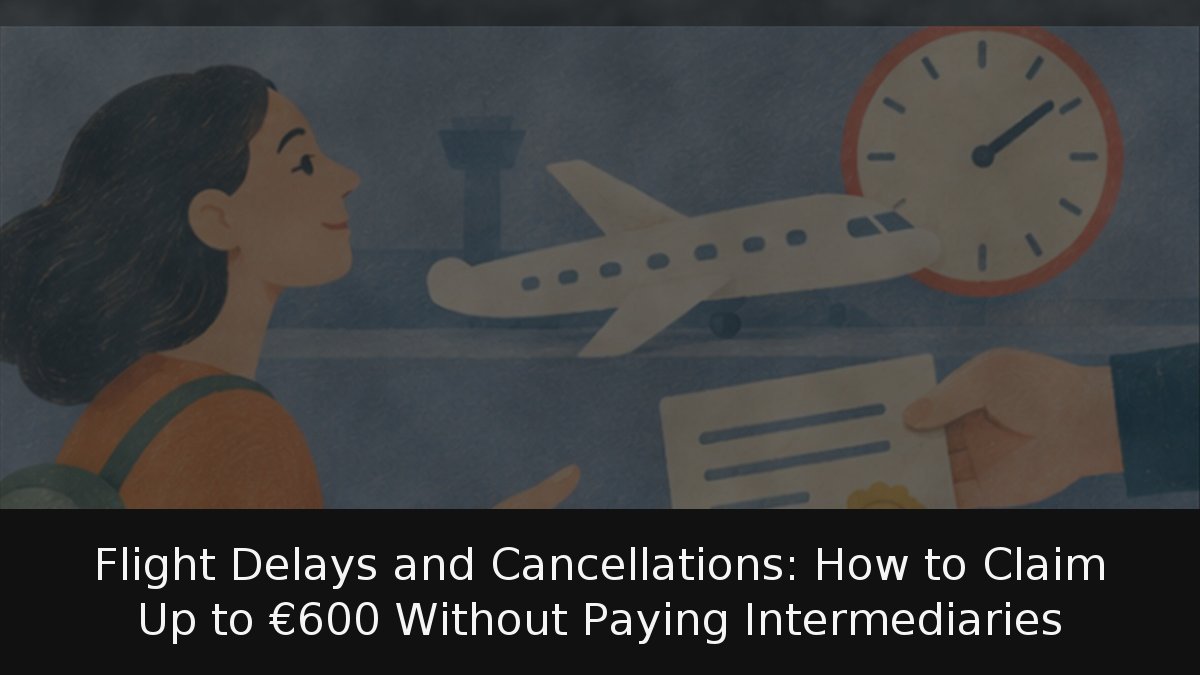
When a flight arrives more than three hours late or is cancelled at the last minute, European rules entitle passengers to compensation of up to €600 per person. Yet many travellers hand over a third of that sum to claims agencies for filling out a form they could submit themselves. The process is simpler than it looks: contact the airline first, and if it fails to pay within a month, escalate to Spain’s State Aviation Safety Agency (AESA) — free of charge and online.
- Compensation tiers: €250 for flights up to 1,500 km, €400 for EU flights over 1,500 km and other flights between 1,500 and 3,500 km, and €600 for all longer routes.
- Extraordinary circumstances: Airlines can refuse only if they prove the disruption was unavoidable — and the burden of proof is theirs.
- Claims agencies: They typically charge around 35% of the recovered amount, which rarely makes sense for a straightforward case.
- Upcoming reform: New EU rules were approved in 2026 but do not take effect until 23 October 2027.
How much money are you owed?
Article 7 of Regulation (EC) 261/2004 sets the amounts by distance: €250 for flights up to 1,500 kilometres, €400 for intra-EU flights beyond that distance and for other flights between 1,500 and 3,500 kilometres, and €600 for everything else.
For delays, what counts is the arrival time at the final destination. According to the European Commission’s Your Europe guide, compensation applies when you arrive three or more hours late; on flights over 3,500 kilometres with a delay of between three and four hours, the figure drops to €300. That right was not written into the 2004 regulation — it stems from the Sturgeon ruling by the Court of Justice of the EU (cases C-402/07 and C-432/07).
For cancellations, advance notice is decisive. There is no compensation if you are informed at least two weeks ahead, nor with shorter notice if you are offered an alternative that barely changes your schedule (the exact margins are in Article 5). Proving when the airline notified you is the airline’s job.
The rules cover flights departing the EU on any carrier, and flights arriving from outside the EU if operated by a European airline. Iceland, Norway and Switzerland are also included — a scope not every European regulation shares.
When can an airline refuse to pay?
Only if it demonstrates that extraordinary circumstances occurred that could not have been avoided even by taking all reasonable measures. The burden of proof rests with the airline, not the passenger.
The Commission cites examples such as air traffic management decisions, political instability, adverse weather and security risks. Most technical problems detected during maintenance do not count, nor do strikes by the airline’s own staff. A strike by third parties may exempt the carrier, but it must prove the link to your specific flight.
A generic response citing “reasons beyond the company’s control” proves nothing. The advice is clear: do not accept a refusal at face value — move to the next step.
Step by step: airline, AESA and the courts
1. Claim to the airline first, through its website or customer service email. AESA will not accept your case without this step, and it points to a five-year window from the incident. Keep your ticket, boarding passes, emails and receipts if you are claiming expenses.
2. If there is no response within a month, or the answer is unsatisfactory, go to AESA. For flights from 2 June 2023 onwards, AESA handles the claim as an alternative dispute resolution procedure. You have one year from your initial complaint. The recommended route is the electronic headquarters, using a digital certificate, electronic ID or Cl@ve Permanente; semi-presential and paper options also exist.
AESA only handles flights departing from Spain, or arriving in Spain from outside the EU with a leg operated by a European airline; if you departed from another EU country, its own authority is responsible. It does not deal with baggage or package holidays.
It must resolve cases within 90 calendar days of receiving all documentation, although its website warns of delays due to claim volume. Its decision binds the airline, which has one month to comply, but not the passenger, who can still go to court. Because AESA notifies through its electronic headquarters, it is worth understanding what happens after ten days with electronic notifications from public administrations.
3. Court, without a lawyer for small claims. Spain’s Civil Procedure Act allows litigants to proceed without a lawyer or court representative in verbal proceedings of up to €2,000 (Articles 23 and 31). Article 264 requires proof of an attempted prior negotiation when the law demands it: keep your claim to the airline. If the company fails to comply with AESA’s decision, you can request judicial enforcement.
What do claims agencies charge — and when are they worth it?
They take a percentage of whatever they recover. In AirHelp’s price list, for example, as of November 2026 the fee is 35% including VAT, applied only if the claim succeeds; if the case goes to court, a further 15% is added, something the company says happens in 3% of cases. On a €600 payout you would keep €390; if the case ends up in court, €300.
In a straightforward case — a clear delay, an airline raising no defence, departure from Spain — paying 35% for a form you can send to AESA for free is expensive.
An agency makes sense when litigation looms: disputed extraordinary circumstances, a flight from another country, or a trial you do not want to take on. There they charge for risk and management you would not handle yourself. Your Europe links to an information note for those who use these agencies; read it before signing.
What changes with the 2026 reform?
It is already law, but not yet in force. Regulation (EU) 2026/2202, signed on 16 September 2026 and published in the Official Journal on 2 October, applies from 23 October 2027. Until then, everything above remains in force.
Amounts and thresholds stay the same: €250, €400 and €600, and more than three hours of delay. What changes:
- A list of extraordinary circumstances in an annex. Among them, airline staff strikes count only when they stem from demands that only public authorities can meet.
- The airline must state which circumstance it invokes and why it could not avoid the disruption.
- It must send you information about your right and claim instructions within 96 hours of the trip.
- You will have nine months from the departure date to request compensation. The airline must pay or justify a refusal within 30 calendar days.
- On flights over 3,500 kilometres it may halve the €600 if you arrive no more than four hours late.
- If a third party claims on your behalf, the airline may require proof of authorisation.
The reform cuts both ways. Forcing airlines to notify passengers and justify extraordinary circumstances in detail is a genuine advance that erodes the intermediaries’ business. But nine months is far less than the five years AESA indicates as of November 2026, and anyone who leaves that email forgotten in the inbox will lose their money.
The best habit does not depend on any reform: claim the same day you land. Compensation exists to make failure costly for airlines; if nobody asks for it, that incentive disappears.