
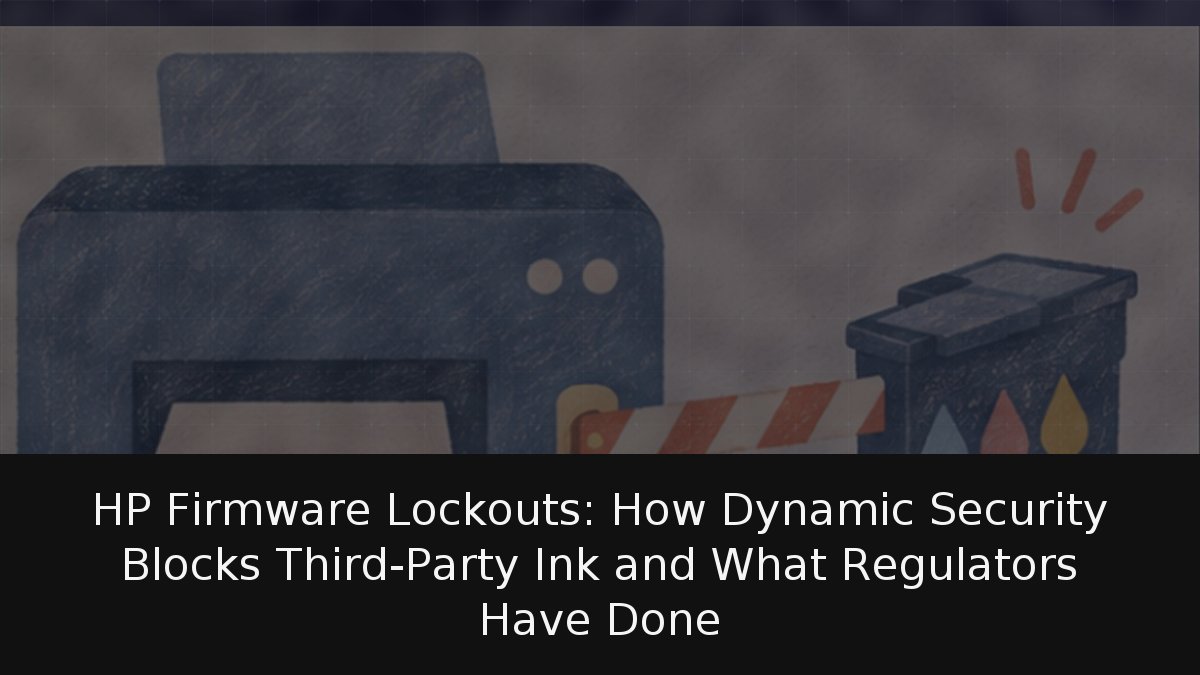
Printer firmware updates that quietly disable third-party ink cartridges have become one of the most contentious issues in consumer hardware, and HP remains the most documented case. Its Dynamic Security mechanism checks cartridge chips and can refuse anything it does not recognize as genuine. The practical consequence is that a compatible cartridge working today may stop functioning after the next automatic update, turning a routine software refresh into a hardware lockout.
- Dynamic Security in practice: Firmware validates cartridge chips and rejects non-original units, with each update changing which chips are accepted.
- Regulatory pressure: Italy’s AGCM fined HP €10 million in 2020 over misleading and aggressive practices, a penalty upheld on appeal in 2024.
- Consumer settlements: A 2022 Euroconsumers agreement offered €20 to €95 in compensation, while a US class action ended with disclosure commitments and no user payouts.
- No EU mandate yet: Brussels is still studying ecodesign rules for printing equipment, and universal cartridges were excluded from the preparatory study.
Why a printer stops accepting a compatible cartridge
The mechanism is straightforward: firmware inspects the chip on each cartridge and can reject those it does not classify as original. In HP’s case this is branded Dynamic Security, and what changes with every update is precisely which chips pass the check and which do not.
Italy’s competition and consumer authority, the AGCM, described the behavior in its December 9, 2020 ruling. Printers recognized genuine HP cartridges and accepted them, but refused to print when they detected non-original cartridges or units manufactured before a certain date. Those limitations, the authority added, were renewed through later updates without their consequences being explained to buyers.
HP disputes that framing. In a 2024 US court filing, the company argued that its measures target cartridges that copy its security chips — cloned or counterfeit units — that it does not block cartridges reusing genuine HP chips, and that it does not conceal Dynamic Security. Taken at face value, that defense suggests recycled cartridges retaining the original chip carry less risk than those fitted with a new one.
What regulators, consumer groups and courts have said
The record so far consists of one administrative fine in Italy, an out-of-court settlement across several European countries including Spain, and at least two US cases. What has been punished or negotiated is mainly the lack of disclosure, not the lockout mechanism itself.
Italy, 2020. The AGCM fined HP Inc and HP Italy a combined €10 million for misleading and aggressive commercial practices. According to the authority, HP failed to adequately inform buyers at the point of sale about the limitation, and its firmware logged cartridge usage data that was also used to deny assistance to printers that had run non-original cartridges, obstructing the legal warranty. HP was ordered to change packaging within 120 days to disclose the restrictions. The company appealed, and the Regional Administrative Court of Lazio rejected that appeal on April 15, 2024; available sources do not indicate whether the decision was later taken to the Council of State.
Spain and other countries, 2022. In September 2022, HP and Euroconsumers — grouping OCU, Altroconsumo, Test Achats and DECO Proteste — reached an amicable compensation agreement without going to court. It covered anyone who suffered a printing interruption with a non-original cartridge between September 1, 2016 and November 17, 2020 on specific models, including several OfficeJet Pro units. Compensation ranged from €20 to €50 depending on the model, with a supplement that could raise it to €95. The agreement does not constitute an admission of wrongdoing by HP, and the OCU campaign is now listed as closed.
United States. A class action filed in 2020 in a California federal court over a November 2020 update affecting Color LaserJet printers ended in an October 2024 settlement given final approval on March 18, 2025. Under the settlement notice, HP denies wrongdoing and commits to continuing to disclose Dynamic Security and to letting users install or reject updates that include it; there is no compensation for users. HP also agreed to pay $725,000 (roughly €649,000 at the October 30, 2026 exchange rate) in attorney fees and expenses. A second class action, filed in January 2024 in an Illinois federal court over updates from late 2022 and early 2023, remains at an earlier stage: the judge granted HP’s motion to dismiss in September 2025 but allowed the plaintiffs to file an amended complaint, and in January 2026 HP asked for the case to be dismissed permanently. No later resolution appears in the sources reviewed.
Is there European regulation against it?
For now, no specific rule in force obliges manufacturers to accept third-party cartridges; an ecodesign process has been open for years. In its response to a 2024 parliamentary question, the European Commission said it was preparing ecodesign requirements for printing equipment and would examine rules to make cartridges more durable and easier to remanufacture, repair and reuse. It also made clear that the Joint Research Centre’s preparatory study did not include universal cartridges, in the style of a common charger, among the requirements worth developing.
The response notes that cartridges with electronics fall under the electronic waste directive. As of October 31, 2026, printing equipment does not appear on the Commission’s list of products with ecodesign requirements. Its 2025-2030 ecodesign work plan includes them among products whose measures may continue under the old ecodesign directive during a transitional period ending December 31, 2026.
Alternatives and cost per page
For light printing, a subscription can be cheap; for heavy use, a tank printer or a laser model usually beats fighting with cartridges. Manufacturer yield figures for ink are measured under the ISO/IEC 24711 standard, which HP cites in its comparisons.
The reference subscription is HP Instant Ink. Official Spanish pricing checked on October 31, 2026 lists a 10-page plan at €1.79 per month (€0.18 per page if fully used), 50 pages at €5.49 (€0.11), 100 pages at €7.99 (€0.08), 300 pages at €15.99 (€0.05) and 700 pages at €31.99 (€0.05). Extra pages cost €1.50 per pack of 10 to 15. Two conditions matter: the printer needs an internet connection, and after the trial months billing is automatic unless cancelled.
The assessment here is that Instant Ink solves the pricing problem while binding the printer even more tightly to its maker: you pay per page, not per ink, and you depend on an account and a connection. Tank printers refilled from bottles and laser models with high-yield toner are the exit route for anyone wanting independence. Since no single official figure applies to every case, the math should be done with the specific model’s spec sheet in hand.
The underlying issue is a business model: cheap printer, expensive ink, and firmware that changes the rules after purchase. Fines and settlements have forced better disclosure, not an end to the practice. Until Brussels turns cartridge reuse into an obligation, the user’s best defense is to choose the printer with the consumable in mind, disable automatic updates where the manufacturer allows it, and never buy a printer simply because it is on sale.