
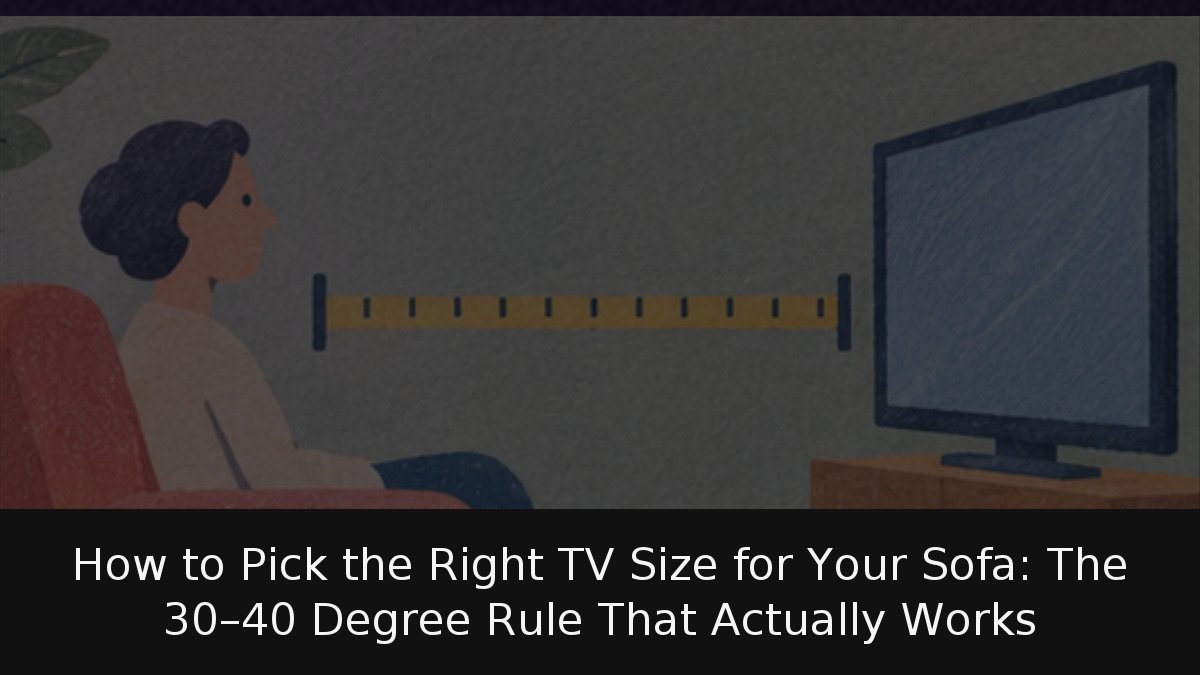
Buying a new television usually comes down to a single agonizing decision: do I go one size up or not? The answer is less about brand loyalty and more about geometry. The most reliable approach is to measure the distance from your eyes to the screen and aim for a display that occupies between 30 and 40 degrees of your field of view. In practice, a sofa positioned 2.5 meters away calls for a screen somewhere between 60 and 82 inches. A 4K panel lets you sit closer without spotting individual pixels, while 8K only adds value if you sit very close to a very large screen. And a projector starts to make sense when you want more than 100 inches and can control the room’s lighting.
This guide is for anyone on the verge of buying a TV and torn between two sizes. What follows are the rules manufacturers themselves publish, why they don’t agree with each other, and a simple calculation to settle the matter with your own measurements.
- The angle rule beats brand formulas: A screen filling 30–40 degrees of your vision is the most stable guideline, regardless of which manufacturer’s chart you consult.
- 4K rewards closer seating: At typical sofa distances, 4K already sits at the limit of what the human eye can resolve, making 8K largely redundant for living rooms.
- Projectors need darkness and distance: They make sense above 100 inches in a room you can darken, with brightness requirements shifting sharply between lit and dark spaces.
What distance do manufacturers actually recommend?
The most widespread rule is to multiply the diagonal by 1.2, with 4K allowing somewhat closer seating. That’s the approach Samsung takes in its size guide: a 98-inch screen multiplied by 1.2 gives 118 inches, roughly 3 meters. The same guide publishes a table with two distances, one “general” and one “recommended for 4K”:
- 55″: about 1,225 mm wide, 1.7 m general distance, 1.4 m for 4K
- 65″: about 1,440 mm wide, 2.0 m general, 1.7 m for 4K
- 75″: about 1,670 mm wide, 2.3 m general, 1.9 m for 4K
- 85″: about 1,885 mm wide, 2.6 m general, 2.2 m for 4K
LG proposes a different formula: 4.2 cm per inch in Full HD (a 50-inch set at 2.1 meters) and only 2.1 cm per inch in 4K. By that logic, a 65-inch 4K television would look fine from just 1.37 meters.
Not every brand guide is equally rigorous. TCL’s Spanish guidance, published in 2023, goes as far as calculating that someone sitting 3 meters away would need a 192-inch screen. These formulas are best treated as what they are: starting points written by the people selling televisions.
The criterion that actually holds up: viewing angle
The most stable way to decide is the angle the screen occupies in your field of vision, not a per-inch formula. Samsung explains this in the same guide: ideally the TV should fill between 30 and 40 degrees. Above 40 degrees you’d have to move your eyes or head to take in the image, and below 30 the experience feels less immersive.
According to the analysis lab RTINGS, the SMPTE (the society of motion picture and television engineers) recommends that the screen fill at least 30 degrees for mixed use, with a 40-degree field advisable for a more cinematic experience. That attribution to SMPTE comes from RTINGS rather than from a document published by the society itself, and it aligns with the range Samsung provides.
Using each screen’s width and a little trigonometry, the table works out as follows:
- 2 m from the sofa: roughly 48″ for 30°, roughly 66″ for 40°
- 2.5 m: roughly 60″ for 30°, roughly 82″ for 40°
- 3 m: roughly 73″ for 30°, roughly 99″ for 40°
These are our own calculations for 16:9 screens, rounded. And here’s something curious: if you apply Samsung’s own criterion to its 4K table, a 65-inch set at 1.7 meters occupies, by the same math, about 46 degrees — above the 40-degree limit the same page considers comfortable. The takeaway is that manufacturers’ “4K” tables push you toward the largest possible screen. It isn’t dishonest, but it isn’t neutral either.
Is an 8K television worth it for the living room?
For the vast majority of living rooms, no. Resolution only pays off if you’re close enough to distinguish the detail, and at typical sofa distances 4K already sits at the limit of what the eye can resolve.
RTINGS notes that a person with normal vision can distinguish details separated by 1/60 of a degree (one arc minute). With that figure, the math for a 65-inch set (our own calculation using Samsung’s stated width) runs like this: in 4K each pixel measures about 0.375 mm and stops being distinguishable beyond 1.3 meters; in 8K, beyond 0.65 meters. Put another way, if you sit more than 1.3 meters from a 65-inch 4K television, you no longer see pixels, and 8K has nothing to add. This calculation squares with LG’s 2.1 cm-per-inch rule.
The same lab advises against buying 8K because there is barely any content in that resolution, concluding it only makes sense with a large screen viewed from very close. We agree. That money delivers more in better contrast, better processing, or a larger 4K size.
When does a projector make more sense than a TV?
When your distance calls for more than 100 inches and you can darken the room, or when you don’t want a fixed black rectangle on the wall. At 3 meters, the 40-degree criterion calls for nearly 100 inches.
Light is the deciding factor. BenQ‘s guide for living-room projectors recommends more than 3,000 lumens for rooms with natural light or lamps switched on, and around 1,800 lumens well calibrated for a dark room. It also highlights ultra short throw models, which sit right against the wall, as an option for small rooms.
Our view: a projector is a great buy for someone who mainly watches movies at night and can lower the blinds. For someone watching sport at midday with sunlight flooding the living room, a television will still deliver better image quality per dollar. And if you spend long hours in front of either, the science on blue light and eye strain is less alarming than it’s often made out to be.
The practical recommendation fits in a single line: measure the real distance from your eyes, find the size that falls between 30 and 40 degrees, and choose the largest option in that range that fits your furniture and your budget. Neither a brand’s formula nor a salesperson’s enthusiasm should push you past 40 degrees — and if you overshoot, you’ll notice the TV is watching you more than you’re watching it. There’s a cheap trick before you buy: cut a piece of cardboard to the width of the screen you’re considering, tape it to the wall for a week, and look at it from the sofa.