
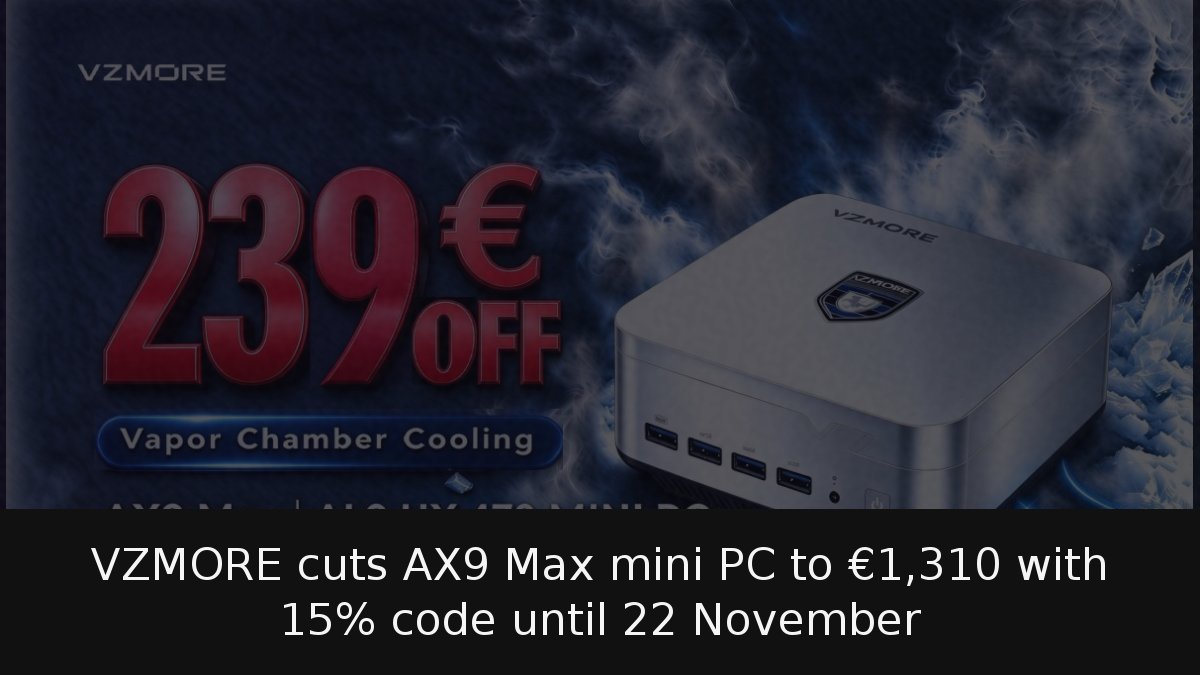
The compact desktop market has a new price benchmark. VZMORE has cut the AX9 Max — a mini PC built around AMD’s Ryzen AI 9 HX 470 with 32 GB of RAM and a 1 TB SSD — from €1,549 to €1,310 using the code AX9MA16F, valid from 13 to 22 November. That is €239 off, a 15% reduction, and VZMORE bills it as the lowest price on the internet for this configuration.
The move lands in the middle of an unusually early discount season, with retailers across Europe already running Black Friday promotions weeks ahead of the traditional date. For buyers weighing a high-end mini PC, the question is less about the chip — several rivals use the same silicon — and more about what surrounds it.
- Price cut: €1,549 down to €1,310 with code AX9MA16F, a 15% saving valid 13–22 November.
- Dual-channel memory: Two DDR5-5600 SO-DIMM modules ship from the factory, a setup that independent testing links to a measurable performance lead over single-module rivals.
- Local AI capability: The Radeon 890M and a 55 TOPS NPU handle mid-sized language models at conversational speeds, with 32 GB as the practical ceiling.
Hardware: compact chassis, serious cooling
The AX9 Max measures 135 × 131.8 × 57.7 mm and weighs 777.5 g, with an aluminium chassis and Windows 11 Pro preinstalled. It is designed either to replace a desktop tower or to mount behind a monitor using the included VESA bracket.
At its heart sits AMD’s Ryzen AI 9 HX 470, a Gorgon Point chip unveiled at CES in January 2026 with 12 cores and 24 threads — four full Zen 5 cores paired with eight smaller Zen 5c cores. Graphics come from the integrated Radeon 890M (16 compute units, RDNA 3.5), alongside a 55 TOPS NPU. AMD rates the chip’s combined AI throughput, adding CPU, GPU and NPU, at 86 TOPS.
One caveat worth noting before paying a premium for the model number: independent analysis has found the HX 470 shares nearly all its specifications with the previous generation’s HX 370, with no measurable generational gain in testing. The real differentiator here is the platform, not the silicon.
Cooling relies on a vapor chamber with three power modes — 45 W in quiet, 54 W in balanced and 65 W in performance. Memory can be expanded to 256 GB, the 1 TB drive occupies an M.2 PCIe 4.0 slot, and a second slot remains free for expansion.
Connectivity is generous for the footprint: two rear USB4 ports at 40 Gbps (one capable of powering the unit at up to 100 W), two HDMI 2.1 outputs supporting up to four displays, five 10 Gbps USB-A ports plus one USB 2.0, dual 2.5 GbE Ethernet, Wi-Fi 7, Bluetooth 5.4, a side SD card reader and a front audio jack.
Where the dual-channel design pays off
The AX9 Max ships with two DDR5-5600 SO-DIMM modules in dual-channel mode, while some competitors using the same processor — including the Geekom A9 Max — sell with a single module. For an integrated GPU that draws on system memory, that distinction matters considerably.
Independent benchmarks put the gap in concrete terms. Against the Geekom A9 Max with the same HX 470 and one module, the AX9 Max scored 25% higher in Geekbench 6.7 multi-core and 9% higher in Cinebench 2026 multi-core, with the dual-channel configuration credited as the main cause. The same testing awarded the machine a score of 85%.
Gaming results are similarly strong for integrated graphics. Cyberpunk 2077 at 1080p with high settings and FSR 4 in Quality mode averaged 55 fps, rising above 90 fps with frame generation enabled. In F1 24 at 1080p, the AX9 Max managed 98.3 fps on the Low preset and 65.5 fps on High — figures that comfortably outpace several Intel Arc-based mini PCs in the same comparison.
Local AI: useful, with clear limits
The AI story is real but bounded. In testing, the AX9 Max ran DeepSeek-R1 at 8 billion parameters at 13.78 tokens per second and LLaVA 13B at 10.16 tokens per second — comfortable for conversation or document summarisation, not for agents chaining hundreds of calls.
VZMORE states the machine works with LM Studio, Ollama and llama.cpp, the standard tools for running models locally, and highlights NPU-assisted features such as on-device voice transcription and automatic background removal. A separate review scored it 4 out of 5, noting that with 32 GB, memory sits near 100% during extended work with language models. Its conclusion: local LM Studio models perform surprisingly well, but do not replace the most capable cloud models.
The underlying argument is privacy rather than raw speed. A machine like this keeps contracts and records inside the office instead of sending them to a cloud service. Those who need larger models are already looking at multi-node local clusters, a different league entirely.
Is €1,310 the right price?
It depends on the workload. For a quiet office machine, far cheaper mini PCs suffice. The AX9 Max makes sense for users who want Windows and x86, multiple displays, dual 2.5 GbE networking and headroom for mid-sized local AI models in a box that screws onto the back of a monitor.
At €1,549 the price looked strained against rivals with the same processor; at €1,310 the dual-channel memory advantage starts to justify the outlay. Buyers should weigh RAM carefully before committing — 32 GB is tight for local AI, and upgrading is not cheap. In its favour, the official store offers a three-year warranty, 30-day returns and free shipping from Germany.
The broader signal is that mini PCs are converging on a formula: a powerful APU, vapor-chamber cooling and dual-channel memory, sold as a compact alternative to a tower. As discounts arrive earlier each year, the segment’s real battleground is no longer the chip inside but the engineering around it — and on that measure, this is one of the more balanced implementations of AMD’s Gorgon Point platform to date.