
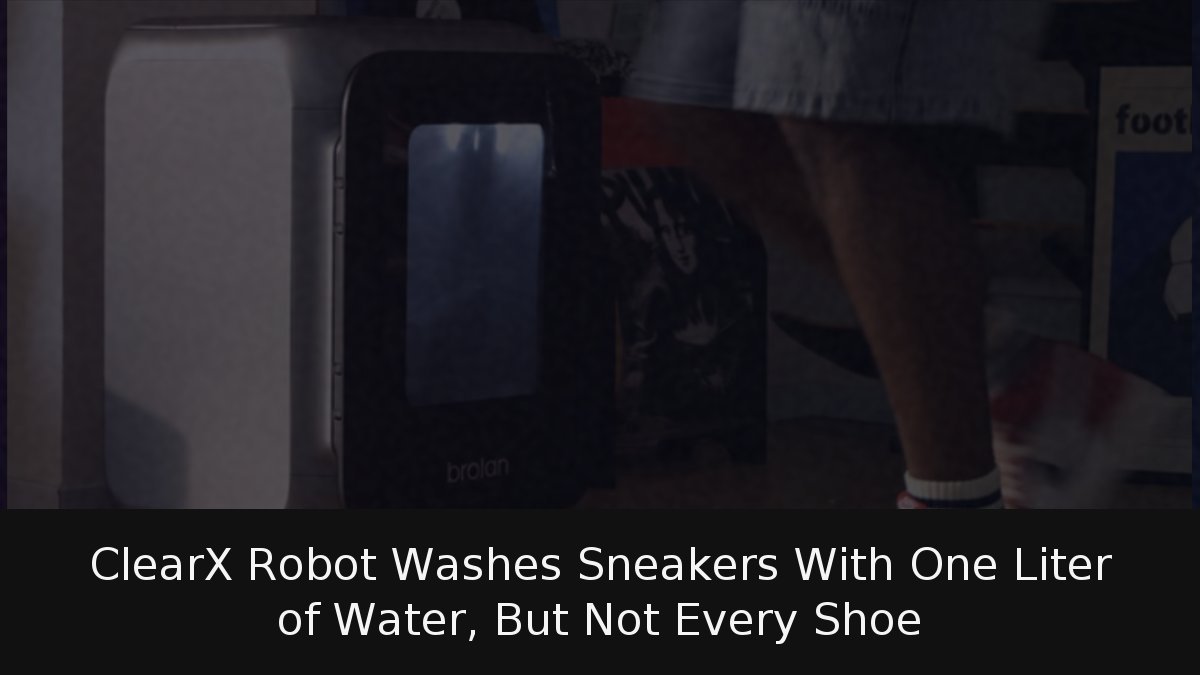
Shenzhen-based startup Brolan has taken its ClearX shoe-care appliance to Kickstarter, promising to wash, dry and sanitize a single pair of sneakers in an automated cycle of roughly 90 minutes. The device uses no harsh brushes, no rotating drum and no plumbing connection. The campaign launched on November 10 and had already raised about €174,721 against a €22,829 goal by the following day, with 333 backers. Launch pricing sits near €492, with delivery expected in mid-2027.
- One pair per cycle: ClearX handles a single pair of shoes at a time, using roughly one liter of water per full wash.
- Gentle cleaning method: Micro- and nanobubble jets combine with a three-degree-of-freedom robotic arm wrapped in velvet covers to lift dirt without a drum.
- Material limits: Suede, nubuck, patent leather, wool felt and heavily flocked or embellished fashion shoes are not supported.
- Kickstarter risk: The campaign is all-or-nothing, delivery dates differ between the press release and reward tiers, and the product has not yet faced published independent testing.
How ClearX cleans without scrubbing
The core mechanism pairs a water jet carrying micro- and nanobubbles, emitted from two nozzles that move up and down, with a robotic arm that passes very soft velvet covers over the shoe surface. Each shoe sits in its own 360-degree rotating holder, so the footwear never tumbles inside a drum as it would in a washing machine.
According to Brolan, the bubbles loosen dirt from fibers and seams while the arm removes it with controlled pressure. Before starting, the machine measures shoe length and adjusts its movements accordingly.
Drying relies on two independent air circuits, one per shoe, blowing inside and out at under 50 °C to avoid damaging materials and adhesives. An ozone module finishes the cycle to reduce bacteria, fungi and odors. The device then rinses its internal parts and the covers themselves, so users do not have to remove and hand-wash them after every use.
Four programs are available: Quick Clean (cleaning only, 30 minutes), Auto (cleaning, drying and disinfection, 90 minutes), Deep Clean (120 minutes) and Drying Mode (drying and disinfection, 60 minutes). The clean-water tank holds 3.3 liters, the dirty-water tank 3 liters, and a full cycle consumes about one liter thanks to filtration and recirculation. Declared noise stays below 56 dB, and power draw remains under 70 W while washing and 450 W while drying.
Operation is handled on the machine itself or through the Brolan app for iOS and Android, which includes a “Shoe Wall” feature for cataloging a collection with photos.
What changed since CES 2026
Quite a lot: installation, timeline, price and the capabilities Brolan now promises. At the January trade show, the device appeared as a rather different prototype. Reports at the time described two versions, one plumbed into the water supply and one with a tank, and placed the campaign launch in May 2026 at an estimated price around $600. Other coverage mentioned a unit that could connect to a hose or run standalone, with a range of $500 to $800 (roughly €447 to €715). Water figures also conflicted in January: one outlet cited 4 liters per cycle including self-cleaning, while others said one liter per pair.
Earlier coverage also noted, according to the company, that sensors would assess material and dirt level, and that a specific leather mode existed. The current press release no longer mentions detecting material or dirt: it refers to length measurement and arm sensors adapting to shape, and compatibility is limited to synthetic leather and water-washable materials.
The read here is that Brolan has trimmed ambition to reach manufacturing: a single version without plumbing and a narrower promise. That is not necessarily bad news, since a simpler product has a better chance of leaving the factory. But anyone who remembers the CES demos should not assume everything shown then remains inside.
Which shoes are off-limits
Suede, nubuck, patent leather, wool felt, heavy flocking and fashion shoes with embellishments are excluded, according to the press release. High heels, tall boots, some high-top sneakers, slippers and irregular shapes may not fit the holders.
The holders accept lengths of 155 to 195 mm for children, 205 to 250 mm for women and 250 to 290 mm for men, up to roughly a US 11.5–12.
Here lies the product’s tension. Its selling story is that of founder Shiyou (Siro) Dong, who explains in the release that he owns more than 200 pairs and a shoe wall at home, and that he put off cleaning them because he trusted no method. The device is aimed at mesh, knit, canvas and synthetics. Anyone with suede or nubuck panels in their collection will still need a brush for those pieces.
Nor is it a device to tuck into a closet: it measures 460 × 432 × 629 mm and weighs 23 kg, both preliminary figures. It also has consumables. The velvet covers last three to six months, and the cleaning solution, optional and intended for tough stains, lasts one to three. The release does not state replacement costs, and that figure will weigh on real cost of ownership more than the launch discount.
Competition and crowdfunding risk
It depends on what you value more: time or material care. The closest rival is Casaboom’s MIDISHI M1, which ran on Kickstarter between April and May with an opposite approach: a drum with multiple brushes, a cycle of under 30 minutes, up to two pairs at once and between 8 and 10 liters of water per wash. That model was reserved at $299 (about €267), with a planned final price of $525 (about €469) and shipping scheduled for October. It closed with $186,196 from 496 backers. ClearX is slower, washes one pair and costs more, but uses far less water and never puts footwear in a drum or scrubs it with bristles.
The idea is not new either: in 2022, Nike installed B.I.L.L. in its London store, a robot-assisted system that cleaned and customized an Air Force 1 in about 45 minutes. That was an in-store service; this aims to be a home appliance.
On price, the launch reward costs about €492 at the exchange rate shown on Kickstarter, including an extra cover, children’s holders, a filter and a complimentary cleaning solution, limited to 1,000 units. The campaign advertises savings of $350 (about €313), or 39%, against a final retail price not yet applied in any store. That percentage deserves the same caution as any discount claim. The two-unit pack sells for $999, and shipping is charged separately.
Then there is the format’s inherent risk. Kickstarter is all-or-nothing and the platform itself warns that rewards are not guaranteed. ClearX is Brolan’s first product, the campaign is managed by a specialized agency, TCF Team, and the dates already wobble: the press release promises delivery in May 2027 while the rewards indicate June 2027.
ClearX gets the diagnosis right: the problem with machine-washing sneakers is the drum, and holding each shoe while an arm cleans it gently is a sensible solution, just as using one liter where others use ten is. But ninety minutes per pair and a single pair per cycle make it a tool for collectors of washable footwear, not the answer for a family with five pairs muddied on Sunday.
The product will ultimately be judged on three things the campaign does not yet show: the price of covers and solution, results in independent tests with real sneakers, and whether it arrives in June or joins the long list of delayed hardware. Until then, it is a nearly €500 reservation on a device that has not yet passed published independent testing.