
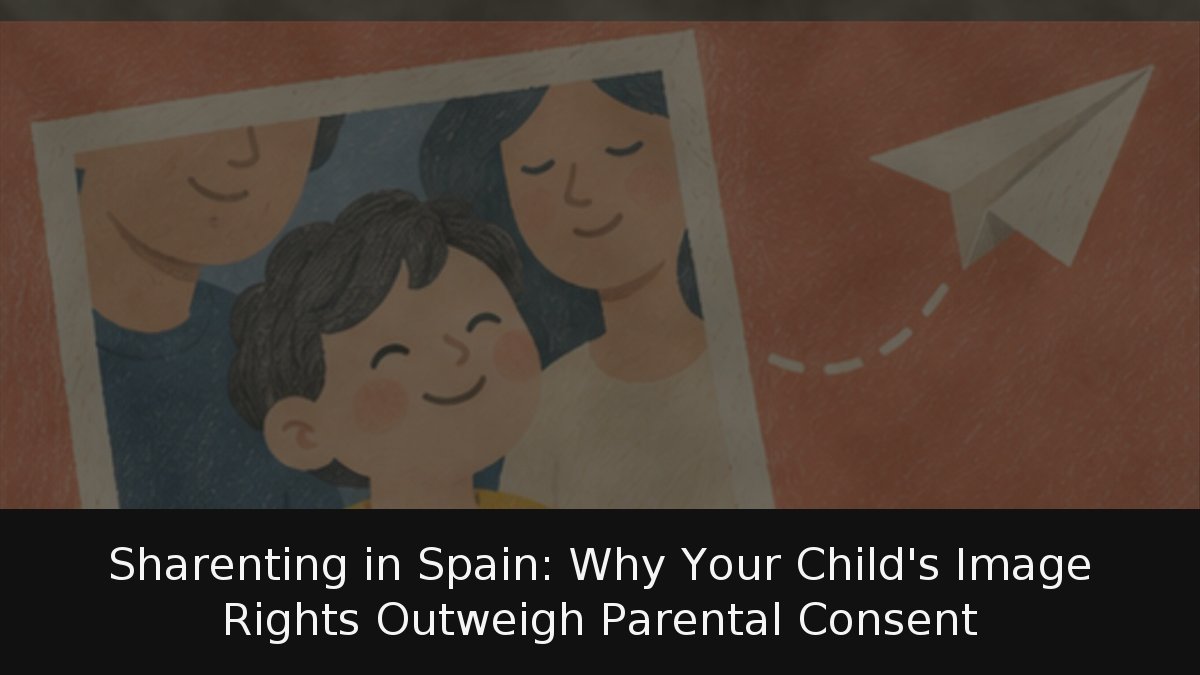
Sharing photos of children online has become a reflex for many families, but in Spain the legal ground is more delicate than it appears. Publishing images of your own kids is not banned outright, yet the child’s best interest carries more weight than a parent’s consent, the Ministerio Fiscal can step in on its own initiative, and any other minors in the frame require permission from their families. TechNews DevTop examines what Spanish legislation actually says, the risks documented by the Policía Nacional and the AEPD, and how families can keep sharing without overexposing their children.
- Child’s rights come first: Spanish law recognizes minors’ right to their own image, and the Fiscalía can act even when parents have consented.
- Age threshold of 14: Below that age, consent for data processing must come from a parent or guardian; above it, the minor can decide.
- Documented risks: Campaign data points to cyberbullying, fake profiles, AI-manipulated images, and a large share of seized abuse material originating from everyday social media photos.
The legal framework: three overlapping laws
The term sharenting blends share and parenting. The Policía Nacional, in a campaign launched with the fundaciónSOL in July 2025, describes it as the habit of parents and relatives posting images, videos, or information about minors on social networks. It is almost always done out of affection, but affection does not control who ends up seeing the photo.
Spanish law says a child holds independent rights over their image, and parents must protect them. Ley Orgánica 1/1996 on the legal protection of minors recognizes in Article 4 the right to honor, privacy, and one’s own image, obliging parents and guardians to respect and defend those rights against third parties. The same article treats as unlawful interference any use of a minor’s image or name in media that could harm their reputation or run counter to their interests, even when the minor or their legal representatives have consented. In such cases, the Ministerio Fiscal is empowered to act, either on its own initiative or at the request of the minor or any interested party.
The LOPDGDD, Spain’s data protection law, extended that protection to the internet. Article 84.2 states that using or disseminating images or personal information of minors on social networks in ways that unlawfully intrude on their fundamental rights triggers intervention by the Ministerio Fiscal, with the measures set out in minors’ legislation. Article 7 sets the age of 14: from that point, a minor can consent to the processing of their data; below it, consent must come from whoever holds parental authority.
A third layer is Ley Orgánica 1/1982 on the right to one’s own image. Article 3 provides that minors give consent themselves when their maturity allows it, and Article 2 makes that consent revocable at any time.
One nuance prevents overstatement: under recital 18, the General Data Protection Regulation does not apply to purely personal or domestic activity, and it explicitly mentions social networking in that context. Yet the AEPD has warned that posting a video of a school outing on an open profile also spreads other children’s images to an indeterminate audience, which requires their consent or that of their parents if they are under 14. A private profile limited to a close circle and a public one with thousands of strangers are not the same thing, either legally or in common sense.
What the documented risks show
The Policía Nacional campaign gathers several figures, most attributed to third parties:
- According to a report by the European network EU Kids Online, produced between autumn 2017 and summer 2019, 89% of families post content about their children at least once a month.
- A survey by security firm AVG across ten countries, including Spain, found that 23% of children have an internet presence before birth through ultrasound images, and that 81% are online before six months of age.
- According to the Committee of experts for the development of a safe digital environment for youth and children, cited in the campaign, 72% of material seized from pedophiles consists of everyday, non-sexualized images of minors taken from social networks, and 42% of minors feel embarrassed by what their parents post about them.
The campaign also lists concrete risks: the child’s own discomfort, cyberbullying, the creation of fake profiles or memes, and image manipulation with artificial intelligence to fabricate child sexual abuse material. It reminds audiences that a photo can contain far more information than it appears to.
Parents hold authority over these decisions, but they must always act in the best interest of the minor, according to Francisco Pérez Bes, deputy to the presidency of the AEPD and member of the fundaciónSOL advisory council.
How to keep sharing without exposing children
Families do not need to stop showing photos to relatives; they need to choose the right channel and content. These guidelines come from the Policía Nacional campaign and AEPD recommendations:
- Limit the audience. The AEPD notes that people you grant access can in turn choose who sees their posts, such as friends of friends. Review who sees each post and whether your profile appears in search engines.
- Share in closed spaces. A private album for relatives only, or a messaging group with specific people, exposes far less than an open post; the AEPD points out that such groups consist only of those who accepted joining.
- Watch what is visible. The Policía recommends avoiding school uniforms or settings that reveal where a minor lives or studies, and thinking twice about holidays and key dates, when posting peaks.
- Respect other children. At school events or birthdays, crop out or refrain from publishing other minors without permission from their families. Others’ images have their own protection.
- Ask the same of your circle. The campaign advises asking relatives and friends not to share images of your children.
- Ask the children. LO 1/1982 ties consent to the minor’s maturity, and asking is the best way to teach them to guard their privacy.
If an image is already out of your control, the AEPD explains how to request removal: first from whoever uploaded it, and if there is no response, from the social network, which has one month to reply; if it fails to act or the response is inadequate, a complaint can be filed with the Agency. If the minor is under 14, parents or guardians exercise that right. The police campaign closes with a blunt line: there is no safe sharenting. That need not mean erasing childhood from our phones, but it does mean changing the question, from whether the photo is lovely to who will see it in ten years and whether your child will be comfortable with it. The law already supplies the legal answer, because the child’s interest outweighs parental consent. Practice is simpler: the photo you truly want to share almost always fits in a private album.