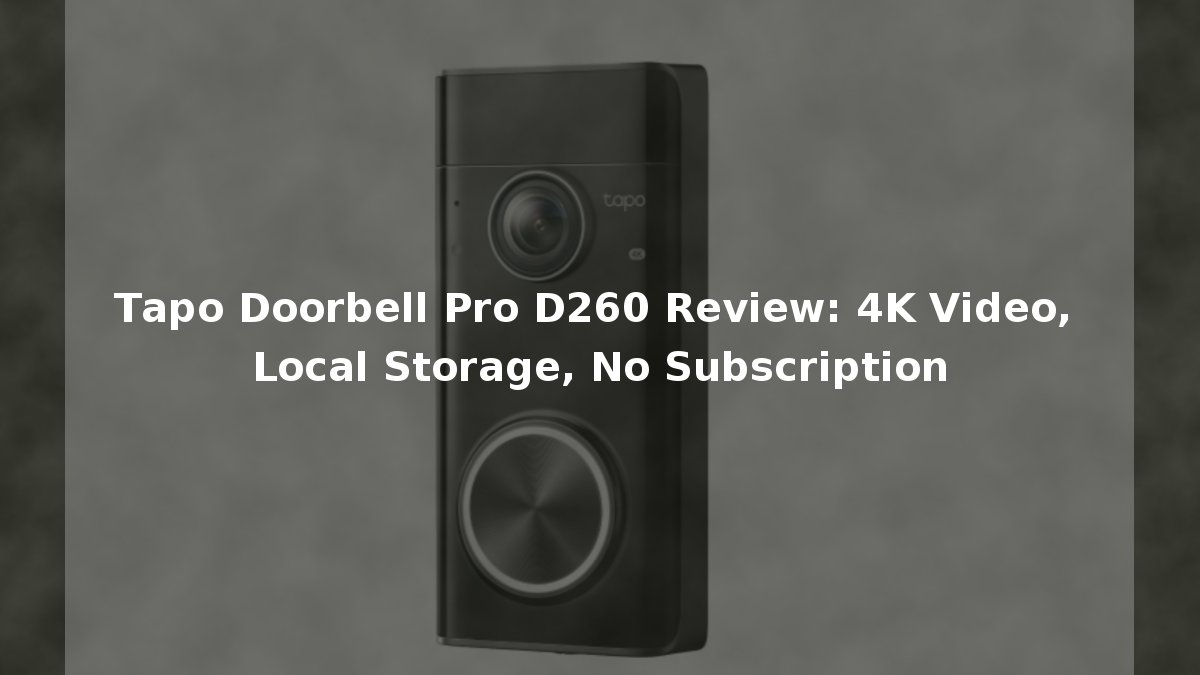
The TP-Link Tapo Doorbell Pro D260 enters a market where video doorbells are typically sold as cheap hardware and monetised through recurring plans — and it refuses to play that game. Priced at $220 (roughly €190 at October 2026 rates), it pairs a 4K camera with on-device detection for people, animals and packages, plus local recording to a microSD card you supply. Hands-on testing earned it a 4.5 out of 5 verdict and a recommendation for almost any household, with one significant caveat: no Apple Home support.
- Subscription optional: Local microSD recording and on-device AI detection work out of the box; cloud storage is an add-on, not a requirement.
- Flexible installation: Runs on existing 8–24VAC doorbell wiring or on battery, and can trigger a mechanical chime you already own.
- Closed ecosystem: Google Home, Amazon Alexa and Samsung SmartThings are supported; Apple Home, Home Assistant, RTSP and FTP are not.
Solid hardware, a ten-minute setup
The unit feels heavier and more substantial than its price bracket usually allows, sliding firmly into its bracket with a doorbell button that delivers a crisp mechanical click. Installation is quick: the mounting plate attaches with the supplied 3M adhesive pad or screws, an angled adapter plate aims the camera toward the door, and a USB-C port on the bottom edge handles power during provisioning. Scanning the device in the Tapo app and following the wizard — including a Wi-Fi signal test from the intended mounting spot — took about 10 minutes. A weak signal there is a router problem, not a doorbell problem.
Both power paths involve trade-offs. Hardwired to an existing 8–24VAC circuit, the camera records around the clock, but loses compatibility with the physical chime. On battery, the chime keeps working, and the 4K footage is sharp, if not class-leading.
Smart features: useful controls and filler
The genuinely useful tools are the ones that tame alert fatigue. Package detection can be confined to one zone of the frame, sensitivity is adjustable per object class — turn it down for animals if neighbourhood squirrels are spamming your phone — and privacy zones block recording of a neighbour’s window. Clips default to 20 seconds and stretch to two minutes, and automations can limit recording to periods when your phone is away from home. Facial recognition, trained on photos from your gallery, held up even when subjects wore a cap and glasses.
Other features are less convincing. “Aerial View” plots arrivals as a dot on a satellite image using dual PIR sensors — technically neat, practically redundant, since the sensors never caught anything the camera had not already seen. “Voice Mask” deepens your voice, but the effect is so obviously synthetic that it may signal to an intruder that a vulnerable person is home alone. The canned quick responses are more entertaining than intended:
“You are trespassing. Police have been notified.”
Custom audio can be recorded instead. Subscription-only video summaries — auto-assembled montages with music and crossfades — were dismissed as random edits that turn visitors into fading ghosts.
Cloud pricing, missing pieces and the privacy question
Tapo Care stays optional and comparatively cheap: 180 days of footage for $3.50 per month or $40 per year on one camera, rising to $33 per month for ten. Rival plans from Arlo and Ring start at roughly $10 per month for a single camera. What the D260 lacks is narrower and more technical — no RTSP, so no streaming to a NAS or a VLC player, and no FTP archival. Its spec sheet also contradicts itself, listing “no local storage” as a con while crediting local storage as a strength; the review text describing the microSD slot settles it.
Privacy deserves equal weight. A street-facing camera captures neighbours and couriers, and the regulatory line keeps moving: California’s governor vetoed a bill that would have required a recording indicator on smart glasses. Buyers weighing alternatives can also consider solar-powered security cameras around the $100 mark, which eliminate recharging entirely.
The D260’s real achievement is less about any single specification than about a business model. Its ceiling is architectural: an Apple household or a NAS enthusiast will look elsewhere, and as Apple prepares to push into the smart home with a hub featuring a six-inch display and facial recognition on 13 October, ecosystem lock-in starts to matter more than megapixels. Hardware that refuses to rent you your own footage tends to age well; closed platforms rarely do. On the evidence, the D260 wins on principle and mostly delivers in practice — provided you live outside Apple’s walled garden.